
EV battery-electric assembly lines now run with 350+ AGVs, 100% welding automation, and per-unit hazardous-waste cut by 60% versus legacy ICE plants, with GAC Honda's Guangzhou facility (400,000 m², ¥3.49 billion) setting the 2024-2026 reference [S2].
Design work starts long before steel is cut: MathWorks provides a Hardware-In-the-Loop Simulink template (PMSM drive, cooling, vehicle dynamics) that lets process engineers validate throughput and energy recovery before a single conveyor is ordered [S4], while Siemens ties the same digital twin into a thread that links product design, line simulation, and MES commissioning in one model [S1].
Site Footprint and Four-Shop Line Architecture
The reference layout splits the line into stamping, welding, painting, and final assembly (the "four major workshops") with internal logistics dominated by AGV robot traffic rather than forklifts, and a smart park layer over the top for order tracking and energy dashboards [S2].
GAC Honda's dedicated EV factory occupies 400,000 m² inside an existing development-zone plant, an investment of ¥3.49 billion, and targets a fully-servo stamping cycle of 3.75 s per steel or aluminum sheet — roughly the throughput floor for a high-mix mid-volume BEV line [S2]. On smaller two- and three-wheeler lines, the footprint compresses further: a BFC-supplied EV assembly line (product 2316) integrates motor, frame, wheel-hub and lithium-battery stations on a single conveyor loop for low-speed passenger and logistics EVs [S3].
Automation Density and Welding Cycle Targets
EV welding shops now specify 100% welding automation, 100% automated in-shop logistics transport, and 100% automated picking and installation of large and medium-sized parts, with a final-assembly overall automation rate near 30% [S2].
The GAC Honda line is staffed by more than 350 AGV robot units communicating over an IoT backbone that connects over 900 machines, shares data and instructions, and handles intelligent scheduling of both production and logistics [S2]. To move panels at that density, the electric pallet truck remains the workhorse for fixed-route pallet moves between stamping and welding, while AGVs handle dynamic, traffic-managed zones. For process motion — clamp actuation, door-hang, and battery-cover tightening — electric actuator modules now replace pneumatics because they cut compressed-air cost and integrate cleanly with the MES heartbeat [S2].
Digital Twin, HIL, and Throughput Validation
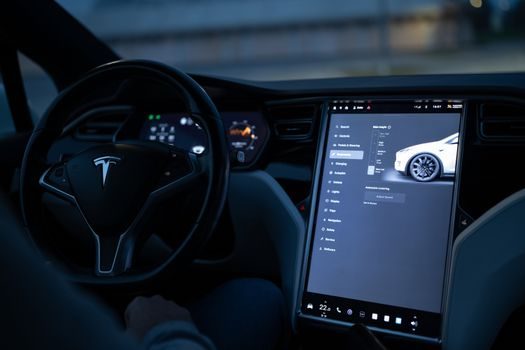
Siemens' "digital thread" front-loads line design: a comprehensive digital twin of both product and process lets engineers run virtual commissioning and takt-time studies before any line hardware ships [S1].
On the control side, MathWorks publishes a Simulink HIL model for an electric vehicle configured for HIL deployment, with energy-based modeling, fixed-step solvers, and subsystems for PMSM drive, cooling, electric/thermal model, and vehicle control — used to verify that the production battery pack and inverter will behave as expected on a fixed-cycle drive profile, including regenerative descent [S4]. The HIL bench typically runs an incline-acceleration / coast-descent profile, exactly the duty cycle that a finished vehicle must pass at end-of-line before shipping [S4].
Painting, VOC, and Environmental Compliance
The painting workshop applies zirconium-based pretreatment and fully automated gluing; the site targets 100% low-VOC waterborne paint and VOC emissions of 4.4 g/m², which is more than 50% below the industry average for traditional automotive plants [S2].
Zirconium-based pretreatment replaces zinc-phosphate, eliminating phosphorus-bearing wastewater and removing the heavy-metal sludge line that used to anchor a traditional pretreatment room. Hazardous waste per unit is reduced by more than 60% versus a legacy factory, and high energy-efficiency equipment is used throughout [S2]. Process valves on the paint circulation loop are commonly electric ball valve types rather than pneumatic, because they fail-closed on power loss, do not leak solvent into the booth, and report position back to the MES for traceable batch records. This integrates directly into the broader 2026 EV process control and instrumentation spec map that most new Chinese BEV plants are following.
Energy, "Zero Carbon" Targets, and Smart-Park MES
The Guangzhou plant runs 100% high energy-efficiency equipment, an MES with ten intelligent modules (equipment monitoring, quality platform, energy/environmental, intelligent logistics, safety, smart park), and order-progress tracking that surfaces on the OEM mobile app [S2].
For mixed-model BEV lines, the same molding line and automatic molding line disciplines used in large-part plastic cells — recipe management, cure-time tracking, reject binning — reappear inside the battery-pack enclosure cell and underbody-shield cell. Process engineers planning a greenfield should expect to design for over 30 globally leading technologies, more than 50 domestically leading technologies, and roughly 60 first-time applications inside one campus, then prioritize MES modules in the order: equipment monitoring → quality → energy → logistics → safety [S2]. Cost-stack alignment for the same plant is detailed in this 2026 EV manufacturing cost breakdown, and quality gates for the four-shop sequence are mapped in EV manufacturing quality 2026: digital twins, aluminum tooling, and process gates.