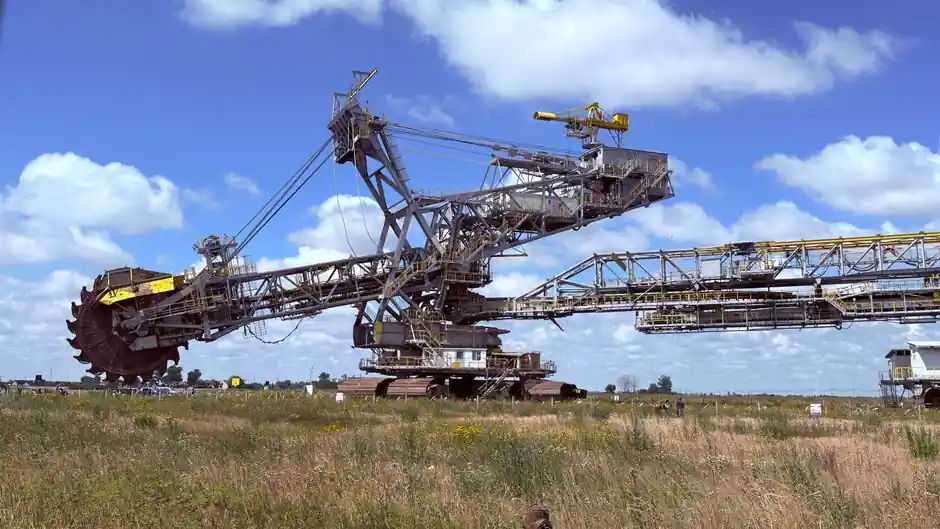
An excavator spec chart is built around three coupled variables: operating weight, maximum dig depth, and bucket capacity, and they move together because heavier machines carry larger hydraulic pumps and longer booms [S1].
The most common public reference points, drawn from Caterpillar's published size bands, are 2,061–22,451 lb for minis, 30,400–40,200 lb for small units, 48,281–77,000 lb for medium, and 77,000–207,300 lb for large excavators [S2].
Mini and compact class: 1–10 metric tons
Mini/compact excavators typically span 1 to 10 metric tons, with the smallest Cat units starting at 13 net hp and digging just beyond 5 ft, while the larger compact machines approach 70 net hp and exceed 15 ft of dig depth [S3]. Cat's published mini range runs from 2,061 lb to 22,451 lb, with digging depths starting at 67 in (about 5.6 ft) at the low end and going beyond 15 ft at the high end [S2].
Bucket capacity in this class is governed by machine weight, not raw bucket volume, because tip force scales with hydraulic pressure and machine mass; mini buckets typically stay under 0.1 m³ (about 1.3 ft³) for trenching work. Transport is the binding constraint: most mini units run narrow widths under 5 ft to pass gates and fences, and Bobcat's 1–3 t units target landscaping and utility trenching specifically [S4]. For deeper context on how breakout force and arm crowd force scale inside this class, the spec-by-spec comparison in Excavator bucket breakout vs arm crowd force: spec-by-spec comparison walks through the trade-offs.
Small and mid-size class: 30,000–70,000 lb (13–32 t)
Standard and mid-sized excavators typically weigh between 30,000 and 70,000 lb, with maximum dig depth in the 19–24 ft band; this is the workhorse class for utility trenching, commercial site prep, grading, and material handling [S3]. Cat's published small band runs 30,400–40,200 lb at 70–130 hp with dig depths to 21 ft, and the medium band runs 48,281–77,000 lb with up to 273 hp and dig depths to 24 ft [S2].
Caterpillar's own product range for this segment lists operating weights of 30,000–60,000 lb paired with 10–20 ft dig depth across the 300 Series mid-size family [S5]. Bucket capacities in this class generally land in the 0.4–1.2 m³ range, and the sizing trade-off between digging deeper and carrying more per cycle is detailed in Excavator Bucket Capacity vs Dig Depth: Sizing the Trade-Off.
Large class: 80,000 lb to 200,000+ lb (36–93+ t)
Large excavators begin around 80,000 lb and exceed 200,000 lb at the top of the production range, with horsepower climbing proportionally and the largest Cat units reaching 207,300 lb at 542 hp [S2][S3]. In this class, maximum dig depth reaches almost 32 ft at the high end for tracked production machines, and maximum dump height reaches 37 ft; engine output runs 300 hp on the low end up to 2,000 hp in the 500+ ton mining class [S1][S2].
The Cat 330 LRC technical sheet is a representative data point: with 800 mm triple-grouser shoes, operating weight is 30,900 kg (68,200 lb) and the maximum material density the general-duty bucket is rated for is 2,100 kg/m³ [S10]. For demolition in this weight band, Cat's high-reach units start at 88,500 lb and the 340 Straight Boom delivers 314 hp for ground-level razing work, while the 340UHD and 352UHD reach up to eight and nine stories respectively [S2].
How the three variables actually scale
Operating weight sets the floor for nearly every other spec: heavier machines carry larger hydraulic pumps, longer booms, and bigger buckets, and they also place more ground pressure on the work surface [S1]. A useful rule of thumb from the published Cat ranges is that maximum dig depth roughly tracks operating weight: ~15 ft at 20,000 lb, ~21 ft at 40,000 lb, ~24 ft at 75,000 lb, and ~32 ft at 200,000 lb [S2][S3].
Bucket capacity scales the same way. In DOZR's published breakdown, small 10–25 t models run 15–22 ft dig depth at 50–170 hp, medium 25–50 t units exceed 30 ft of dig depth with engines up to 359 hp, and large units above 50 t push past 40 ft of dig depth at 300–2,000 hp depending on mining versus construction configuration [S1]. An excavator size chart typically aligns those three columns in that order because they correlate strongly within a class.
Matching the chart to your job
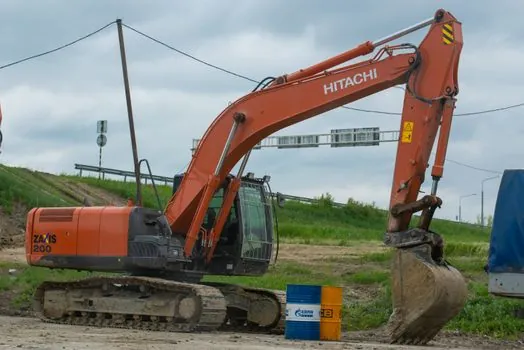
For a residential or landscaping job with gates and tight access, the mini/compact class (under 22,451 lb, dig depth under 15 ft) is the right band, and over-sizing wastes fuel and transport cost [S2][S4]. For utility trenching, commercial site prep, and general contracting, the small/mid band at 30,000–70,000 lb with 19–24 ft dig depth covers the majority of fleet work [S3].
For bulk earthmoving, road sub-grade, quarrying, or mining, the large class at 80,000 lb and up, with 24–32+ ft dig depth, is the only option, and you must budget for lowboy trailers, escort vehicles, and a much larger working footprint [S1][S2]. Demolition adds its own axis: a 340 Straight Boom at 314 hp handles ground-level work, but multi-story razing needs the 340UHD or 352UHD high-reach configurations [S2]. The general construction machinery and equipment reference is a good place to compare excavators against dozers, loaders, and motor graders when the project scope spans multiple machine types.
Selection criteria and common failure modes
Three selection criteria dominate: transport weight (does your trailer and DOT permit cover it?), site access (gate width, overhead clearance, ground pressure), and required dig depth plus bucket productivity per cycle [S1][S4]. A frequent mis-spec is choosing a large machine for short-duration deep dig work; a medium excavator with a longer boom can match the dig depth at lower transport and operating cost [S3].
Another common mistake is using a mini's published maximum dig depth as a working envelope; published maximums are with the bucket curled at full stick extension, and realistic production dig depth is typically 10–20% less because of truck-loading reach and benching geometry. Bucket capacity ratings are also tied to material density: the Cat 330 LRC's general-duty bucket is rated for 2,100 kg/m³ maximum material density, and overshooting that density (for example, trying to handle wet iron ore in a bucket rated for loose earth) causes premature wear and structural failure [S10].
Standards, sourcing, and what to verify on a data sheet
There is no single global standard for excavator size classification; OEM-published size bands (Caterpillar, Komatsu, Volvo, SANY, XCMG, Bobcat, John Deere) are the de facto reference, and most rental and specification guides echo them [S1][S2][S4][S8]. Bucket capacity ratings are typically expressed in cubic meters or cubic yards, with a paired maximum material density (kg/m³ or lb/ft³) for each bucket model, as shown on the Cat 330 LRC sheet at 2,100 kg/m³ [S10].
When you read a spec chart, verify three numbers against the manufacturer's own data sheet: operating weight with the specific shoe width and counterweight configuration, maximum dig depth at the longest stick option, and bucket capacity matched to your material density. The manufacturer page for the excavator category and a side-by-side chart from a comparison site are useful starting points, but the OEM product specification PDF is the document of record for any procurement decision [S5][S9].
Trackable signals to watch over the next quarter: OEM updates to the mid-size 30,000–70,000 lb band as Stage V/Tier 4 Final repowers land, any expansion of zero-tail-swing models in the 6–10 t segment, and published updates to high-reach demolition boom envelopes above nine stories. These three shifts move spec-chart values more than any other change in the market [S2][S3].
The underlying component specifications are covered under bucket elevator.