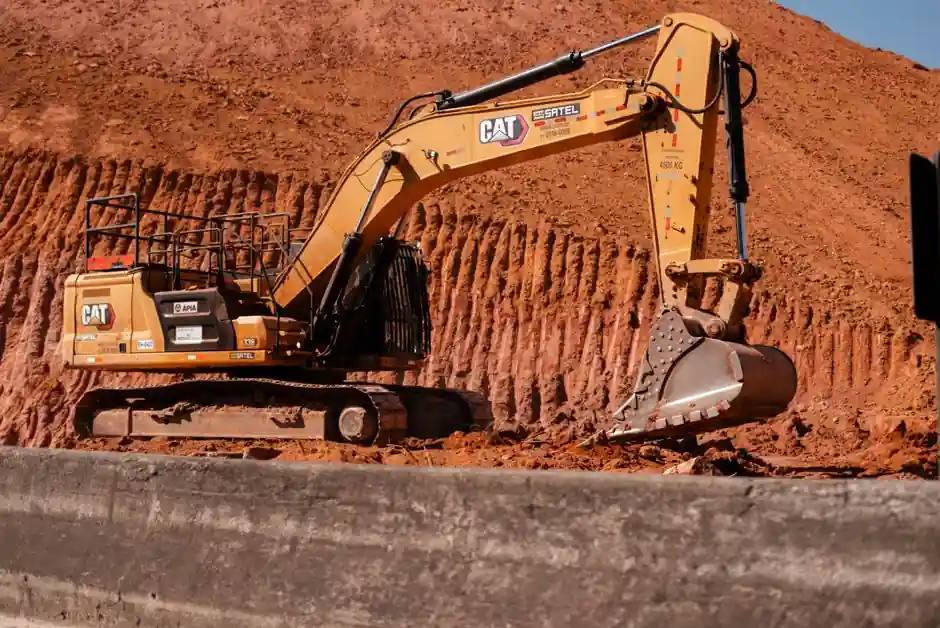
For rough grading and bulk earthwork, a tracked excavator on a fixed track base cuts high spots, fills low spots and spreads soil with a dozer blade roughly the width of its undercarriage, typically putting ground contact pressure in the 30-50 kPa range on compact tracked units [S1]. For fine grading on long runs, the motor grader drags a moldboard between its front and rear axles, mechanically averaging bumps to a tolerance of 10-25 mm against a reference, a band the excavator cannot match [S1][S3].
The decision is not which machine is better, it is which tolerance band, surface length and haul geometry the job sits in. Bulk cut-and-fill, foundation digs, trenching and slope shaping in soft or wet ground go to the excavator; final trim before paving, gravel-road maintenance, ditch cutting and cambered runs above 200 m go to the motor grader. Most real sites use both, with the excavator on the rough pass and the grader closing out the surface [S1][S2].
Tolerance Bands: Rough vs Fine Grading
Rough grading brings the surface to within 50-100 mm of design level; fine grading takes it to 10-25 mm, the band a road base or floor slab actually needs [S1]. The motor grader's mid-frame blade is what makes that 10-25 mm finish achievable in a few passes, because the moldboard floats between the front and rear axles and self-corrects over short irregularities, while the excavator's arm and bucket have no such averaging and rely on the operator plus a string line or GPS [S1][S3]. On paired GPS-or-laser machines, modern motor graders hold that 10-25 mm band without rework, which is why they are standard on final trim before asphalt and on concrete-slab prep [S3][S4].
For rough grading and bulk earthwork, the excavator's value is speed per cubic metre, not finish quality. The 150-300 mm lift-then-compact cycle that a proper fill demands fits naturally into an excavator's bucket-and-swing rhythm, and a dozer blade on smaller excavators covers the full track width so spot fills blend rather than leaving ridges [S1]. If your acceptance criterion is "drains the right way after the first rain," the excavator pass meets it; if the spec calls for a 10 mm tolerance under a floor slab, you finish with a grader.
Terrain, Ground Pressure and Slope Stability
Tracked excavators distribute weight over a long footprint, typically 30-50 kPa ground pressure for compact 6-20 tonne class units, which lets them work on soft, wet or freshly filled ground where a wheeled grader would rut or bog [S1][S5]. On a slope the excavator works from a fixed track base while the upper structure slews; the operator stays level inside the cab and the machine does not have to drive across the fall line to cut, which is the safer configuration on inclines [S1]. The grader, by contrast, has to keep moving forward to cut, and a long-wheelbase motor grader on a 1V:3H slope or wet clay can lose traction before it loses steering, which is why most contractors restrict grader work to ground that will already carry a loaded dump truck.
On Georgia clay and similar sticky, high-cohesion soils, crawler-mounted hydraulic excavators dig and rough-grade where a wheeled machine would simply polish the surface, and the same tracked unit backfills, trenches and loads trucks without a second spread of equipment on site [S5]. For sites where the soil changes from cut to rock within 50 m, the excavator with a bucket or hammer stays productive while a grader sits idle waiting on a dozer to break the rock first [S2][S5].
Cut-and-Fill Geometry: Volume vs Finish
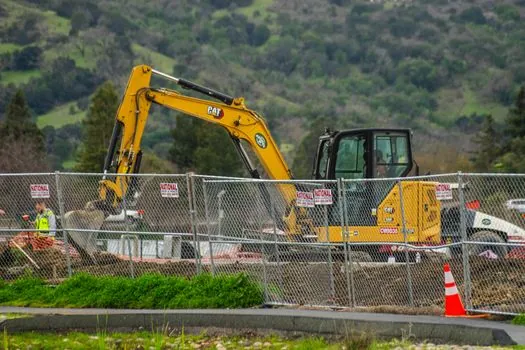
A scraper moves 8-30 m³ heaped per cycle, cutting, loading, hauling and spreading in one machine, which is why scrapers dominate large, repetitive cut-and-fill on subdivisions, dam sites and airport pads [S3]. The motor grader neither digs nor hauls; it shapes what is already in place, so pairing a scraper or an excavator-and-truck fleet with a grader for the final pass is the standard workflow on bulk earthwork [S2][S3]. On a small plot where the total cut-and-fill is under a few thousand cubic metres, the scraper is overkill and the motor grader has nothing to finish, so the excavator alone is the right answer [S1].
For road formation specifically, the sequence is well-defined: dozer or excavator strips topsoil and roughs the alignment, motor grader shapes camber and cross-fall, and the grader is also the machine that periodically re-blades the unsealed running surface to shed water and stop the base from pumping [S2][S3]. If the road is short, under about 200 m, and the substrate is uniform, an experienced excavator operator with GPS can hit 30-40 mm tolerance in a couple of passes and the grader is not required [S1][S5].
Site Constraints: Room to Maneuver, Boundary Work and Mobility
Motor graders need a long, relatively straight run to be efficient: the moldboard is 3.7-4.3 m wide on a 14-18 tonne class machine, the wheelbase is roughly 6 m, and articulated steering gives a tight turning radius, but the machine still cannot dig, load or backfill [S2][S3]. Inside a 10 m by 20 m plot, against a boundary wall, or in a back yard where access is a single 3 m gateway, the grader physically cannot work; the excavator, slewing on a 2-3 m track footprint, can reach the back of the plot and dump directly into a truck waiting on the road [S1].
For a small site where one machine has to dig the foundation, load the spoil, level the slab area and drive itself to the next job on public roads, a backhoe loader or a compact excavator on a trailer is the practical choice, and a full-size motor grader is not even in the running [S1]. On a long highway rehabilitation, the opposite is true: the grader leads the trim train and the excavator shows up only for culvert replacement and slope repairs, not for the running surface [S2][S3].
Productivity, Control and Operator Skill
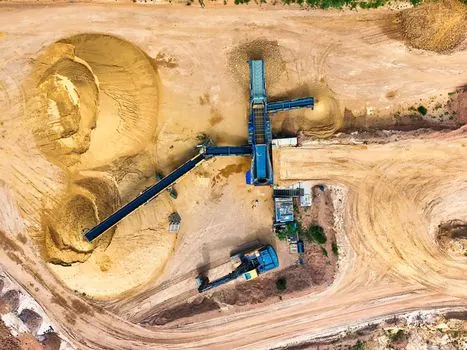
On GPS-equipped machines, a 200-manager field study cited by a north-Georgia site contractor found that excavator-based grading with GPS guidance outperformed traditional approaches by roughly 45% on combined efficiency, fuel use and precision accuracy in clay terrain [S5]. The same study still concluded that the grader closes the surface: the excavator gets the plot to "drains correctly" tolerance, the grader gets it to "ready for base course" tolerance, and skipping the grader pass costs more in rework than the grader day-rate saves [S5].
Operator skill matters more than machine choice at the tolerances that separate a finished job from a callback. A motor grader operator holding a 4-5 mm cross-fall across a 200 m run is a learned skill built on dozens of jobs, not a default skill from a weekend course; an excavator operator pulling finish grade to 30 mm with a 2D or 3D system is similarly craft-dependent [S1][S3][S5]. If the crew is strong on one machine and weak on the other, factor that into the hire, because a bad grader pass is more expensive to fix than a bad excavator pass.
Decision Matrix: When to Spec Each Machine
Spec the excavator when the work is cut-and-fill, trenching, foundation dig, slope shaping, work in clay or wet ground, sites under about 50 m in any dimension, boundary-wall work, or anywhere a single machine has to dig, load and level. Spec the motor grader when the work is final trim before paving, gravel-road maintenance, cambered or cross-falling runs longer than about 200 m, ditch cutting, or snow and debris removal on a long alignment. Spec both, with the excavator on rough and the grader on finish, on any road job, subdivision pad, commercial building platform or industrial yard above roughly 5,000 m² [S1][S2][S3][S5].
The same rule reads cleanly across three decision criteria. On cost per cubic metre moved, the excavator wins below a few thousand m³ and the scraper-excavator-truck combination wins above; the motor grader is not in the cost-per-cube picture. On tolerance to design level, the motor grader is the only machine that holds 10-25 mm routinely, while the excavator holds 30-100 mm. On ground that will not carry a wheel, the tracked excavator is the only safe option and the grader simply does not go [S1][S2][S3][S5].
Trackable signals to watch over the next planning cycle: GPS and 3D grade-control retrofit rates on mid-size hydraulic excavators, since that trend is what is pulling excavator tolerance down into grader territory on small and medium sites [S5]; and motor-grader hire pricing in your region, because the day-rate gap between an excavator and a grader is usually larger than the mobilisation cost, which is why contractors skip the grader on small plots even when the spec says they should not [S1][S2].
Component reference pages worth checking: ac motor.
Background reading: Cobalt sulfate demand 2026-2030: EV cathode pull, grade split, supply concentration.