
Excavator weight classes are defined by operating weight with a full fuel tank, hydraulic oil, and a standard bucket, and the industry places the mini-to-midi cut at roughly 6 metric tons while the midi-to-standard cut sits near 7 to 10 metric tons [S2][S6].
Micro machines below 2 tons pass through a standard 36-inch gate, 3 to 4 ton mini units stay under 10,000 lb, and 5 to 6 ton compacts top out the small-machine class before midi capacity begins, making the 6 to 7 ton band the most contested boundary in the market [S2][S5].
Where the Class Boundaries Actually Sit
Field guides published in 2026 place the micro class at 1–2 metric tons (2,000–5,000 lb), the mini class at 3–4 tons (6,500–10,000 lb), the compact class at 5–6 tons, and the midi class at 7–10 tons (13,227–22,046 lb), with midi labeled the highest-volume segment in industry size-class definitions [S2][S6].
Other published cuts differ: one 2026 guide lists mini as under 7 metric tons, compact as 7 to 45 t, and large above 45 t, collapsing both mini and midi into a single bucket under 7 t [S3]. A second 2026 source uses under 1.5 t for mini, 1.5 to 6 t for compact, 7 to 45 t for standard, and 45 t and up for large, with the mini-to-compact break at 1.5 t instead of at 2 t or 3 t [S4]. A third 2026 article writes mini as under 6 t and compact as extending to 8 t, demonstrating that the compact/midi label is used inconsistently across manufacturers [S9].
The inconsistency traces to two facts: weight is a continuous variable while class names are discrete buckets, and OEMs shift cutoffs to fit their model lines. In the encyclopedia entry on excavator classes this shows up as overlapping ranges rather than hard lines, because 6-ton and 7-ton machines from different brands will end up in different classes depending on whose chart you read.
Mini Excavator Sub-Classes: Micro, Mini, and Compact
Within the mini segment, three sub-classes are now standard: 1–2 t micro, 3–4 t mini, and 5–6 t compact, and within each sub-class the operating weight scales almost linearly with dig depth and bucket width [S2]. A 1-ton micro digs 5–6 ft deep and reaches 9–10 ft, while a 2-ton micro digs 7–8 ft deep and reaches 11–13 ft, and the sub-3-foot retracted width of true micros is what lets them through a 36-inch gate [S2].
3-ton and 4-ton machines jump to 9–10 ft and 10–12 ft dig depth respectively, and at 24–30 in bucket widths they cover what the rental industry calls the residential workhorse band [S2]. The 5–6 t compact group is where zero-tail-swing and reduced-tail-swing machines concentrate, and is the practical upper limit before trailer weight and width rules in many U.S. states force a different transport setup [S1][S2].
One useful rule of thumb from the trade press: presence of a front blade is the visual cue that separates a mini from a regular crawler, and machines above 18,000 lb (about 8.2 t) are usually pulled out of the "large mini" bucket and relabeled compact or midi depending on the OEM [S5].
Midi Excavators: 6 to 10 Metric Tons
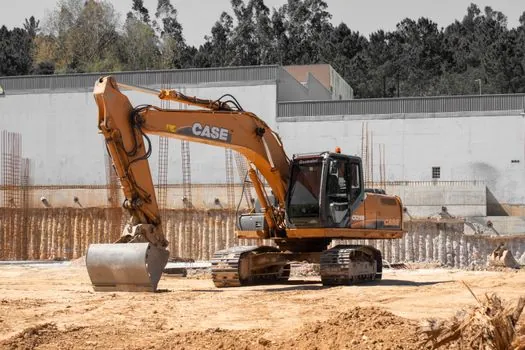
Midi, or mid-sized, excavators are defined at 6 to 10 metric tons (13,227 to 22,046 lb) in the original CASE Construction Equipment size-class guide, which also notes that midis account for a large share of total industry unit volume [S6]. Independent guides echo the same 6 to 10 t window and add that midis deliver more power and reach than a 5–6 t compact while still fitting on a standard equipment trailer in most jurisdictions [S7].
In practice the 6-ton machine is the largest "true mini" in one industry reading, while 7 to 10 t units are labeled midi and 12 to 13 t units are described as the smallest "full size" machines, a vocabulary that tracks the U.S. dealer convention rather than a fixed standard [S8]. The construction machinery and equipment reference captures this as a three-tier continuum (mini 0–6 t, midi 6–10 t, full size 10 t and up) rather than a strict set of bins.
Forum operators and rental-fleet managers use the 6–10 t midi band specifically for production digging on small commercial sites: deeper utility trenches, small foundation digs, and pool excavations where a 5-ton compact is under-powered but a 14-ton standard is overkill [S7][S8].
Standard Excavators: 7 to 45 Metric Tons
Standard excavators are commonly placed at 7 to 45 metric tons, the 2026 Oregon reference explicitly calls 7–45 t the standard class, and this range covers most commercial, road, and utility work outside mining and mass excavation [S4]. Inside the 7–45 t band there is a secondary split at roughly 10 t between the lower end (midi-overlap) and the higher end, and at 22 t to 30 t where crawler machines start requiring lowboy trailers and oversize-load permits in most U.S. states.
Capability scales with weight in a predictable way: a 7–10 t machine digs 12–15 ft, a 20-ton machine digs 20–22 ft, and a 40-ton machine digs 25–28 ft, with max reach roughly 1.5× to 2× the dig depth for general-purpose booms. The class comparison piece on mini vs midi vs standard excavator specs lines these up against operating weight, dig depth, transport weight, and tail-swing, and is the fastest way to see the operating envelope difference at each boundary.
Large excavators, defined at 45 t and up, are a separate purchasing decision: dedicated lowboy, on-site fuel, and a different operator class, and they are rarely compared to midis in the same buying workflow [S4].
Decision Criteria: Which Class for Which Job
Site access is the dominant criterion: a 36-inch gate or a finished lawn forces a sub-3 t micro, a 48-inch side gate forces a 3–4 t mini, and an open residential lot allows 5–6 t compacts [S2][S4]. Dig depth is the second filter, since 5–6 ft of trench fits a 1–2 t micro, 8–10 ft of trench needs a 3–4 t mini, and basements at 9–14 ft need at least a 5–6 t compact or a midi [S2][S4].
Transport weight is the third filter. A 3-ton mini plus trailer stays under 7,000 lb GVWR and can be towed by a half-ton pickup, while a 6-ton compact plus trailer crosses the 10,000 lb threshold and usually needs a 1-ton truck, and a 10-ton midi plus trailer crosses 26,000 lb and requires a CDL in some U.S. states. Production rate, expressed in cubic yards per hour, climbs roughly with the square root of operating weight: a 1.7 t micro moves 3–5 yd³/hr in ideal conditions, a 3 t mini moves 8–12 yd³/hr, a 5 t compact moves 15–25 yd³/hr, and a 10 t midi moves 30–50 yd³/hr [S2].
Tail swing is the fourth filter. Zero-tail-swing and reduced-tail-swing models are concentrated in the 1.5–6 t range, while conventional tail swing dominates above 6 t because the higher classes are typically worked on open sites where tail overhang is not a constraint [S1][S5].
Comparison Table: Mini vs Midi vs Standard at a Glance
The table below lines the three classes up against the four most common decision criteria. All numbers are the band centers reported across the 2026 reference set; treat the 6–7 t overlap as the contested zone where OEMs differ. [S2]
The 6–7 t band is the seam: most guides put it in mini, some put it in midi, and a few put it at the bottom of standard, so the safest procurement language is to specify operating weight and required dig depth rather than the class name [S2][S4][S6].
Limits, Edge Cases, and Sourcing Caveats

There is no single industry standard for excavator class cutoffs; ISO and SAE both publish operating-weight measurement procedures but do not assign class names, and OEM marketing material adjusts the bands to fit model line-ups [S4][S9]. A 6-ton Bobcat E26 and a 6.5-ton competitor machine will show up in different classes in two different brochures despite a 500 kg weight gap that is invisible to most operators [S1].
Operating weight is the most consistent single number: it is measured with the machine ready to work (full fuel, hydraulic oil, standard bucket, operator), and it correlates strongly with dig depth, lift capacity, and trailer weight, which is why the 2026 guides converged on it as the primary axis even while disagreeing on the class labels [S1][S2][S5].
Two trackable signals for the next 6 months: first, watch whether any major OEM publishes a unified 0–6 t / 6–10 t / 10–45 t scheme, since the 2026 guides are still split across two- and four-class systems [S3][S4][S9]. Second, watch the 6–7 t overlap for a new model launch, since any new 6.5-ton machine will be reclassified by at least one competitor's marketing as either "the largest mini" or "the smallest midi" [S2][S6][S8].
The underlying component specifications are covered under lamps and light fittings.