Maximum swing torque on production crawler excavators covered in OEM documentation ranges from 35 kN·m (25,815 lbf·ft) on the 15,400 kg Cat 315 GC [S4] to 187 kN·m (137,924 lbf·ft) on the 48,600 kg Cat 349F L [S3], a roughly 5.3x spread across one operating-weight class band.
Maximum travel speed for the same class sits in a much narrower 4.7–5.6 km/h (2.9–3.5 mph) band [S2][S4][S6], and swing speed falls from 13.3 rpm on a Hitachi ZX130-5A [S1] to 8.7 rpm on the 349F L [S3], a pattern set by hydraulic motor displacement, swing reduction ratio, and the inertia of the upper structure.
Operating-Weight Class and Where Each Spec Lands
The Cat 315 GC at 15,400 kg operating weight posts 11.5 rpm swing speed, 35 kN·m swing torque, and 5.4 km/h (3.4 mph) maximum travel [S4]. The Cat 326 at 25,600 kg posts 9.9 rpm, 106 kN·m, and 5.6 km/h (3.5 mph) [S2]. The Cat 340 at the upper end of the next size band posts 8.84 rpm, 143 kN·m, and 4.7 km/h (2.9 mph) [S6]. The Cat 349F L at 48,600 kg posts 8.7 rpm, 187 kN·m, and 4.67 km/h (2.9 mph) [S3].
Travel speed is gated less by engine power than by undercarriage design and hydrostatic drive pressure. Cat specifies 35,000 kPa (5,075 psi) maximum travel pressure on the 315 GC [S4] and 35,000 kPa on the 326 [S2], with the 349F L swing circuit capped at 27,500 kPa (3,989 psi) and travel at 35,000 kPa (5,076 psi) [S3]. Higher mass classes lean on wider shoes (600–790 mm) and longer tracks to convert that hydraulic pressure into drawbar pull rather than speed: 117 kN drawbar on the 315 GC [S4] versus 228 kN on the 326 [S2] and 151 kN on the 349F L [S3].
Swing Speed vs Swing Torque: The Inverse Curve
Swing speed and swing torque move in opposite directions because the swing motor is sized for a fixed hydraulic input power envelope. The compact Hitachi ZX130-5A runs 13.3 rpm swing [S1]; the mid-class Cat 320E posts 11.2 rpm at 45,581 lbf·ft [S7]; the Cat 326 drops to 9.9 rpm at 106 kN·m [S2]; the Cat 340 sits at 8.84 rpm and 143 kN·m [S6]; the Cat 349F L at 8.7 rpm and 187 kN·m [S3].
Volvo documents a similar split for the EC360 crawler excavator: 10.3 rpm maximum swing speed against 126.2 kN·m maximum swing torque, with swing circuit relief set at 27.9 MPa versus 33.3 MPa on the travel circuit [S8]. The asymmetry reflects that swing work is dominated by accelerating the upper structure, so torque, not speed, scales with mass. The 349F L swing system moves 386 L/min at up to 27,500 kPa [S3], which is roughly the same hydraulic input as its travel circuit but routed to a much higher reduction ratio in the swing gearbox.
How Travel Speed and Drawbar Pull Interact
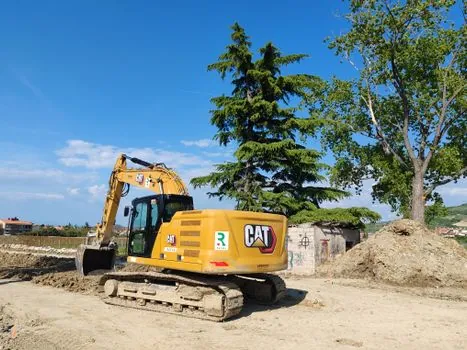
Maximum travel speed on these machines is the unloaded, low-resistance top end; useful tractive effort is set by drawbar pull and gradeability. The Cat 326 holds 5.6 km/h against 228 kN drawbar pull and 35°/70% gradeability [S2]. The Cat 315 GC posts 5.4 km/h against 117 kN and the same 35°/70% grade envelope [S4]. The Cat 349F L is the outlier on drawbar, 151 kN at 4.67 km/h, because its heavier upper structure and longer track on ground reduce the no-load top speed even though engine power is far higher [S3].
Two-speed travel with auto shift is a standard compact-class feature for moving between work and repositioning without operator input: the Takeuchi TB235-2 specification sheet lists "2-Speed Travel with Automatic Shift" alongside cushioned boom and swing cylinders for that reason [S5]. On larger machines the equivalent is hydrostatic two-range travel, but the 4.7–5.6 km/h top-end band stays remarkably tight, because anything faster on steel tracks quickly destroys shoes and sprockets.
Selection Criteria: Matching the Specs to the Work
Swing torque is the spec that decides whether a machine can break a stuck bucket free from a face or rotate uphill on a side slope with a full load. The 35 kN·m figure on the 315 GC [S4] is sized for general excavation in the 15-tonne class; the 187 kN·m on the 349F L [S3] is sized for production truck loading where the upper swings fully loaded every cycle. For mass-excavation or quarry duty, swing torque and hydraulic swing pressure (27.5–27.9 MPa on the larger Cats and the EC360 [S3][S8]) matter more than swing speed, because the cycle is set by how fast the bucket can be filled and dumped, not how quickly it rotates empty.
Travel speed matters most for machines that reposition frequently: utility work, pipe laying, and road-building where the excavator walks 50–200 m between digs. In that case the 5.4–5.6 km/h band on the 315 GC and 326 [S4][S2] is genuinely useful; on a mining face where the machine moves 10 m every few hours, the 4.67 km/h of the 349F L is irrelevant, and operators override travel to the low range permanently. Gradeability of 35°/70% [S2][S4] is consistent across the class and is more about centre-of-gravity and counterweight than raw hydraulic pressure.
Comparison Table: Five OEM Data Points
Cross-referencing the OEM sheets side by side, the swing torque to operating weight ratio stays inside a narrow band: 2.27 kN·m/t on the 315 GC (35 kN·m at 15.4 t) [S4], 4.14 kN·m/t on the 326 (106 kN·m at 25.6 t) [S2], and 3.84 kN·m/t on the 349F L (187 kN·m at 48.6 t) [S3]. Travel speed per ton of operating weight tells the same story in reverse: 0.35 km/h per tonne on the 315 GC, 0.22 on the 326, 0.10 on the 349F L.
The Cat 340 at 143 kN·m and 8.84 rpm [S6] and the Cat 320E at 45,581 lbf·ft (61.8 kN·m) and 11.2 rpm [S7] sit inside the same envelope when plotted against operating weight, which suggests OEM sizing is converging on a hydraulic-input-power-per-tonne target rather than a single rpm or torque figure. For more on how that mass-to-lift relationship plays out, the excavator operating weight vs lifting capacity piece lays out the rated-lift side of the same trade-off.
Standards, Testing, and What Spec Sheets Actually Measure
OEMs publish swing speed and travel speed as no-load maximums on flat ground with factory standard track shoes. Cat notes that "advertised power is tested per the specified standard in effect at the time of manufacture" and that net power is at the flywheel with engine speed at 2,200 rpm on the 326 [S2] and at 2,400 rpm on the smaller 315 GC [S4]. Swing torque is published as a peak at the swing bearing, not a continuous duty figure, and the same numerical torque can be reached through different relief pressures and motor displacements across the Cat 326 (35 MPa equipment, swing relief lower), Cat 340, and EC360 (27.9 MPa swing circuit) [S2][S6][S8].
Trackable signals worth watching on the next spec refresh: whether OEMs start publishing swing torque at continuous duty rather than peak, because real-world cycle work rarely hits peak; and whether 2-speed travel with auto-shift, currently a compact-class item [S5], migrates to mid-size machines as standard. The excavator lineup reference covers the broader machine-class context, and the construction machinery and equipment index is the right jumping-off point for the driveline components behind the swing gearbox.
Spec-level background on the components involved: swing check valve.