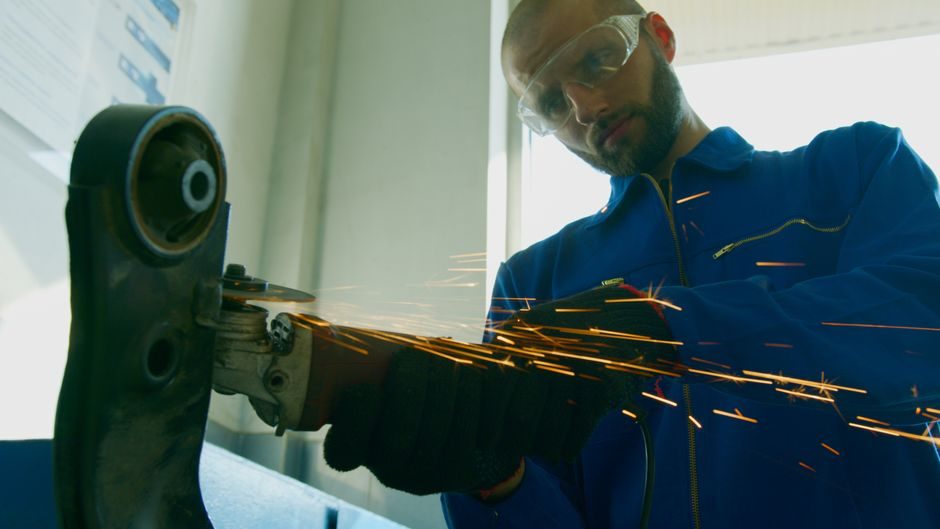
A fettling grinder — a heavy-duty angle grinder variant used in foundry cleaning rooms to knock gates, risers, and parting lines off castings — is offered in two main formats: bench/floor snagging grinders (3-10 HP, 12-24 inch wheels) and swing-frame grinders (5-15 HP, 12-24 inch wheels), per Ganesh foundry-equipment product data [S3].
The defining spec band is wheel diameter 12 to 24 inches paired with motor power 3 to 15 HP, with the snagging line typically 3-10 HP and the swing-frame line 5-15 HP for heavier grinding [S3].
Definition and Where It Sits in a Foundry Line
A fettling grinder is positioned downstream of the shakeout and knockout stages, where it performs the manual material-removal work that cleans a raw casting before shot-blasting or machining [S3]. Snagging grinders are the stationary, bench- or pedestal-mounted variant with the motor at the base, double-row ball-bearing main shafts sealed against dust, and rigid guards on both sides of the wheel to contain wheel-burst fragments [S3].
Swing-frame grinders are the larger, pivoted, floor-mounted variant hung from a swing arm so the operator can drive a bigger wheel across the casting face; the Ganesh design uses a heavy seamless-tube main body with a dynamically balanced spindle and external belt-tensioning provision to keep the machine vibration-free under heavy load [S3]. Both are direct ancestors of the handheld angle grinder family, but rated for continuous foundry duty rather than intermittent fabrication work.
Headline Advantages: Stock Removal, Rigidity, Throughput
The primary advantage is aggressive metal removal at high wheel diameter: a 24-inch wheel on a 15 HP swing-frame grinder removes gates and feeders in a fraction of the time a handheld 7-inch angle grinder would need, and the double-row ball-bearing spindle takes both heavy radial and axial loads without deflection [S3]. Foundry throughput data from the centerless-grinder literature confirms the principle: machines built for heavy, continuous cutting on rigid work supports out-produce lighter conventional machines on parts-per-hour by a wide margin [S4].
Other quantifiable advantages, drawn from the Ganesh specification sheet, are: dynamically balanced spindles and complete rotating assemblies that keep vibration below operator-fatigue thresholds; external belt-tensioning arrangements that let the fitter re-tension without disassembly; dust-sealed bearings on the snagging line that extend service intervals in abrasive dust; and a capacity ladder (12, 14, 16, 24 inch) that lets the foundry match wheel size to casting weight without over-spec'ing the motor [S3].
Real Disadvantages: Safety, Noise, Dust, Capital Cost
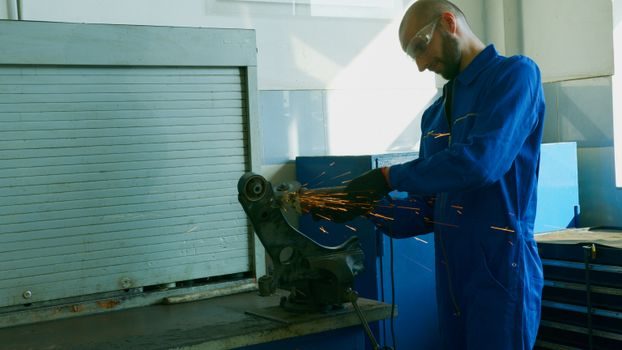
The trade-off stack is dominated by operator-safety exposure: a 24-inch wheel bursting at 1800-3600 rpm stores enough kinetic energy to cause fatal injury, which is why both formats require rigid two-side guards, and the swing-frame design must keep the guard concentric with the wheel under all pivot angles [S3]. Wheel RPM, abrasive-grade selection, and ring-test inspection are operator-controlled variables that the rigid machine design cannot compensate for.
Secondary disadvantages: high noise exposure above the 85 dB(A) action threshold typical of unshielded 5-15 HP grinders; heavy airborne dust loading from the abrasive and the casting sand, which is why foundries pair fettling booths with extraction; vibration exposure for operators on the swing-frame line (mitigated but not eliminated by the dynamically balanced spindle [S3]); and capital cost that scales steeply with HP — a 15 HP swing-frame is roughly 3× the cost of a 3 HP snagging bench. For non-foundry work, a floor grinder is the wrong tool and vice-versa; spec the machine to the workpiece, not the other way around.
Selection Criteria: Wheel Size, HP, and Format Match
Three spec gates decide the model: (1) wheel diameter 12-24 inches, which dictates the maximum casting envelope the operator can reach in one pass; (2) motor power 3-15 HP, which dictates continuous-duty metal-removal rate; (3) format — bench snagging for small-to-medium castings where the workpiece moves to the wheel, swing-frame for heavy castings where the wheel must reach across the part [S3].
Comparison of the two formats across decision criteria: | Criterion | Bench/Pedestal Snagging Grinder | Swing-Frame Grinder | |---|---|---| | Wheel diameter | 12-24 in [S3] | 12-24 in [S3] | | Motor power | 3-10 HP [S3] | 5-15 HP [S3] | | Operator position | Standing at fixed wheel | Driving pivoted wheel over part | | Best for | Small/medium castings, high repetition | Large castings, gates & risers | | Spindle design | Double-row ball bearings, dust-sealed [S3] | Dynamically balanced, belt-tensioned [S3] | | Capital cost band | Lower | 2-3× higher at same wheel size |
For most iron and steel foundries the swing-frame is the workhorse for riser removal, while pedestal snagging handles the smaller trim and finishing work — a split that mirrors the casting-weight distribution in the shop.
Who It Is For, and Where It Is the Wrong Tool
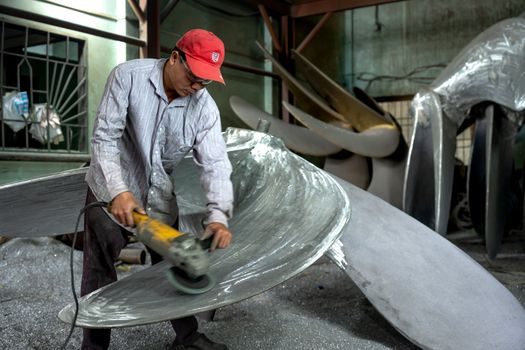
Snagging grinders and swing frame grinders, such as those manufactured by Ganesh Quality Machines, are available with abrasive wheel sizes from 12 to 24 inches and motor ratings ranging from 3 to 15 HP, with capacities designed for heavy radial and axial loads [S3].
It is NOT for: precision surface grinding (use a surface or floor grinder with dressed wheels); thin-wall sheet work (use a die grinder or handheld angle grinder); clean-room or food-grade environments (use dedicated stainless finishing tools with extraction); and job shops that only need intermittent deburring on small parts (a bench fettling grinder under 5 HP is the right ceiling). Choosing the wrong class is the most common spec error on incoming purchase orders.
Standards, Sourcing, and Trackable Signals
Two standards govern the safety side of the spec: ISO 525 for bonded-abrasive product designations (shape, grain, grade, structure, bond) and ISO 6103 for wheel-burst and peripheral-speed test methods — these define the maximum operating speed marked on every wheel and the ring-test acceptance procedure. Sourcing signals to track over the next quarter: the 7-15 HP swing-frame segment, where Indian and Chinese OEM capacity continues to expand and lead times have dropped to 4-8 weeks on standard 16-inch models [S3]; and the regulatory direction on crystalline-silica dust, which is pushing foundries to specify integrated extraction hoods as standard rather than optional. For adjacent spec work, the ball valve selection map covers a related foundry-process decision tree.