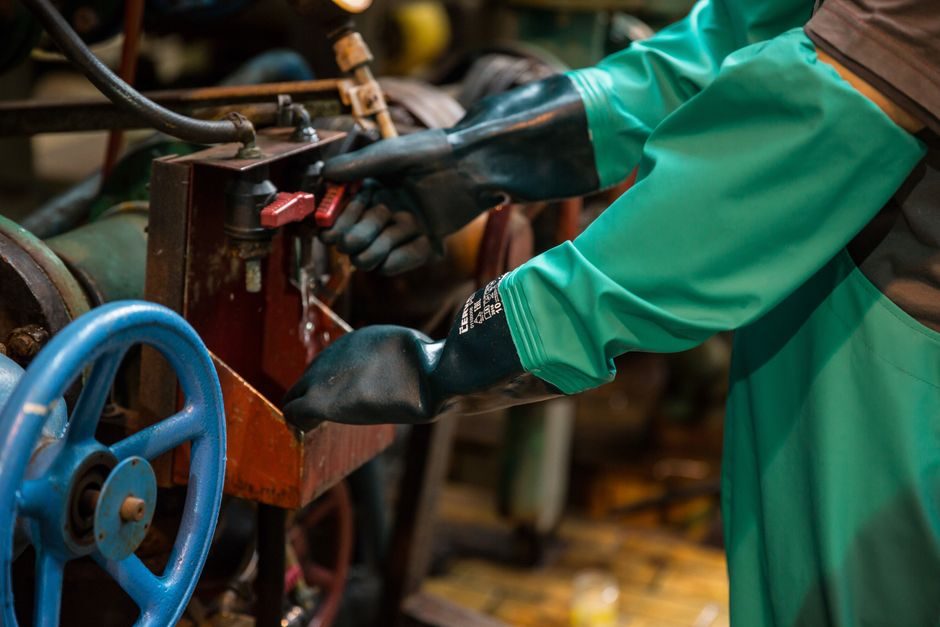
A ball valve is selected by aligning five engineering gates — bore configuration (floating vs trunnion), body rating, seat material, end connection, and actuation — against the actual service fluid, pressure, and temperature, not by brand alone.
The industrial ball-valve supply base is broad: the DirectIndustry ball-check-valve index alone lists 137 manufacturers and 252 products [S1], while Chinese industrial suppliers such as ZECO, Carilo, Baoyi, Multi-Valve, and High Mpa offer the full floating-to-trunnion range at DN15–DN250 [S3][S5][S7][S8]. Picking from that field requires a deterministic checklist, not a brochure.
Floating vs Trunnion: The First Decision Gate
Floating ball valves are the most common configuration in industrial piping: the ball is held by two PTFE seats and the line pressure pushes it against the downstream seat to maintain seal [S3]. The geometry is economic and lightweight but torque scales with Δp × seat area, so practical bore tops out at DN250 (10"), above which the seats can no longer reliably support the ball mass [S3].
Trunnion ball valves fix the ball on upper and lower trunnion bearings; line pressure does not move the ball, so seat load is decoupled from system pressure. Multi-Valve Technology's side-entry trunnion range is built to API 6D/API 6A in two- or three-bolt forged bodies for oil & gas, petrochemical, and system-isolation service [S5]. For any Class 600+ pipeline, large-bore transfer line, or DBB (double block & bleed) application, trunnion is the correct gate; for utility water, air, and low-pressure chemical service below 10", floating is the economic default.
For a primer on the mechanics and seal logic of a ball valve, the floating vs trunnion split is the single most important reading before any spec sheet is opened.
Pressure, Temperature, and Seat Material: The Second Gate
Floating-ball standard envelopes are well-defined: design to API 6D, API 6DSS, ASME B16.34, ISO 14313, and ISO 17292; pressure range PN10 (ANSI 150) to PN420 (ANSI 2500); temperature range −50 °C to +200 °C; size range DN15 to DN250 [S3]. End connections on a serious industrial floating ball include ASME B16.5 RF/FF/RTJ flanges, ASME B16.25 butt-weld, ASME B16.11 socket-weld, ASME B36.10 plain-end, and ASME B1.20.1 NPT threaded [S3].
Seat material is the third decision axis. PTFE seats handle most chemical and water duty within the −50/+200 °C window; metal-seated trunnion valves push that ceiling to ≈500–600 °C for high-temperature power-station and refinery hot-side service. ZECO's own description of floating-ball operation notes explicitly that "the amount of torque required increases significantly when operating pressure and/or valve size increase, and/or whenever the nature of the seat is made more robust" [S3] — meaning a metal-seated upgrade is not free, it forces actuator resizing.
Carilo Valve's published 12" Class 600 forged steel line demonstrates where the envelope moves upward: this is the trunnion, metal-supported-seat regime, not floating PTFE [S7].
End Connections and Body Material: The Third Gate

End connection choice is driven by the piping code, not preference. Butt-weld (BW) ends are mandatory for buried or hazardous hydrocarbon lines because they eliminate the gasket path; RF flanges per ASME B16.5 dominate chemical and refinery tie-ins; NPT threaded ends are limited to DN50 and below in non-cyclic, low-hazard service such as instrument air and utility water [S3]. RTJ (ring-type joint) flanges are restricted to Class 600 and above hydrocarbon service because the metal ring concentrates the seal load.
Body material follows media. Wenzhou Fuchuang Valve builds stainless steel mini ball valves, float valves, and exhaust valves for OEM and light-industrial accounts [S4]; ZECO and Carilo build carbon-steel and stainless forged floating/trunnion valves for the process industries [S3][S7]; Baoyi in Yongjia covers Wenzhou's general industrial line in carbon and stainless ball, gate, and globe valves [S8]. UPVC motorized ball valves, by contrast, show up only in DN15–DN50 water-treatment and irrigation packages (S6).
Actuation: Manual, Electric, and Pneumatic
Manual lever is fine for infrequent isolation and DN50; gear operators (worm gear) take over above DN50 or where space forces a hand-wheel; pneumatic and electric actuators are specified for remote or automated service. The motorized-brass-ball segment sold on AliExpress, 1/2"–2" (DN15–DN50), 2-wire 12V/24V/110V/220V, normally closed or normally open, in brass and stainless, defines the low-end commercial automation envelope (S6). [S6]
For motorized units that still need on/off logic but in a more spec-driven build, an electric ball valve selection walks through voltage, duty cycle, IP rating, and torque headroom in the same order. High Mpa Valve Group packages ball, gate, globe, check, plug, and butterfly valves for petroleum, chemical, fertilizer, pharmaceutical, metallurgy, and power-station service, with the rotary 0°–90° plug-valve principle and worm-gear variants documented on the public site [S2].
Comparison: Main Ball-Valve Options on Four Decision Criteria
Four realistic options, lined up against four buyer-facing criteria. Use this as a shortlist filter:
Floating PTFE-seated carbon/stainless ball (ZECO-class): size DN15–DN250, pressure PN10–PN420, temp −50/+200 °C, cost low — fits general process and water, fails above 10" and at high Δp [S3].
Trunnion metal-seated side-entry ball (Multi-Valve-class, API 6D/API 6A): size DN50 and up including 12" Class 600, pressure ANSI 150–2500, temp up to ≈600 °C with metal seats, cost high — fits oil & gas, DBB, hot hydrocarbon [S5][S7].
Mini stainless ball (Wenzhou Fuchuang-class): size DN6–DN15, threaded NPT, low pressure, low cost — fits OEM, water dispensers, small pneumatic manifolds [S4].
Motorized brass/stainless ball (commercial automation, 12V/24V/220V, 2-wire): size DN15–DN50, low-to-medium pressure, IP65 typical, cost low — fits water, HVAC, irrigation; not for flammable gas or high-cycle industrial service (S6).
Who Should NOT Pick the Mainstream Floating Ball Valve
Floating PTFE-seated ball valves are the wrong choice for four service classes. (1) Above DN250, where seat deflection under ball weight destroys the seal — switch to trunnion [S3]. (2) Above ~200 °C or in thermal-cycling service, where PTFE cold-flows and softens — move to metal-seated trunnion [S3]. (3) For large-bore DBB or pipeline isolation in oil & gas, where API 6D double-block-and-bleed performance is contractually required — specify trunnion to API 6D/API 6A [S5]. (4) For slurries, fibrous media, or fluids that score the seat, where a V-port or segmented ball is the correct geometry instead.
The ball-check, non-return category — also heavily populated (137 manufacturers, 252 products on DirectIndustry) [S1] — is a different device, not a substitute for an isolation ball valve. If the duty is check-only, see the ball valve reference and choose a true check valve separately.
Standards and Sourcing Discipline
For oil & gas and refinery service, the design baseline is API 6D (pipeline) and API 6A (wellhead), with ASME B16.34 for valve design and ASME B16.10 for face-to-face dimensions; for process and chemical service ISO 14313, ISO 17292, and EN 1092-1 govern the equivalent envelope [S3][S5]. For low-pressure commercial and water service, the relevant standards are generally manufacturer-specific and listed on the data sheet (for example, the motorized-brass segment on AliExpress uses DN15–DN50 with 2-wire 12V/24V/110V/220V options (S6)). Always match the certification on the body stamp to the piping code that governs the line, not the brochure claim.
Track the following three signals before locking a vendor: the manufacturer's published API/ISO certificate scope (covers your class and size), the seat material's documented temperature ceiling, and the actuator torque margin at maximum Δp. A common field failure — a manual floating ball that cannot be closed against full differential pressure — is almost always traced back to one of those three signals being misread on the data sheet [S3].
The underlying component specifications are covered under ball bearing.
See also our earlier report, Flow Sensor vs Color Mark Sensor: A Spec-First Selection Map.