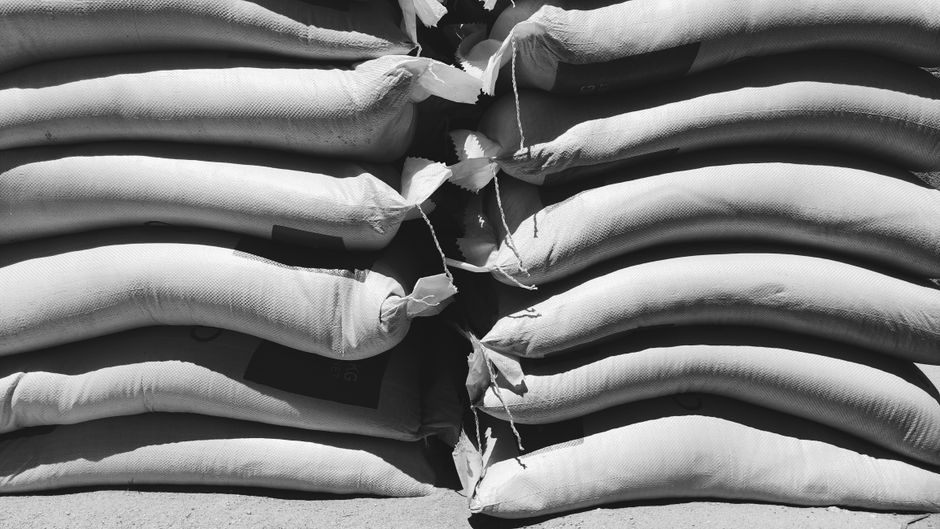
Posted Chinese-export listings on 2026-05-12 and 2026-05-06 quote FIBC bulk bags at US$1.78-5.6 per piece at 200-2000-piece MOQs, with 1000 kg virgin-PP super sacks dominating cement, chemical, fertilizer, mineral and food-grade fills [S1][S4].
Across the same Made-in-China and Alibaba indexes, the dominant configuration is a 1000 kg four-loop cross-corner woven polypropylene body with a safety factor of 5:1, a top fill spout, and either a flat, star, duffle, or full-open bottom [S1][S4][S7].
What an FIBC actually is and the variants that matter on the PO
An FIBC, also called a bulk bag, jumbo bag, big bag, tonne bag or super sack, is a flexible woven polypropylene container engineered for 500-2000 kg payloads; an encyclopedia entry on bulk bag types, UN ratings and load geometry sets the baseline taxonomy used by every specifier. [S1]
The variants that change the price and the freight class are the body shape (U-panel, four-panel, tubular, baffle/Q-bag), the loop configuration (cross-corner, side-seam, sleeve, single/two/four-loop), the top fill (spout, duffle, open), the bottom discharge (flat, star, spout with iris, full open, pajama), and the safety factor (5:1 single-trip vs 6:1 re-use, or 8:1 UN-y) [S1][S3][S7].
Verified export listings on 2026-06-14 and 2026-05-28 confirm that baffle "Q-bag" square-form big bags command roughly 30-60% higher unit pricing than the equivalent non-baffle cross-corner 1000 kg PP bag, because the internal baffles keep the cube shape during pallet stack and truck loading [S3][S5].
Decision criteria before you click RFQ
Working load, density, angle of repose and discharge behaviour drive the bag choice more than price; a 1000 kg cement fill behaves nothing like a 1000 kg fish-meal or fertilizer fill, and the body style, liner and bottom option must match the bulk [S1][S4].
Five specs that must be fixed on the RFQ before comparing FOB quotes: (1) SWL in kg, (2) safety factor 5:1 / 6:1 / 8:1, (3) body style and loop option, (4) top fill + bottom discharge geometry, (5) food-grade / UN / conductive / baffle / liner requirements [S1][S3][S4].
JMJ Packaging, founded in 1994 as a UK supplier, ships FIBCs for the construction sector with a corporate-plus-SME service model, illustrating that the European channel layers print, design and short-run customization on top of the same woven PP base fabric used in Asian export channels [S2].
Comparing the main FIBC types against decision criteria

Side-by-side, the four common body styles trade off on stacking cube, cost, food compatibility and discharge control: U-panel is the cheapest 1000 kg workhorse, four-panel gives better shape retention for mineral and salt, tubular is the cleanest food-grade option with no side seams, and baffle Q-bag maximises pallet cube at a price premium [S3][S4][S7].
A straight comparison on four specs, pulled from current 2026 export listings: 1000 kg PP U-panel cross-corner bag with spout top and flat bottom sits at roughly US$1.78-3.15 per piece at 200-1000-piece MOQs; 1000-1500 kg four-panel with spout top and star bottom at US$2.55-4.95; 1000-1500 kg tubular food-grade with duffle top and spout bottom at US$2.55-4.85; baffle Q-bag 1000 kg with sewn-in baffles at US$2.5-4.86 [S3][S4][S7].
For static-sensitive or explosive-dust service (powder, toner, grain dust, aluminium powder), the type-C conductive or type-D antistatic FIBC replaces the standard non-conductive PP body, and the price step is typically 40-100% over the equivalent non-anti-static bag; type-B bags are restricted to dry non-flammable fills [S1].
Real use cases and how they map to the right FIBC
Cement, fly-ash and lime: a 1000 kg cross-corner U-panel bag with top spout and flat bottom, 5:1 SF, no liner, polypropylene lamination optional; current 2026 China listings put this at US$2.15-3.15 per piece at 1000-piece MOQ [S4].
Sand, gravel, mineral ore and construction aggregate: 1000-2000 kg four-panel with duffle top and full-open or star bottom, often with PE inner liner for moisture; the Made-in-China 2026-05-06 index prices these at US$2.89-3.08 per piece at 1000-piece MOQ with no minimum on the 2-tonne construction variant [S1][S4].
Food, sugar, salt, fishmeal and fertilizer: virgin-food-grade tubular or four-panel with PE/AL/foil liner, BRC or FSSC 22000 audited mill, and a 6:1 safety factor for multi-trip re-use; 2026-05-28 listings price food-grade 1000-1500 kg fishmeal bags at US$3.86-4.86 per piece at 1000-piece MOQ [S5][S7].
Chemicals, fertilizer and hazardous powder: UN-certified 13H or 13H3 with 8:1 SF, type-C conductive or type-D antistatic, and printed UN markings; bag-by-bag UN test certificates are non-negotiable on a mill with a 13H code [S1].
Limits, failure modes and inspection gates

Three failure modes end FIBC service life prematurely: UV degradation of the woven PP tape if the bag sits in direct sun past the printed 6-12 month rating, abrasion at the cross-corner lift loops from crane hooks, and bottom-seam blow-out when the discharge spout is undersized for the fill's angle of repose [S1][S3].
Inspection gates on a 2026 shipment should be enforced: (1) fabric weight in g/m^2, typically 140-230 g/m^2 for 1000-1500 kg SWL, (2) loop tensile and break-strength test certificate, (3) drop-test record per the bag's SF rating, (4) UV-stabiliser loading verified by the mill, and (5) food-grade or UN documentation matched to the order code [S1][S3].
Sandbaggy and other US-channel converters sell form-fit PE liners for retro-fitting existing FIBCs, with a 250-pack of large bulk-bag clear liners advertised at US$960 on 2024-10-31, illustrating that liner retrofit is a viable alternative to buying pre-lined bags when existing stock is in serviceable shape [S8].
Price bands, MOQs and 2026 sourcing levers
The cleanest 2026 pricing band for a standard 1000 kg cross-corner PP super sack with 5:1 SF, spout top, flat or star bottom, sits at US$1.78-3.15 per piece FOB China at 200-2000-piece MOQs; the 1500 kg and food-grade variants lift the band to US$2.55-4.95, and the heavy-duty 2000 kg construction or mineral bag runs US$2.89-5.6 at 1000-piece MOQ [S1][S4][S7].
Three sourcing levers move the price more than the brand: (1) lifting MOQ to a full 20 ft or 40 ft container fill (typically 10000-20000 pieces), (2) consolidating to 1-2 stock SKUs instead of many printed variants, (3) specifying "with liner" only where the bulk actually demands a moisture, oxygen or static barrier [S1][S4].
For 2026 sourcing, Chinese mills on Made-in-China and Alibaba continue to dominate 1-20 tonne orders with audited UN, BRC and FSSC 22000 lines, while UK/EU suppliers like JMJ differentiate on short lead time, custom print and lower minimum order quantities for construction and waste-handling customers [S2][S5].
End-of-line storage, AS/RS palletising and truck-loading behaviour should be reviewed against the chosen FIBC: a baffle Q-bag maximises pallet cube in a pallet rack bay, and a 1000 kg woven PP body drops cleanly into a plastic pallet footprint without the wood-pallet nail-tear risk.
Track the next two signals in Q3 2026: (1) post-IMO 2025 sulphur-cap freight spread between FOB Ningbo and CIF Rotterdam for a 40 ft HQ of FIBC, and (2) any mill audits published by the European FIBC Association that re-rate Asian mills into or out of the food-grade UN 13H3 list.
For component-level specifications, see bag filter, and linear guide.