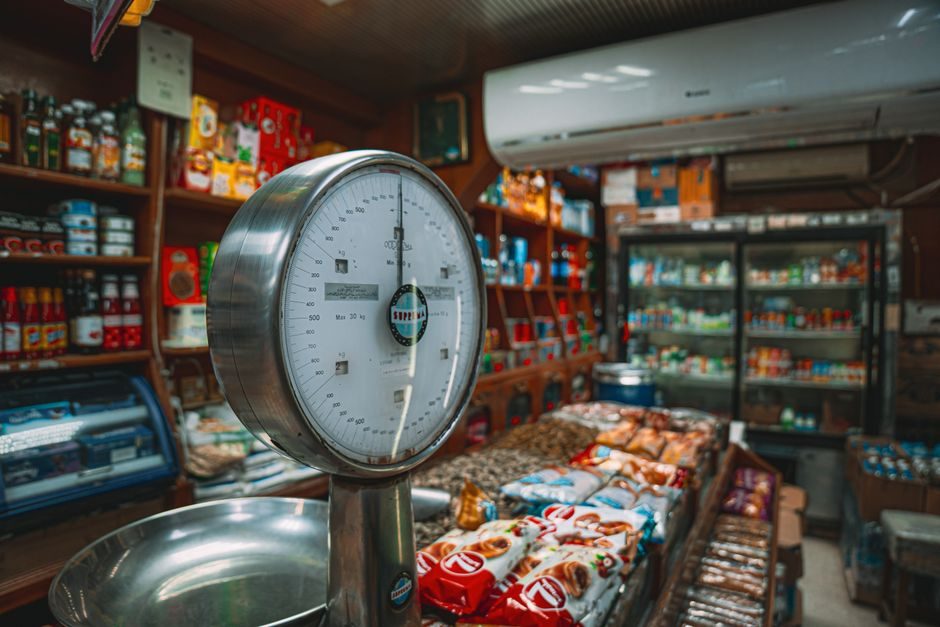
A filling scale combines a filling machine head with a load-cell-based weighing station so each container is filled to a target mass, not a target volume — a hard requirement when product density varies batch-to-batch, as it does with powders, granulars, and viscous liquids [S3].
Where Filling Scales Beat Volumetric or Counting Systems
Filling scales are specified when net-weight accuracy is non-negotiable, product density drifts more than 2-3% between batches, or the SKU mix is wide enough that one volumetric cup set cannot economically cover the catalogue [S3]. A bench scale mounted under the fill head is the standard cell on 1-25 kg bag lines, and the filling-weighing-scale class is the de-facto choice for 25-50 kg open-mouth or valve bags, flour, sugar, and chemical powders.
Repeatability of 0.1-0.5% (1σ) on a properly tuned system is the headline number, against 1-2% typical for auger-based volumetric fillers, and parts-per-million traceable calibration is achievable because the load cell is the legal-for-trade element [S3]. The same accuracy spec also drives the right answer on the wider plant floor: a review of truck scale TCO shows the same load-cell hygiene, calibration cadence, and traceable-mass discipline — the buy decision downstream rarely hinges on the fill head at all, it hinges on the cell.
The Hard Limits: Throughput, Density, and Head Geometry
Mechanical settling time, not electronics, sets the ceiling — a typical 5-25 kg gross-fill cycle needs 1.5-3.0 s of weigh-dwell plus 2-4 s of cut-off dribble before the next container indexes in, which is why single-head filling scales stall around 10 weighings/min even with a fast 200 Hz update rate on the indicator [S3].
Bulk density variation above roughly ±5% will defeat a fixed-parameter volumetric pre-stage and push the design toward a two-stage cut-off (fast bulk + slow dribble) with an adaptive algorithm, and a checkweigher downstream then has to absorb the residual — the 2-3% reject rate seen on poorly tuned systems drops to under 0.5% once the fill algorithm is locked. Comparing this against a checkweigher TCO line item is the right move: the checkweigher is the safety net that pays for itself only when the upstream filler is already in spec.
Selection Criteria Mapped Against the Main Architectures

On four decision criteria the split is clean: net-weight gross-fill wins on accuracy (0.1-0.3%) and capex (USD 8k-40k per head) but loses on throughput; multi-head wins on throughput and giveaway (typically 0.3-0.8% giveaway against 1-2% on gross-fill) but loses on cleanability and footprint (3-4 m head-of-line height); linear sits in the middle on every axis and is the default for irregular shapes like pasta, candy, or IQF vegetables. The cutoff is roughly 20-25 weighings/min — below that, net-weight gross-fill; above that, multi-head becomes the only option.
Who It Is For, and Who Should Walk Away
Filling scales are for plants where the SKU is heavy (1-50 kg), the product density drifts, the bag or container tare varies by more than 50 g, or the line is regulated — food, pharma, and chemical packaging under GAMP, 21 CFR 11, or ATEX 2014/34/EU all map cleanly onto a load-cell-based fill [S3].
High-speed beverage lines above 60 packs/min, ultra-cheap water or thin-chemical dosing, and any application where volumetric accuracy within 1-2% is acceptable are the wrong fit — a flow-meter or piston filler will run 5-10× faster at roughly half the capex. Hygiene-classified lines (EHEDG, 3-A) are also a poor match for open-frame net-weight fillers: the load cell, brackets, and cut-off gate are difficult to clean in-place, and a sanitary multi-head or aseptic piston filler is the correct specification there.
Failure Modes, Calibration, and Standards

Load cells drift, and a 0.05% linearity spec does not mean 0.05% in service — vibration, temperature swings, and over-range events push field accuracy toward the 0.3-0.5% band, which is why legal-for-trade verification under OIML R76 or NTEP HB44 is a contractual requirement, not a nice-to-have [S3]. The two most common failure modes are bag-clamp drift (the container shifts on the spout, the cell sees the wrong force, and a "good" reading is recorded on a bad fill) and dribble cut-off wear (the trim gate no longer closes in 50-100 ms, and the system overshoots the target by 2-5 g on every cycle).
Standards that govern the stack: OIML R76 for load-cell accuracy classes A through D, ATEX 2014/34/EU for explosive-dust environments (flour, sugar, aluminum powder), and 21 CFR 11 for pharma data integrity — picking the wrong class on R76 is the most common procurement error, and a Class C cell is the right floor for 0.2% net-weight filling, not the cheaper Class D cell that the catalogue tends to default to. Calibration with traceable masses at install, quarterly, and after any cell replacement keeps the system inside its 0.1-0.3% envelope; without it, the same hardware will drift to 0.5-1.0% within six months.
Sourcing and Lifecycle Signals to Watch
Three signals to track over the next 6-12 months: load-cell lead times, which stretched from 4-6 weeks to 16-24 weeks during the 2024-2025 supply crunch and are the single biggest schedule risk on a new line; IIoT-enabled indicators with OPC-UA and PROFINET, which have moved from premium to standard on most platforms and let the filler push 10-50 tags straight into a process control layer without a gateway; and the rise of dual-mode fillers that switch between volumetric and net-weight in a single recipe, which closes the 1-2% volumetric vs 0.1-0.3% net-weight accuracy gap at the cost of a longer changeover.