
Confined space entry on a process site almost never relies on a fire hydrant as the in-space water source; the hydrant system's job is to feed a 900 LPM landing valve at 7 bar residual pressure, supply a hose reel or standpipe at the access point, and back up the rescue team's water-mist cooling line [S4][S2].
Specifying that chain correctly means matching hydrant type (wet barrel, dry barrel, landing valve), clearance, water-reservoir sizing, and pump capacity to the entry permit's hazard class, not to the building code alone. Singapore SCDF Clause 4.4 (2026-03) still mandates a 1000 mm clearance between any private hydrant and the adjacent building or retaining wall [S1].
Why Confined Space Entry Changes the Hydrant Spec
OSHA 29 CFR 1910.146 governs permit-required confined spaces and treats fire protection as one of several external support functions, not as the primary rescue or cooling system inside the vessel [S2]. The hydrant at a confined-space job site is sized so that the standby fire watch, the attendant, and the entry supervisor can each reach a charged hose within 15 m of the manhole or hatch, and the hydrant must sustain 900 LPM at 7 bar residual pressure to feed the landing valve downstream [S4]. The vendor-spec landing valve (100 mm × 80 mm oblique, 63 mm orifice) drops only ~0.3 bar across the orifice itself; the 7 bar figure is the residual pressure the system preserves for hose and nozzle use, not the differential the orifice consumes [S4].
For an entry into a petroleum storage tank, a sewer, a cargo hold, or a reactor with hot internals, a single landing valve at 900 LPM is the typical minimum; multi-valve layouts scale the fire pump, not the hydrant, because the 63 mm orifice passes ~4338 LPM at 7 bar if the full differential were dropped across it [S4]. Specifiers should therefore treat the 7 bar/900 LPM pair as a residual-pressure contract, not as an orifice limit.
Hydrant Type Selection: Wet, Dry, and Landing Valves
Above-grade wet-barrel hydrants are common in temperate warehouses and food plants where the line cannot freeze; the SCDF Fire Code 2023 treats a private wet hydrant as the default unless the climate forces a dry variant [S1]. Dry-barrel hydrants are mandatory where frost penetrates below the hydrant base, and they rely on a drain valve that closes automatically when the stem is lowered.
For confined-space sites, the practical choice is a pillar-type hydrant feeding an oblique landing valve mounted at 1.0–1.4 m above floor level, with a 1000 mm unobstructed clearance to any wall on at least one face to allow two firefighters to connect simultaneously [S1]. A 63 mm orifice oblique landing valve is the most common SKU because it pairs with 65 mm instantaneous BS 336 or Storz couplings used on entry-team hose reels; threaded NST is the North American alternative but requires an adapter at the hose reel for mixed fleets [S4].
Clearance, Siting, and Access Geometry
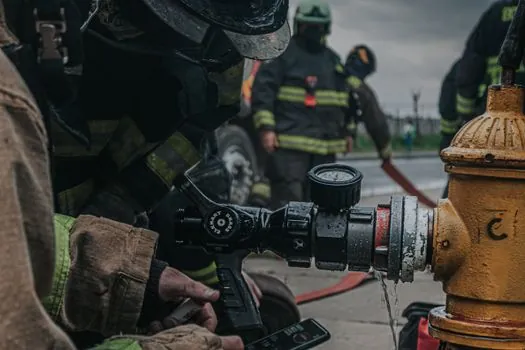
SCDF Clause 4.4 (Private Fire Hydrant) keeps the 1000 mm clearance from the building face or retaining wall as a hard minimum, and waives hydrant H1 only if the adjoining land is permanently maintained as open space with no combustible storage [S1]. The clause also requires hydrants to sit within 50 m of the riser entry point so that the fire pump, the Siamese connection, and the access hatch can all be reached without laying more than two lengths of 65 mm hose.
For a confined-space job, the geometry of the access point matters as much as the hydrant location. A vertical entry through a 600 mm manhole cover in a roadway requires the nearest hydrant to be at least 4 m clear of the cover so that the rescue tripod, winch, and gas detector can be set up without hose lay crossing the exclusion zone. The WCESS confined-space training curriculum treats a 4–6 m standoff between the entry point and any fire-water discharge as standard practice, because the mist from a charged landing valve can contaminate breathing-air sample lines within that radius [S2].
Flow and Pressure Sizing for the Entry Team
The hydraulic math behind a 900 LPM / 7 bar landing valve is straightforward: a 63 mm sharp-edged orifice at Cd ≈ 0.62 drops only 0.30 bar to pass 900 LPM, so almost all of the 7 bar is delivered as residual pressure to the hose and nozzle downstream [S4]. Pump head for a single-valve system stacks up as 0.3–0.5 bar for the valve, 0.5 bar per 5 m of static lift, 1–3 bar for 50–100 m of 100 mm Sch 40 pipe friction, and the 7 bar residual at the outlet [S4].
For a 50 m hose run at 5 m elevation, a single-valve entry system therefore needs roughly 9–10 bar at the pump discharge. For a two-valve system running simultaneously, the pump flow scales to 1800 LPM and the friction term roughly doubles at the same pipe size, so the typical pump selection is 30 m³/h at 11–12 bar for moderate runs, and 60 m³/h at 12–14 bar for shipyard or refinery entries. These numbers also line up with a dedicated hydrant tank sized to deliver 90 minutes of two-valve flow, which is the storage volume many AHJs (including those aligned with AS 2419 and NFPA 24) require for industrial sites [S3].
Water Storage: Hydrant Tank vs Combined Fire Water Tank
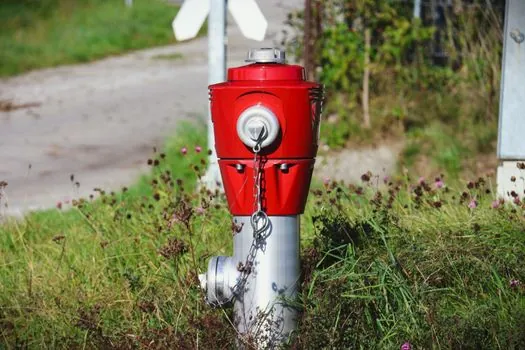
A dedicated hydrant tank is usually the correct choice when hydrants are the primary fire-protection measure at a single-hazard site, because the storage volume, pump sizing, and pipework all align to one demand curve [S3]. A combined fire-water tank makes more sense when the same reservoir feeds sprinklers, deluge, water monitors, and the hydrant system, because the storage and pump room can be shared, though the tank then has to be sized to the worst-case concurrent demand [S3].
For a confined-space entry, the storage question is normally answered by the site's existing hydrant system rather than by the entry permit itself, but the rescue team should verify the tank's effective capacity before issuing the permit. A typical 90-minute, two-valve demand at 1800 LPM is 162 m³, and a 200 m³ tank with 10% foam concentrate allowance is a common industrial standard [S3]. Anything smaller than 100 m³ at a site with multi-hour entries should trigger a written risk assessment and a backup supply such as a tanker or a river intake through a listed hydrant.
Component Compatibility, Couplings, and Common Spec Errors
The most common spec error on confined-space sites is conflating pump-rated pressure with residual pressure at the valve, which leads to undersized hose reels and nozzles that fail to throw a water-mist pattern at 4–5 m [S4]. The second most common error is coupling mismatch: a 65 mm BS 336 instantaneous coupling does not mate to a 2.5" NST without an adapter, and a single adapter failure during a real entry has ended rescue attempts on more than one site. A third frequent error is treating the 7 bar figure as a maximum when the system is in fact designed to deliver a minimum residual, which means the pump duty point must hold 7 bar at 900 LPM, not at shutoff [S4].
For new builds, the cleanest spec is a pillar hydrant feeding an oblique landing valve (100 mm × 80 mm, 63 mm orifice) at 1.0–1.4 m above grade, with 1000 mm wall clearance [S1], 65 mm instantaneous couplings on the hose side, and a fire pump rated for at least 11 bar at 30 m³/h for single-valve entries or 60 m³/h for two-valve entries [S4]. For storage, a 200 m³ dedicated hydrant tank with a low-level float and a test drain covers most industrial entries without overcommitting the site to a combined fire-water system [S3]. The fire hydrant selection page on SourceBySpec walks through the wet/dry/landing-valve trade-offs, and the fire safety page covers the broader integration with extinguishers and alarms.
Field Signals to Track After Spec Lock
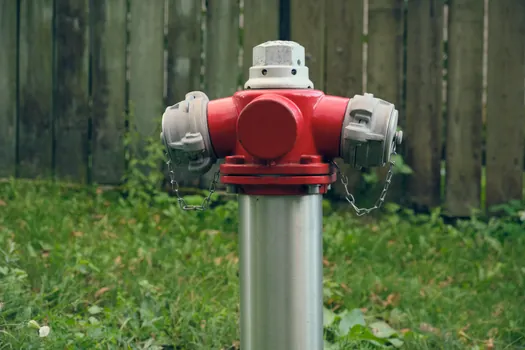
Trackable signals after the spec is locked include the as-built residual pressure at the most remote landing valve during the quarterly flow test, the pump-room ambient temperature (for dry-barrel drain reliability), and the tank's effective storage volume after silt and corrosion allowances. Sites that integrate the hydrant system with a fire-rated door or fire door program usually extend the same flow-test discipline to the riser feed, which keeps the confined-space entry permit aligned with the building's overall fire-safety case. [S3]
Background reading: Automatic Level Selection for Bridge Construction: 2026 Spec Map.