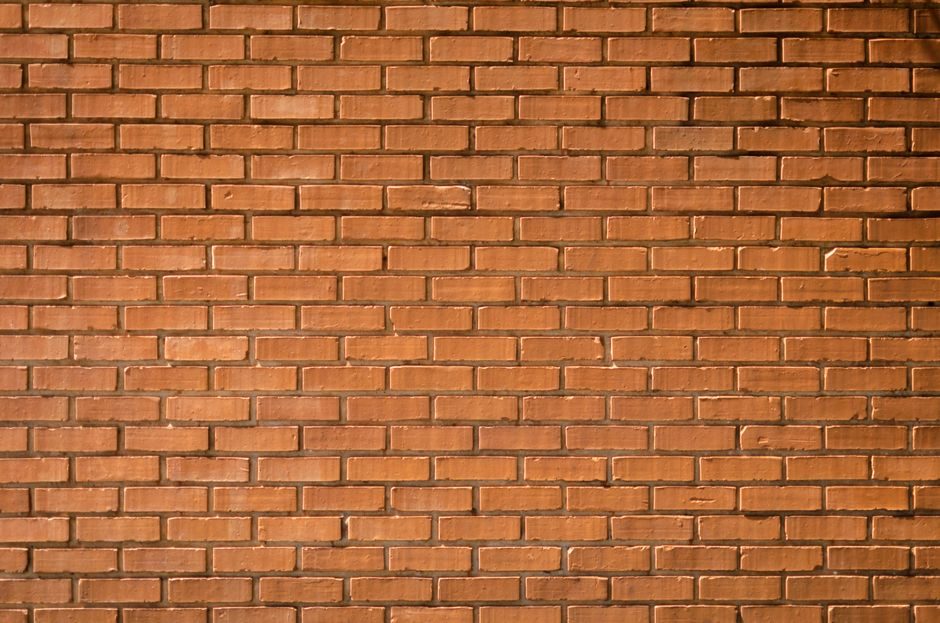
Fired clay brick is the most-specified masonry unit for structural load-bearing walls, refractory linings, and architectural facades where high temperature, acoustic mass, and long service life dominate the design brief.
The performance envelope runs from ASTM C27 fire-clay brick refractories (service to ~1700°C, 1500-1800 kg/m³ bulk density, 5-8% apparent porosity) down to C902 pedestrian-and-light-traffic paving brick (compressive strength ≥55 MPa for Grade SX). Between those two reference points sits a wide grade space the specifier must navigate against calcium-silicate and autoclaved aerated alternatives [S1].
Material Composition and Grade Boundaries
Refractory-grade fired clay brick follows the Al₂O₃-SiO₂ phase diagram: high-alumina firebrick runs 45-90% Al₂O₃ and sustains continuous service to 1750°C, while medium-duty fire-clay brick at 35-45% Al₂O₃ tops out near 1450°C.
Building-grade solid clay brick is classified by ASTM C216 (Facing) and ASTM C652 (Hollow) into grades SW (Severe Weather), MW (Moderate Weather), and NW (Negligible Weather) by 24-hour cold-water absorption limits of 8%, 12%, and unlimited respectively. Compressive strength for Grade SW facing brick sits in a typical 20-40 MPa range, with the ASTM C216 minimum at 20.7 MPa for individual units and 17.2 MPa average for five tests [S3].
The Al₂O₃-content band is the single most important spec parameter because it pins both refractoriness (PCE / pyrometric cone equivalent) and thermal-shock resistance. A drop from 45% to 30% Al₂O₃ can lower maximum service temperature by 200-300°C and double the thermal-expansion coefficient from ~5.5×10⁻⁶/°C to ~11×10⁻⁶/°C, a critical value for cyclic-heat-up / cool-down service [S1].
Advantages: Where Fired Clay Brick Wins
Refractory performance is the headline benefit: high-alumina firebrick maintains dimensional stability and load-bearing capacity at 1500-1700°C continuous service, beating castable refractory in many kiln and furnace linings where abrasion resistance matters. [S1]
Durability numbers are concrete: clay brick masonry routinely delivers 100+ year service life in load-bearing applications, with documented historic structures exceeding 500 years.
Acoustic performance and thermal mass complete the case: a 100 mm solid clay brick wall achieves STC 45-50 airborne sound transmission, and thermal mass of ~1200-1400 J/kg·K delivers phase-shift damping that reduces HVAC cycling in diurnal-swing climates [S1].
For a deeper look at the grade ladder, the Fired Clay Brick Types and Classifications composition grades and performance reference walks the ASTM C216, C652, C902, and C27 code paths side by side.
Disadvantages: The Real Cost of Using Fired Clay Brick
Unit weight is the structural penalty: solid clay brick at 1800-2000 kg/m³ produces 4-5 kPa dead load per 230 mm wythe, forcing larger footings and more reinforcement in multi-storey construction versus 600-800 kg/m³ autoclaved aerated concrete at one-third the mass [S1].
Labour intensity is the second penalty. A 230 mm load-bearing wall typically runs 8-12 bricks per m² of wall area and 0.4-0.6 hr/m² placement time for an experienced mason, against panelised systems that can hit 1.0 m²/minute. The Fired Clay Brick Installation article documents substrate prep, mortar match, and joint control as the three controllable variables that make or break cycle time on a typical 2.44 m wall module [S1].
Thermal conductivity runs 0.6-1.2 W/m·K for solid fired brick, requiring either thicker walls or supplementary insulation to meet modern envelope R-value codes in heating-dominated climates. The product family row in our fired brick encyclopedia entry carries the conductivity ranges against calcium-silicate and AAC alternatives.
Comparison: Fired Clay Brick vs Calcium Silicate vs AAC
Decision-criteria matrix for typical wall and lining service:
Bulk density: Fired clay 1500-2000 kg/m³, calcium silicate 1800-2000 kg/m³, AAC 400-700 kg/m³. Thermal conductivity: 0.6-1.2 vs 0.9-1.4 vs 0.10-0.20 W/m·K. Compressive strength: 20-40 MPa vs 10-20 MPa vs 4-6 MPa. Max continuous service: 1000-1700°C (refractory grade) vs ~250°C vs ~700°C. Embodied carbon per kg: ~0.2-0.4 kg CO₂e fired clay vs ~0.3-0.5 calcium silicate vs ~0.15-0.25 AAC [S1][S3].
Spec rule of thumb: pick fired clay brick for any service above 700°C, for severe-exposure (SW-grade) facades, and where 100-year service life is contractual. Pick AAC where the brief is dry-weight floor area under 5 kPa wall line-load and U-value under 0.30 W/m²·K. Pick calcium silicate only for fair-exposure interior partitions and fire-rated walls where appearance and paintability matter more than mass [S1].
Selection Criteria and Application Boundaries

For refractory service, the spec is driven by four numbers: maximum continuous service temperature (°C), thermal-shock cycling rate (cycles/day), chemical attack profile (slag, alkali, acid), and abrasion exposure. Fired clay brick in the 35-90% Al₂O₃ range covers most kiln, boiler, and incinerator lining duty [S3].
For structural masonry, the decision is engineering-economic: a 230 mm solid clay brick load-bearing wall in a 5-storey building adds roughly 8-12% structural steel/RC cost versus a frame with lightweight infill, recovered by acoustic and thermal-mass gains over 30-year life cycle. Where the wall line-load budget is tight, hollow clay brick (ASTM C652) drops density to 1100-1400 kg/m³ at 25-40% void ratio [S1].
For partition and lining service where weight and speed dominate, the Lightweight Partition Panels: Spec Trade-Offs Engineers Must Weigh reference lays out the alternative selection tree, and Lightweight partition panel installation covers the 2.44 m module anchor pattern that often replaces brick at the partition layer.
Installation and Long-Term Performance Constraints
Heat-up rate for refractory-grade linings is capped at 50-100°C/hour to avoid thermal-shock spalling, and the first commissioning heat-up is the most failure-prone step in any new furnace lining. Joint mortar must be matched to the brick Al₂O₃ content; air-setting refractory mortar at 1-3 mm joint thickness is the standard for high-temperature service [S1].
For load-bearing wall service, brick must be kept dry on site and pre-wetted before laying to control suction rate: brick with initial rate of absorption above 30 g/min/30 in² requires pre-wetting to prevent mortar dehydration. Efflorescence on facing brick is a service-life cosmetic issue tied to soluble-salt content in the raw clay, not a structural defect [S3].
These figures are the lower bound of the maintenance window the specifier should design for [S1].
Standards, Sourcing, and Traceability

The reference standards stack: ASTM C27 for fire-clay brick refractories, ASTM C216 for facing brick, ASTM C652 for hollow brick, ASTM C902 for paving brick, ASTM C270 for mortar, and ISO 2245 for shape-coded refractory bricks. European equivalents EN 771-1 and EN 1304 cover the same product space with different grade letters [S3].
Sourcing should be tracked per batch with the manufacturer's certificate listing Al₂O₃ content, bulk density, apparent porosity, cold crushing strength, and refractoriness-under-load (RUL) at the specified temperature. A typical RUL test point is T₀.₅ (0.5% deformation) at 0.2 MPa load, reported as the temperature where the brick softens [S1].
For project-level TCO modelling on the wall-system side, the Lightweight Partition Panel TCO 4 Cost Drivers Over Service Life reference gives a parallel cost model; cross-walk both product families at the same service life and same thermal-performance baseline to get a defensible selection.
Track these signals for the next spec revision: ASTM C216 and C270 are the moving targets to watch for grade-limit changes, and any new high-alumina or low-carbon clay-brick product data sheets released in 2026 should be cross-checked against C27 RUL values before they replace incumbent refractory grades. The block brick encyclopedia entry covers the comparable concrete-block grade space for non-refractory service.
Spec-level background on the components involved: pressure transmitter.