Agricultural projects typically need tower cranes in the 5-18 t maximum-load band, with flat-top 5-100 t units serving open grain-elevator sites and luffing-jib 8-18 t machines covering tight farmstead footprints, per manufacturer line-ups published 2026-08-11 [S3].
CE marking plus ISO9001 is the de-facto procurement baseline for European and export-channel farm buyers, while RoHS, UL and ETL certifications appear on Chinese OEM line cards targeting multi-region agricultural contractors [S3].
Agricultural duty profile: why a construction-class tower crane is even on the table
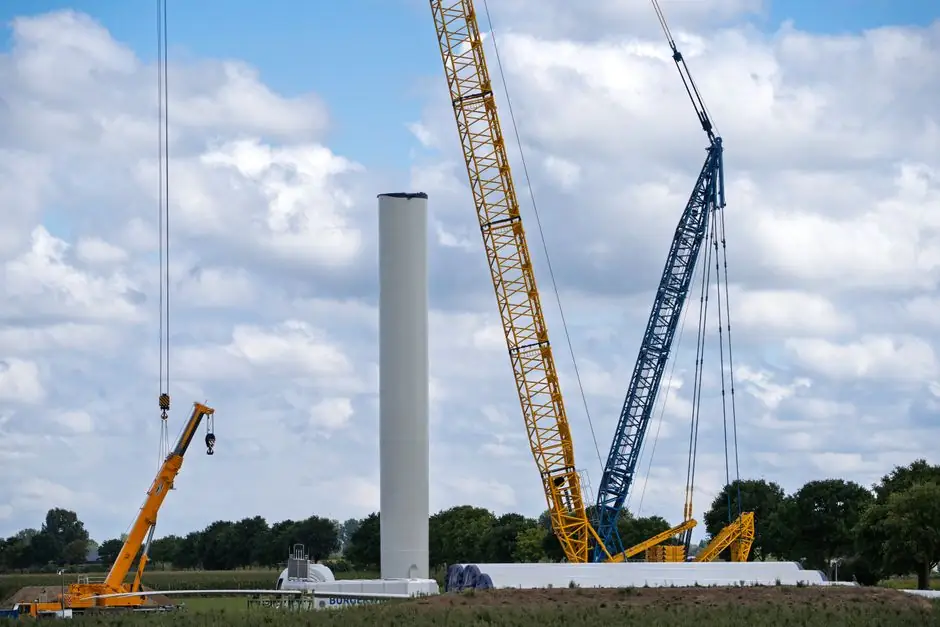
Modern farm infrastructure, including 30-50 m concrete grain silos, 25 m drive-through hay barns, steel-frame dairy parlours, and pump-station assemblies for centre-pivot irrigation, routinely generates lifts in the 6-12 t range at 18-30 m radius, which sits squarely inside the tower crane envelope rather than telehandler or mobile crane territory. Faced with erecting a 220 t wind-tower-class structure, Dahan Technology's 220-tonne ultra-large tower crane (DHL3300-220) was delivered as the world's first wind-powered unit of that capacity [S5], a useful upper anchor for what "agricultural-adjacent" structural steel can demand. Flat-top machines in the 5-100 t class dominate because their tie-free, low-overhead geometry clears irrigation booms, overhead power lines and grain conveyors without requiring counter-luffing clearance [S3].
Agricultural work shifts the duty cycle: lifts per shift are lower than high-rise concrete pours (typically 20-40 versus 80-120), but cycle times stretch because crews feed bags, seed pallets and steel sections from ground-level trailers. This argues for 2-fall reeving, 4-6 m/min hoist speeds, and 30-40 m jib lengths as the spec sweet spot for 90% of farm jobs in the 5-8 t class. Luffing-jib units in the 8-18 t class are reserved for sites where neighbouring sheds, tree lines, or 11 kV/33 kV distribution lines block the jib arc, since the luff geometry can fold the load line inside a 6-8 m envelope at vertical [S3].
Selection criteria: load chart, free height, foundation class, and certification
Four decision gates govern agricultural tower crane selection. First, free-standing height: a 5-8 t flat-top with a 1.6-1.8 m tower section normally free-stands to 40-45 m without tie-ins, which is enough for most grain-silo clusters; once barn height plus silage dome clearance pushes the hook above 45 m, the user must accept tie-wall brackets or a climbing frame. Second, foundation class: 5-8 t machines at 40 m free height typically need a 4-5 m square, 1.2-1.5 m thick reinforced pad (C30/C37 concrete), and 12-16 t of kentledge as ballast for the 6-8 m outrigger base, sized to the OEM ground-pressure table. Third, certification: CE-marked machines (Machinery Directive 2006/42/EC conformity) plus EN 13000 for crane safety are the floor; ISO9001 is the quality-system baseline most Chinese OEMs publish [S3][S5]. Fourth, power: 380-415 V three-phase at 50 Hz with a 30-60 kVA site genset is typical, and topless designs lower wind-load sensitivity, which matters on exposed prairie or fenland sites where gust factors push above 1.4.
Counter-jib ballast, hoist motor power, and slew drive torque set the cap on what a smaller agricultural crane can lift at radius. The VEGA flat-top line spans 5-100 t maximum load, while the luffing line stops at 8-18 t, a ratio that maps directly onto farm demand: 5-8 t covers 80% of silo and shed work, 10-18 t covers dairy rotary parlour erection and grain-elevator head-house steel, and 50-100 t is reserved for the rare 80-120 m feed-mill build [S3]. For comparison, FANGYUAN's PT6016-8t model sits in the middle of the agricultural sweet spot, with a price band of US$123,000-123,437 per set on a 5-set MOQ basis (2022-01 listing, used here only for cost anchoring) [S4].
Comparison: flat-top 5-8 t vs flat-top 10-18 t vs luffing 8-18 t for farm sites
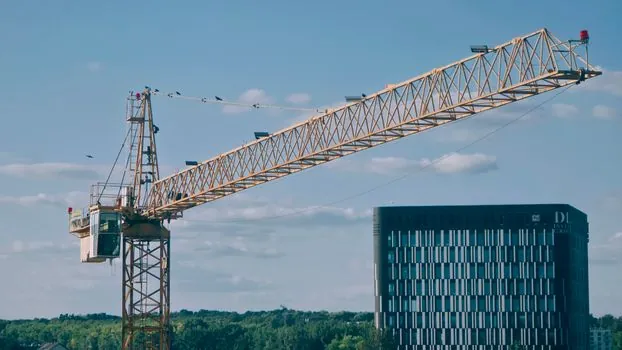
Lining the three common agricultural classes against the criteria that actually matter on a farm:
1. Max load / typical agricultural lift. Flat-top 5-8 t: 5-8 t max, lifts 3-6 t concrete panels and 2-4 t steel trusses at 18-25 m radius. Flat-top 10-18 t: 10-18 t max, lifts 6-12 t silo ring sections and 8-10 t rotary parlour columns at 22-30 m radius. Luffing 8-18 t: 8-18 t max, same lift envelope, but folds the jib vertically to clear obstacles.
2. Site footprint. Flat-top 5-8 t: 4-5 m square base, fits inside a 6 m farm-gate. Flat-top 10-18 t: 6-7 m square base, needs a 9 m clear apron. Luffing 8-18 t: 5-6 m square base, but needs 8-10 m vertical headroom for the folded jib.
3. Obstacle tolerance. Flat-top 5-8 t: poor for tight sites, jib arc is fixed. Flat-top 10-18 t: poor, same limitation, larger arc. Luffing 8-18 t: strong, luff from 15 degrees to 75 degrees, working radius drops to 6-8 m at vertical.
4. Capex band. Flat-top 5-8 t: low (US$120-150k for a new 8 t Chinese OEM unit) [S4]. Flat-top 10-18 t: mid. Luffing 8-18 t: 20-35% premium over flat-top of the same class [S3].
For most farm jobs, the flat-top 5-8 t wins on cost and simplicity; the luffing 8-18 t is justified only when adjacent sheds, tree lines, or live 11 kV/33 kV lines constrain the swing arc.
Where agricultural tower cranes are NOT the right tool
Tower cranes lose to alternatives in three farm scenarios. First, single-pivot moves: a telehandler or mobile crane erects a single 200-500 t grain bin faster and cheaper than mobilising a 6-axle tractor-trailer for a flat-top. Second, low-rise repetitive bag work: 3-5 t of seed or fertiliser on pallets is telehandler territory, since the cycle time per lift is faster and no climbing crew is needed. Third, short-duration 1-3 day jobs: a self-erecting mobile crane or truck-mounted telehandler under 30 t class deploys in hours; a flat-top needs 1-2 days for erection and another for striking, which only pays back above 4-6 weeks of continuous work. [S3]
For very large feed-mill or fertiliser-plant builds where lifts of 30-60 t recur over 6-12 months, the crawler crane class is often the more flexible choice, since it can reposition around the site without a separate climbing crew. The rule of thumb I use on agricultural jobs: tower crane payback starts at 30 lifts per week sustained over 8 weeks, anything below that and the rental economics collapse.
Sourcing channels, standards, and lead-time reality
Three sourcing channels dominate the 2026 agricultural market. First, direct OEM from Chinese manufacturers (VEGA, FANGYUAN, Dahan, Hongda), with CE/ISO9001 documentation and 5-set MOQ pricing on entry-level 5-8 t flat-tops [S3][S4][S5][S6]. Second, European hire fleets such as NIBM Tower Cranes (Varna, Bulgaria) and Boland Cranes (Brisbane, Australia) that buy new and resell refurbished 6-12 t units to agricultural contractors, with 30+ years of operator cover included [S1][S7]. Third, used-equipment platforms like Alibaba's used-tower-crane trade channel, which list 6-12 t luffing and flat-top machines out of 5-10 year service, typically at 40-55% of new-OEM list [S2].
Standards that govern every agricultural tower-crane purchase in the EU and export channel: EN 13000 (safety of tower cranes), Machinery Directive 2006/42/EC (CE conformity), and ISO9001 (quality system) [S3][S5]. Buyers in North America additionally look for UL/ETL on the electrical package, which VEGA publishes on its 2026 model range [S3]. Lead times as of 2026-08-11 sit at 30-45 days for 5-8 t flat-tops ex-Shanghai or ex-Shenyang, 60-90 days for 10-18 t flat-tops, and 90-120 days for luffing 8-18 t class, driven by slewing-ring and luffing-cylinder queues at the two large bearing suppliers that feed the Chinese OEM cluster.
Failure modes and operator-side constraints specific to farm sites
Agricultural tower cranes fail differently from construction units because the surrounding environment is the failure driver, not the duty cycle. Three modes dominate. First, wind: exposed prairie, fenland, or coastal farm sites hit 15-20 m/s gusts during autumn harvest, and the OEM storm-pin sequence must be executed below 20 m/s; a flat-top with topless design handles this better than a cat-head because the absence of the pendant line reduces sail area. Second, soft ground: many farms run on clay or reclaimed pasture with CBR 3-5, and a 5-8 t crane at 40 m free height exerts 80-100 kPa under each outrigger pad, so 2 m square bog-mat spreads are non-negotiable or the pad will punch through. Third, power quality: farm sites often run off 50 kVA tractor-driven gensets at 380-415 V, and a 30 kW hoist motor with poor voltage regulation can stall mid-lift, so soft-start VFDs (variable frequency drives) on the hoist and slew are worth specifying on the purchase order. [S5]
Operator qualifications matter here: in the EU, the crane operator must hold an EN 13000-compliant certificate plus a national lifting-equipment endorsement, and the appointed person for the lift must be SEP (Safety and Environmental Protection) trained under the local scheme. In Australia, Boland Cranes' 30-year hire practice pairs every crane with a licensed riggerdogman and a dogger for the full hire period [S1], a model that maps well onto farm projects where the contractor's own crew rarely holds the certification.
Trackable signals for the next 90-180 days
Two signals are worth watching from 2026-08-12 onward. First, the tower crane supply chain into the EU: the 2026-08-11 VEGA portfolio still lists 5-100 t flat-top and 8-18 t luffing as the standard agricultural band [S3], and any EU-side capacity expansion at NIBM Tower Cranes in Varna will tighten delivery into the Balkan and Eastern European farm market [S7]. Second, the Chinese OEM move into larger tonnage: Dahan's 220-tonne wind-tower-class delivery (DHL3300-220) signals that the same factories are now building units well above the 18 t agricultural ceiling, which historically pulls pricing down on the 10-18 t class within 12-18 months as production lines rebalance [S5].
This topic is covered further in Hearing protector selection for oil and gas facilities.