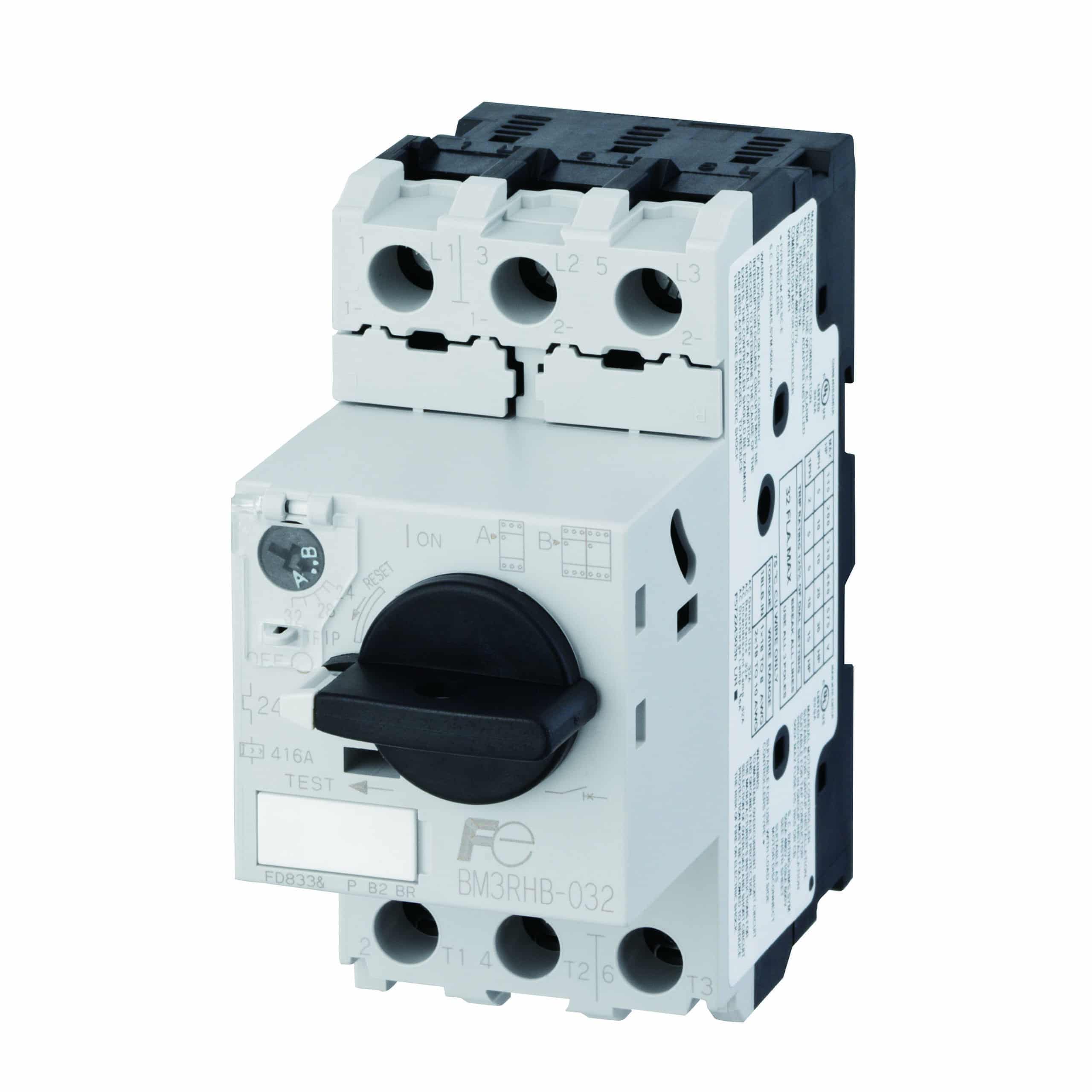
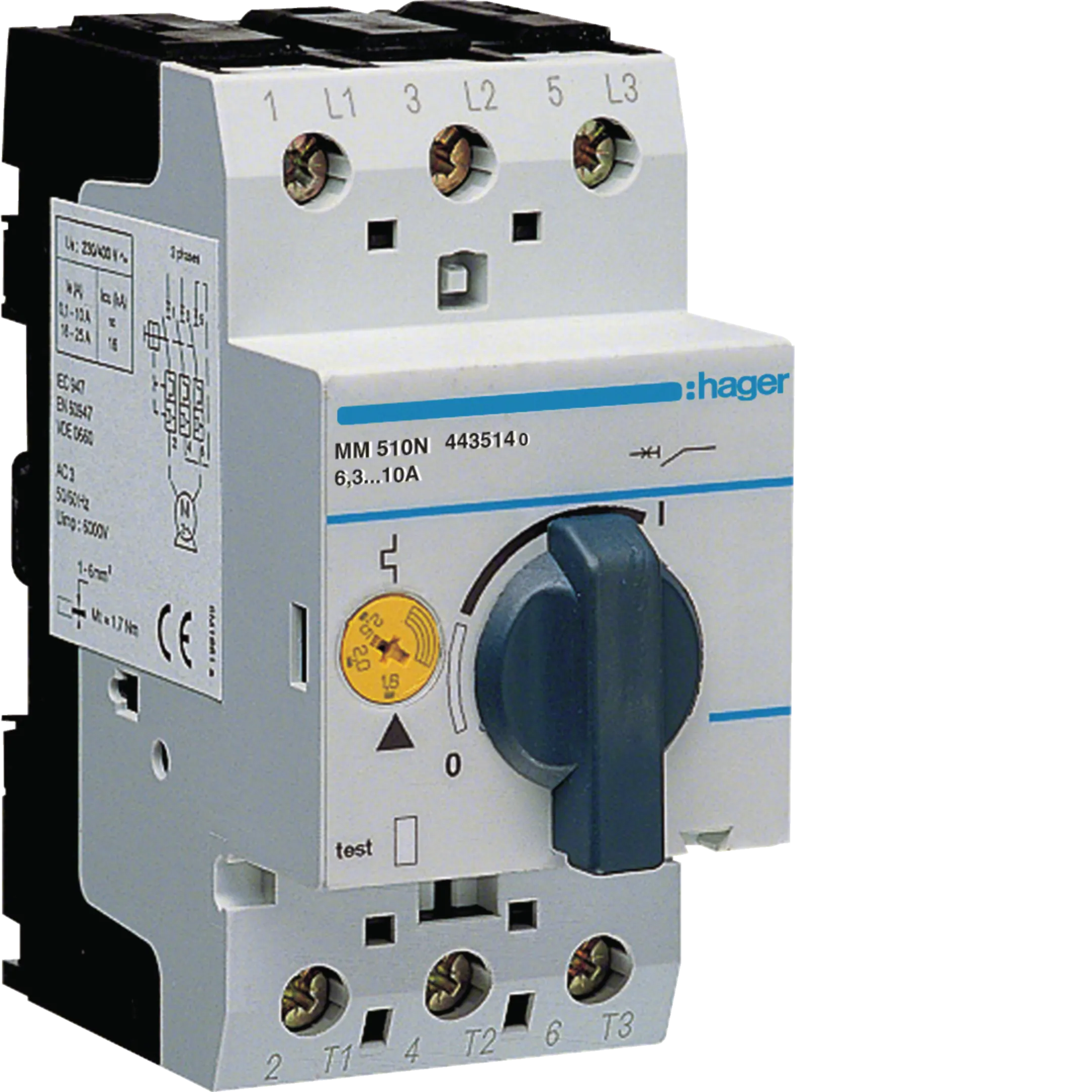
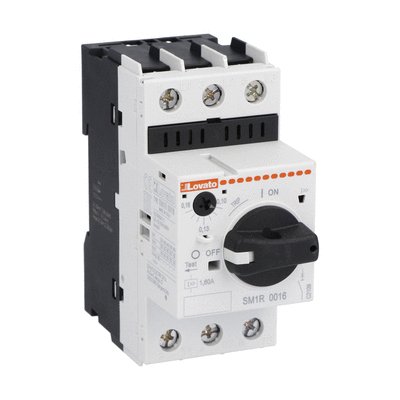
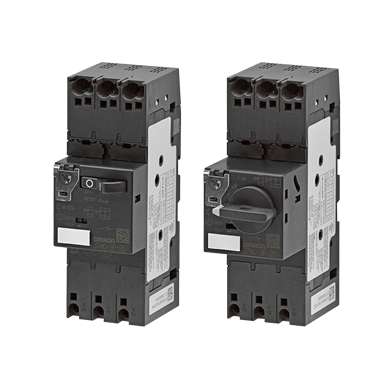
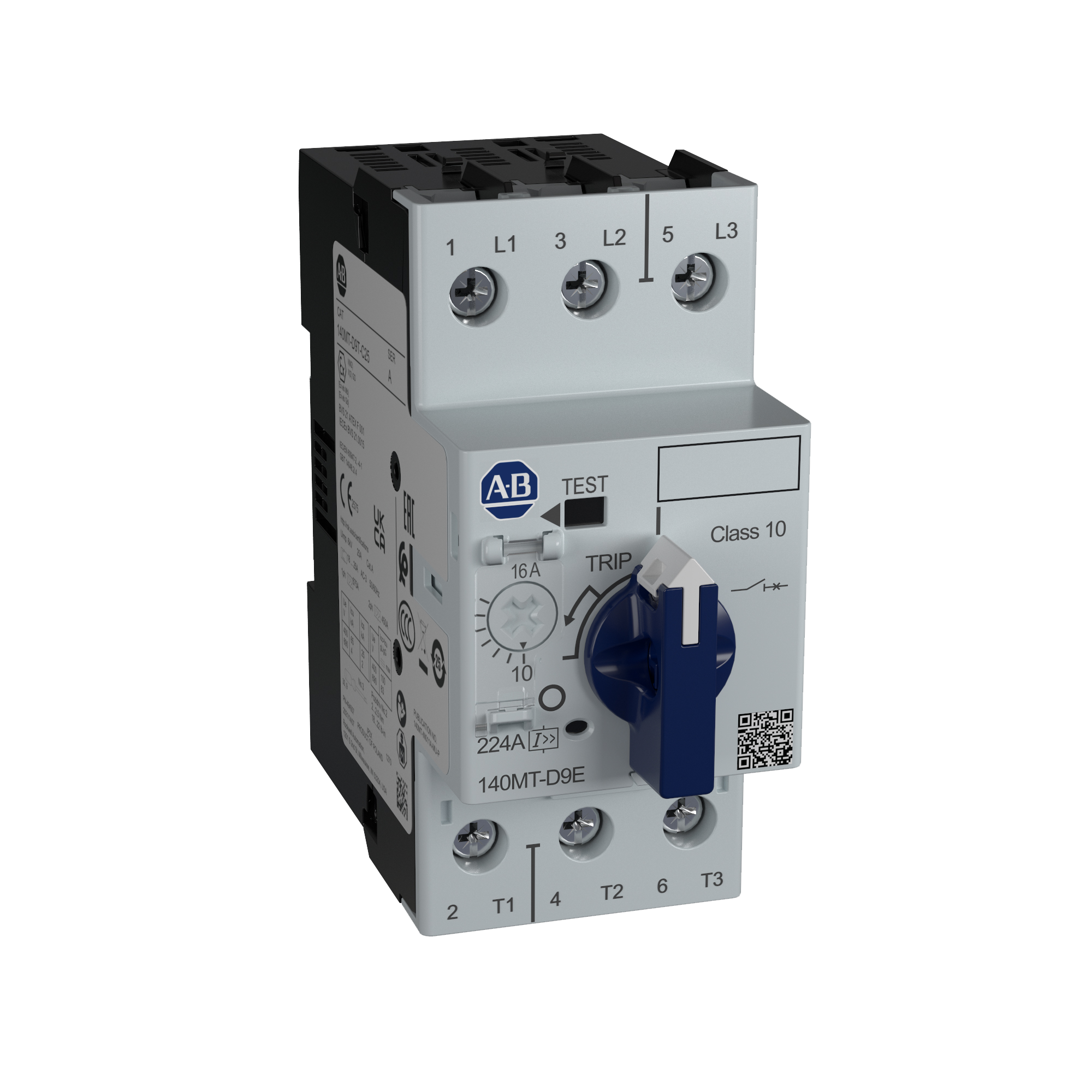
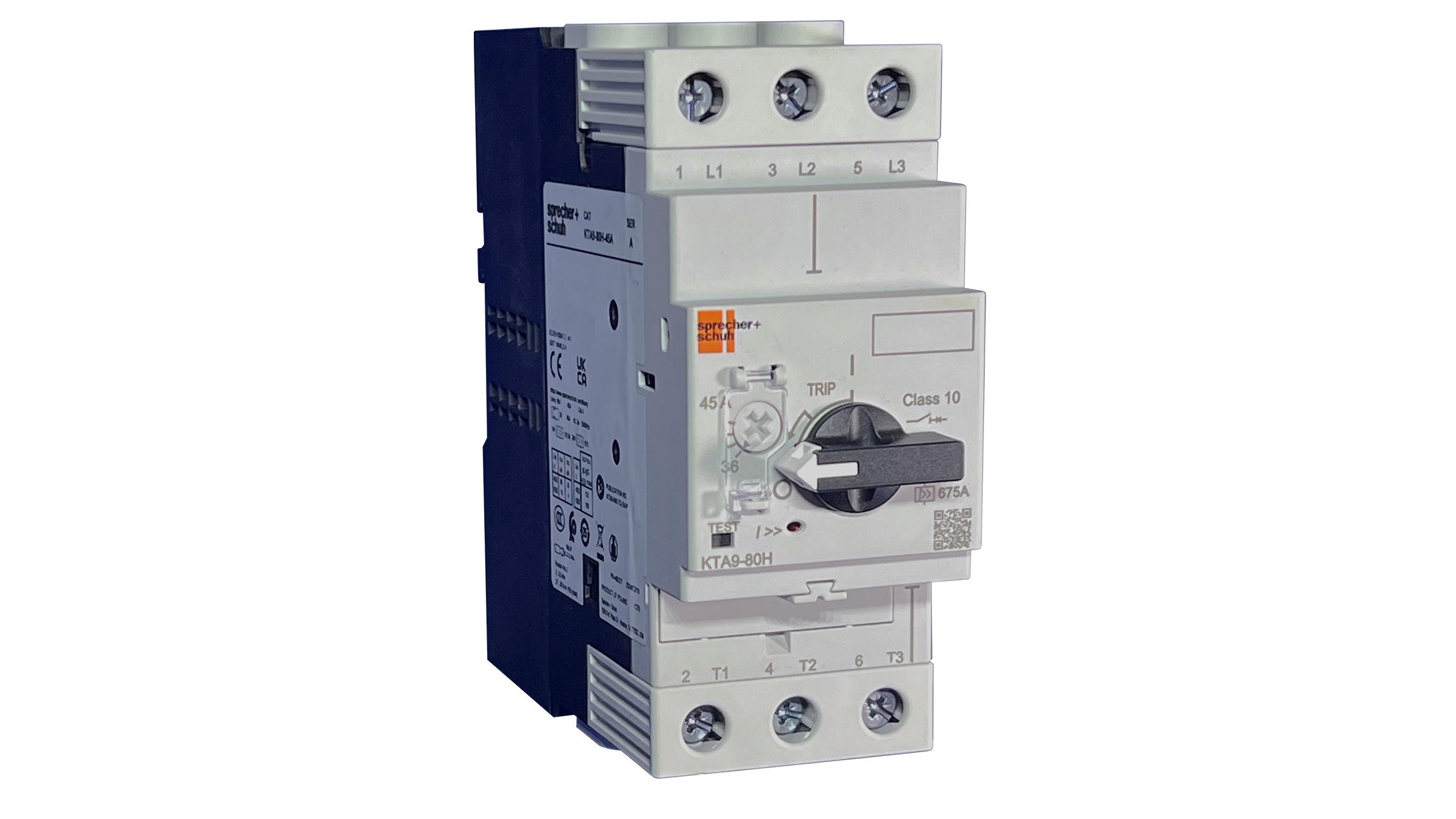
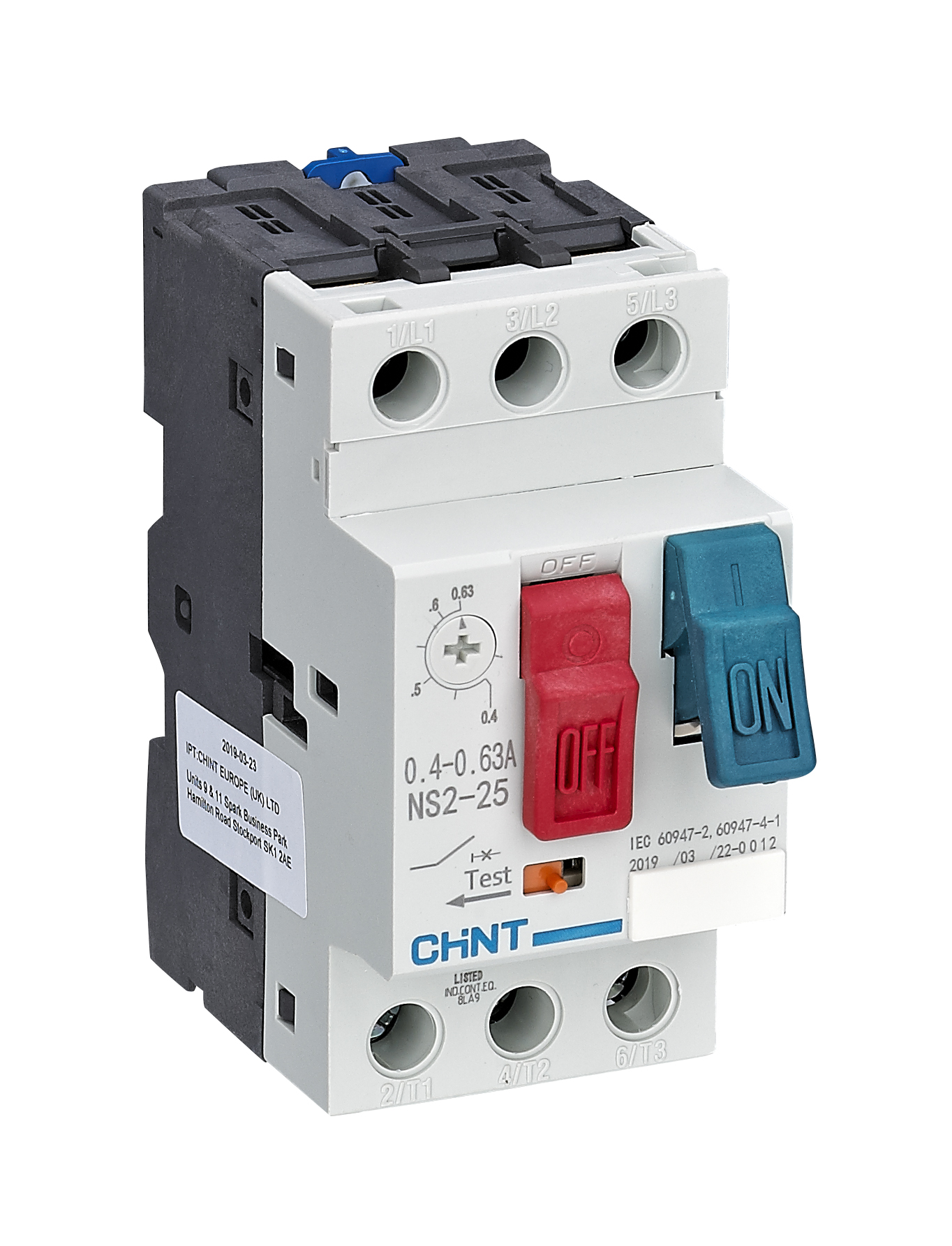
A motor protector is a device that disconnects an electric motor before abnormal current or temperature destroys the winding insulation. The category spans bimetallic thermal overload relays, motor protection circuit breakers (MPCBs), solid-state electronic overload relays, multifunction motor protection relays, and thermistor or RTD sensors embedded inside the windings. They share one job: model the heat building up in the motor and trip in time, while tolerating the 6 to 8 times inrush current of a normal start.
Unlike a general purpose circuit breaker, which is sized to protect the cable, a motor protector is matched to the thermal damage curve of the motor it serves. That distinction, set by standards such as IEC 60947-4-1, IEC 60034-11, and the trip class system, is the foundation of every selection decision covered in this guide.
Photo: Sarah Adrita, CC BY-SA 4.0, via Wikimedia Commons
This guide is written for procurement engineers and design engineers specifying motor protection for low-voltage and medium-voltage drives. Across 6 chapters it covers what a motor protector is, the main device classes, the protection technologies, the standards and coordination rules, the spec-sheet parameters that drive selection, and a step-by-step decision sequence, closing with 7 selection FAQs. All parameters reference the public standards IEC 60947-4-1, IEC 60034-11, IEC 60204-1, DIN 44081 and DIN 44082, and the IEEE/ANSI device-number system.
Chapter 1 / 06
What is a Motor Protector
A motor protector is a protective device whose purpose is to keep a motor inside its thermal and electrical safe operating envelope, disconnecting the supply before damage becomes permanent. The dominant failure mode of an induction motor is winding insulation breakdown caused by overheating, and heat in a conductor rises with the square of the current. A small sustained overload, say 120 percent of rated current, produces about 1.44 times normal losses, which over minutes pushes the winding past the insulation temperature limit. The motor protector exists to catch that condition before the insulation degrades.
The defining behaviour of a motor protector is its inverse time-current characteristic, which deliberately mimics the heating curve of the motor. A direct-on-line induction motor draws an inrush of typically 6 to 8 times its rated current for the first few seconds of every start. A protector tuned for cables would trip on that inrush, so a motor protector instead carries the inrush long enough for the motor to reach speed, then becomes progressively faster as the overload grows. This thermal memory, whether built from a physical bimetal or a firmware model, is what separates motor protection from ordinary overcurrent protection.
It helps to separate three things a motor protector is often confused with. A general circuit breaker protects the cable and is sized to the conductor ampacity, not the motor. A contactorswitches the motor on and off under load but provides no overload sensing on its own. A motor protector adds the thermal model and trip logic. In practice these are combined: the classic low-voltage motor starter is a contactor plus a thermal overload relay plus an upstream short-circuit device, a combination IEC calls a type 1 or type 2 coordinated starter. A motor protection circuit breaker folds the overload and short-circuit functions into a single switching device.
The industrial lineage is well documented. Bimetallic overload relays appeared in the 1920s and 1930s alongside the magnetic contactor and remain the workhorse for small and medium motors. The snap-action bimetallic thermal protector, widely known by the Klixon trade name from what is now Sensata Technologies, was developed for built-in protection of fractional and single-phase motors. Embedded PTC thermistor protection standardized under DIN 44081 and DIN 44082 spread through the 1970s and 1980s for larger motors. Microprocessor-based electronic overload relays and motor management systems arrived in the 1990s, adding unbalance, ground fault, and communication, and now coexist with the older technologies rather than replacing them.
The engineering stakes are concrete. A single-phasing event, where one supply phase opens while the motor runs, can burn out a three-phase winding in minutes because the two surviving phases overheat. A locked rotor draws starting current indefinitely with no cooling rotation, cooking the winding in seconds to minutes depending on size. Frequent starts accumulate heat faster than the motor can shed it. Each of these is a distinct protection requirement, and a complete motor protector is judged by how many of them it covers and how accurately it models the real winding temperature.
Chapter 2 / 06
Device Types and Classification
Motor protectors fall into five practical families, distinguished by where they sense (line current versus winding temperature), how they decide (physical bimetal, analog electronics, or microprocessor), and what protective functions they bundle. Choosing the wrong family is the most common specification error: fitting a plain thermal overload relay where the duty actually needs phase-loss and ground-fault detection, or fitting a full motor management relay on a small fan where a class 10 bimetallic relay would do. The table below summarizes the five families.
Family
Sensing Basis
Typical Functions
Common Rating Span
Relative Cost
Bimetallic overload relay
Line current, heated bimetal
Overload, differential phase loss
0.1 to 630 A
Low
Motor protection circuit breaker (MPCB)
Line current, thermal + magnetic
Overload, short circuit, isolation
0.1 to 100 A
Low to medium
Electronic overload relay
Line current, RMS, firmware model
Overload, unbalance, phase loss, ground fault, stall, jam
Bimetallic thermal overload relays are the most widely deployed motor protector. The line current passes through small heater coils that warm a bimetal strip; the strip bends and, at a calibrated point, snaps an auxiliary contact that drops out the contactor. Three-pole versions add a differential mechanism so that uneven bending across the three poles, the signature of a lost phase, accelerates the trip. They are self-powered, rugged, and inexpensive. Limitations are a fixed trip class, ambient temperature sensitivity (ambient-compensated designs correct for this within roughly minus 20 to plus 60 degrees C), and no inherent short-circuit interruption, so they must always sit behind a fuse or breaker.
Motor protection circuit breakers, also called manual motor starters or motor circuit protectors, combine an adjustable thermal bimetallic overload element with a fixed instantaneous magnetic short-circuit release in one switching device with manual on-off and isolation. The magnetic release is typically factory-set near 13 times the upper current setting, above the worst-case inrush but fast enough to clear a fault. Setting ranges step from fractions of an ampere up to about 100 A in the largest low-voltage frames. Representative series include Schneider TeSys GV2, GV3 and GV4, ABB MS116, MS132 and MS165, Siemens SIRIUS 3RV2, and Eaton PKZM.
Electronic (solid-state) overload relays read true RMS current through internal current transformers and run a digital thermal model. Because the model is computed rather than physical, accuracy is far less ambient-dependent, and the same unit can offer a wide, dial-free current range and a selectable trip class. They add the protections a bimetal cannot: current unbalance, true phase loss, ground fault, stall during start, jam during run, and underload. Many provide Modbus or fieldbus output for diagnostics. Examples include Schneider TeSys T, ABB UMC100, Siemens SIMOCODE pro, Eaton C440, and Rockwell Allen-Bradley E300.
Dedicated motor protection relays sit at the top of the range, scaling with external current transformers to protect large low-voltage and medium-voltage motors. They implement the full IEEE/ANSI device set, log every trip and start, and integrate into substation automation. Examples include Schneider SEPAM and Easergy P3, ABB REM615, SEL-710, and GE Multilin 369. Embedded thermistor and RTD protection is a different axis entirely: PTC thermistor chains (DIN 44081 and DIN 44082) or PT100 RTDs buried in the winding measure real temperature, feeding a simple trip relay or an analog input. Because it senses temperature directly, it catches heating that current sensing cannot see, such as blocked cooling or high ambient.
Chapter 3 / 06
Protection Technologies and Functions
Beneath the device families sit the individual protective functions, each addressing a specific failure mode. A useful way to specify a motor protector is to list the functions the duty requires, then choose the cheapest family that covers them all. The IEEE/ANSI device-number system gives each function a standard code that appears on relay datasheets and single-line drawings. The table below maps the core functions to their ANSI codes and to the device family that typically provides them.
Protective Function
ANSI Code
Failure Mode Addressed
Typical Provider
Thermal overload
49
Sustained over-current heating
All families
Instantaneous overcurrent (short circuit)
50
Winding or cable fault
MPCB, relay + breaker
Time overcurrent
51
Locked rotor, stall
Electronic, management relay
Phase unbalance / negative sequence
46
Voltage unbalance, single-phasing
Electronic, management relay
Ground / earth fault
50G / 51G
Insulation breakdown to earth
Electronic, management relay
Undercurrent / underload
37
Dry-run pump, broken belt
Electronic, management relay
Over-temperature (RTD / thermistor)
49 / 38
Blocked cooling, high ambient
Embedded sensor + relay
Thermal overload (49) is the irreducible core function. In a bimetal it is the heated strip; in an electronic relay it is an I-squared-t algorithm that integrates measured current against a thermal capacity, holding a thermal memory so a hot restart trips sooner than a cold one. The algorithm references the programmed full-load current and the selected trip class, and reproduces the inverse-time curve the standard defines.
Short-circuit protection (50) is a separate, much faster job. A thermal overload relay cannot interrupt a short circuit; it relies on an upstream fuse or breaker, and the pairing must be coordinated so the back-up device clears the fault without destroying the relay. An MPCB integrates this magnetic release internally, typically tripping above 13 times rated current within milliseconds, which is why an MPCB plus contactor can form a complete starter.
Phase unbalance and phase loss (46) protect against the single most destructive everyday fault. When supply becomes unbalanced or one phase opens, negative-sequence current induces double-frequency heating in the rotor, and on a running motor the surviving phases can carry 1.7 to 2 times normal current. Three-pole bimetallic relays use a differential linkage to react faster than a plain overload; electronic relays measure the unbalance directly and typically trip when current unbalance exceeds about 30 to 40 percent for a set delay.
Ground fault (50G / 51G), underload (37), stall and jam round out the electronic suite. Ground-fault sensing trips on the residual (vector sum) of the phase currents, catching insulation breakdown early before it escalates to a phase fault. Underload protection guards pumps against dry running and conveyors against broken belts by tripping when current falls below a floor. Stall protection trips if starting current persists past the expected acceleration time; jam protection trips on a sudden run-time current spike. Direct temperature protection via embedded PTC thermistors or PT100 RTDs is the only function that measures the real winding temperature rather than inferring it, and is therefore the recommended backup for inverter-fed and frequently started motors where current alone underestimates heating.
Chapter 4 / 06
Standards, Trip Classes and Coordination
Motor protection is one of the more heavily standardized corners of low-voltage engineering, which is good news for the buyer: the trip behaviour, the embedded-sensor response, and the coordination rules are all defined in public documents, so two compliant devices from different makers behave comparably. The governing standards are IEC 60947-4-1 for contactors and motor starters (including overload relay trip classes), IEC 60204-1 for the safety of machinery electrical equipment, IEC 60034-11 for thermal protection built into the machine, and DIN 44081 with DIN 44082 for the PTC thermistors themselves. UL 60947-4-1 mirrors the IEC starter standard for the North American market.
The trip class is the single most important number on an overload relay or MPCB datasheet. Under IEC 60947-4-1 the trip class is the maximum time, in seconds, that the device may take to trip when carrying 7.2 times its set current Ir, starting from a cold (ambient, about 40 degrees C) state. The class number is literally that time ceiling. The table below lists the standard classes, their trip ceiling at 7.2x, and the motor duty each suits.
Trip Class
Max Trip Time at 7.2x Ir (cold)
Typical Start Time
Suited Motor Duty
Class 5
≤ 5 s
< 4 s
Light, fast-starting loads
Class 10A
≤ 10 s
< 8 s
Normal duty, hot-restart sensitive
Class 10
≤ 10 s
< 8 s
Normal duty pumps and fans
Class 20
≤ 20 s
8 to 15 s
Heavy duty conveyors, compressors
Class 30
≤ 30 s
15 to 25 s
High inertia centrifuges, large fans
The rule is simple: the trip class must be longer than the motor start time but no longer than necessary, because excess class delays response to a real overload. Class 10 or 10A covers the great majority of pumps and fans. Class 20 suits loaded conveyors and reciprocating compressors. Class 30 is reserved for genuinely high-inertia loads. Class 10A is a refinement of class 10 that adds a defined hot-state requirement, making it preferable where the motor restarts while still warm.
Type 1 and type 2 coordination describe how a starter survives a short circuit. Under IEC 60947-4-1, type 1 coordination permits damage to the contactor and overload relay after a fault, provided there is no danger to persons or surroundings; the devices may need replacement. Type 2 coordination requires that, after clearing a short circuit, the overload relay and contactor remain serviceable with at most light contact welding that can be separated. Type 2 demands a verified combination of breaker or fuse, contactor, and overload relay, which manufacturers publish in coordination tables. For critical processes, specify type 2.
Embedded thermal protection is governed by IEC 60034-11, which classifies built-in temperature protection and references the PTC thermistor response. The thermistors themselves follow DIN 44081 (single sensor) and DIN 44082 (three sensors in series for the three phases), which fix the resistance-temperature curve: a low, near-flat resistance below the rated response temperature that rises sharply (to several kilo-ohms) within a narrow band around it. The response temperature is matched to the winding insulation class, with common values such as 130, 150, and 160 degrees C, leaving margin below the insulation limit. A dedicated thermistor trip relay reads the chain and drops the contactor when the resistance crosses the threshold, providing temperature-true protection independent of the current-based path.
Chapter 5 / 06
Key Specification Parameters
Reading a motor protector datasheet is a core procurement skill. A given overload relay or MPCB may list dozens of entries, but only a handful actually drive the selection. The Key Specifications comparison below contrasts the three current-based device families on the parameters that matter most, followed by an explanation of each.
Parameter
Bimetallic Relay
MPCB
Electronic Relay
Current setting range ratio
~1.5 : 1
~1.5 : 1
up to ~5 : 1
Trip class options
10A or 10 or 20 (fixed)
10 or 10A (fixed)
5 to 30 (selectable)
Short-circuit release
None (needs back-up)
Magnetic, ~13x Ir
None (needs back-up)
Ambient compensation
-20 to +60 °C
-20 to +60 °C
RMS, wide range
Phase-loss / unbalance
Differential only
Differential only
Measured directly
Ground fault
No
No
Yes (residual)
Communication
None
None
Modbus / fieldbus
Control power needed
No (self-powered)
No
Usually yes
Current setting range and ratio. The single most important match is the dial range against the motor full-load current. Bimetallic relays and MPCBs typically span a narrow band (for example 9 to 13 A or 17 to 23 A), so the catalog is a ladder of overlapping frames, and the FLA must land near the middle of a frame, never at an extreme. Electronic relays cover a much wider ratio, often up to 5 to 1, so one part number serves many motor sizes, which simplifies spares.
Trip class. As covered in Chapter 4, this is the trip-time ceiling at 7.2x Ir. Bimetallic relays and MPCBs ship at a fixed class (commonly 10 or 10A); some MPCB ranges offer a class 20 variant. Electronic relays let the user select the class in firmware, which is valuable when the same hardware must protect both quick-starting fans and slow high-inertia loads.
Short-circuit handling and breaking capacity. A plain overload relay has no interrupting rating and must be coordinated behind a fuse or breaker. An MPCB carries its own rated ultimate short-circuit breaking capacity (Icu) and rated service short-circuit breaking capacity (Ics) at a given voltage, for example tens of kiloamperes at 400 V, and may extend higher with a back-up fuse. Always check that the device Icu meets or exceeds the prospective short-circuit current at the installation point.
Reset mode, ambient rating, and the protective functions table. Reset can be manual (deliberate operator action, preferred where an unexpected restart is hazardous) or automatic (the relay re-arms after cooling). The ambient compensation range states the temperatures over which the trip point stays accurate; outside it, bimetal trip points drift. Beyond these, the function list (phase loss, ground fault, unbalance, stall, jam, underload) and the presence of a communication port (Modbus RTU, PROFIBUS, PROFINET, EtherNet/IP) determine whether the device suits a simple starter or a monitored smart-factory drive. Embedded thermistor relays add their own parameters: number of sensors in the chain (typically 3 or 6), rated response temperature, and the resistance thresholds for trip and reset per DIN 44081 and DIN 44082.
Chapter 6 / 06
Selection Decision Factors
To turn the preceding chapters into a specific part number, work the decision sequence below in order. Most selection mistakes are not a single wrong value but a decision taken at the wrong level, for example fixing on a brand before confirming the motor full-load current and start time. These eight steps double as an RFQ template.
Motor data first: read the nameplate for full-load current (FLA), service factor, rated voltage, number of phases, and insulation class. Every downstream choice references the FLA, never the cable size or the breaker rating.
Start profile and trip class: establish the acceleration time and inertia of the driven load, then pick the trip class that exceeds the start time with margin but no more (class 10 or 10A for normal pumps and fans, class 20 for loaded conveyors and compressors, class 30 for high inertia loads).
Device family: choose the cheapest family that covers the required functions. A class 10 bimetallic relay or MPCB suffices for a simple non-critical motor; add an electronic relay where phase-loss, ground-fault, or stall protection is needed; choose a management relay for large or process-critical motors; add an embedded thermistor chain where current sensing cannot see the real heating.
Current setting range: select the frame whose dial range places the FLA near mid-scale. For service factor 1.0 set at 100 percent of FLA; for service factor 1.15 a setting up to 115 to 125 percent is generally permitted by code. Avoid the range extremes.
Short-circuit coordination: confirm the prospective short-circuit current at the installation point, then specify either an MPCB with adequate Icu or a coordinated fuse / breaker plus relay combination. For critical processes require IEC 60947-4-1 type 2 coordination from the manufacturer table.
Reset mode and mounting: choose manual reset where an automatic restart would be hazardous (conveyors, hoists), automatic reset for unattended remote pumps. Confirm DIN-rail or contactor-mount form factor, terminal type, and panel space.
Environment and certification: verify ambient temperature range, vibration, and enclosure rating; for hazardous areas confirm ATEX or IECEx certification of the complete starter, and check regional approvals (UL / CSA for North America, CCC for China).
Communication and total cost of ownership: decide whether Modbus, PROFINET, or EtherNet/IP reporting is required for the asset management strategy, then weigh purchase price against avoided downtime. A burned-out motor and lost production usually dwarf the price gap between a basic relay and an electronic one on a critical drive.
One dimension that buyers consistently underrate is serviceability and spares strategy. A wide-range electronic relay can replace a whole ladder of fixed bimetallic frames, cutting spare-part inventory dramatically; a management relay logs every trip so the maintenance team can find the root cause rather than just resetting. Local availability of replacement units, the maker's coordination tables, and firmware or configuration tools all shape repair response time across a 10 to 20 year service life. Schneider Electric, ABB, Siemens, Eaton, and Rockwell Automation all maintain broad distribution and documented coordination tables, which is why they dominate specifications for large projects.
FAQ
What is the difference between a motor protector and a circuit breaker?
A standard circuit breaker protects the cable against short circuit and gross overcurrent, sized to the conductor ampacity. A motor protector protects the motor itself: it tracks the thermal accumulation in the windings using a time-current model so it tolerates the 6 to 8 times inrush during starting but trips on a sustained 110 to 120 percent overload that a cable breaker would ignore. A motor protection circuit breaker (MPCB) combines both functions in one device, adding an adjustable thermal element plus a fixed magnetic short-circuit release, typically set at 13 times the rated current. The thermal overload relay alone has no short-circuit interrupting capability and must always be paired with an upstream fuse or breaker for back-up protection.
What does trip class 10, 20, or 30 mean?
Trip class under IEC 60947-4-1 is the maximum time in seconds that the device takes to trip when carrying 7.2 times the set current Ir from a cold state. Class 10 trips within 10 seconds, class 20 within 20 seconds, class 30 within 30 seconds, and class 5 within 5 seconds. The standard also defines class 10A, which adds a hot-state requirement (trip within 2 hours at 1.05x and the same 10 second ceiling at 7.2x). Class 10 or 10A suits normal duty motors such as pumps and fans that reach speed in a few seconds. Class 20 suits heavy duty loads such as loaded conveyors and crushers. Class 30 covers high inertia loads such as large centrifuges that take 20 seconds or more to accelerate.
How do I set the overload relay current dial?
Set the dial to the motor full load current (FLA) stamped on the nameplate, not to the breaker rating or the cable size. For a service factor 1.0 motor, set at 100 percent of FLA. For a service factor 1.15 motor, NEC and many local codes allow setting at up to 115 to 125 percent of FLA. Confirm the dial covers the FLA near the middle of its range, never at the extreme top or bottom, because accuracy degrades at the range ends. After commissioning, measure the actual running current with a clamp meter and verify it sits comfortably below the set point. If the motor nuisance-trips during normal starting, check the trip class before raising the current dial.
What is the difference between bimetallic and electronic overload relays?
A bimetallic relay heats a bimetal strip with the motor current; the strip bends and trips a contact at a calibrated temperature. It is rugged, self-powered, and inexpensive, but its trip point drifts with ambient temperature (ambient-compensated versions correct for this) and it offers only thermal overload and, on three-pole units, differential phase-loss sensing. An electronic (solid-state) relay measures true RMS current with current transformers and computes a thermal model in firmware. It holds accuracy across a wide ambient range, adds phase unbalance, phase loss, ground fault, stall, jam, and underload protection, and reports data over Modbus or a fieldbus. Electronic units cost more and need control power, but they reduce nuisance trips and enable predictive maintenance.
How does embedded PTC thermistor protection differ from current-based protection?
Current-based protection (overload relay or MPCB) infers winding temperature from the line current, so it cannot see heating that does not show up as current, such as blocked ventilation, high ambient temperature, or a failed cooling fan. Embedded PTC thermistors (to DIN 44081 and DIN 44082, evaluated under IEC 60034-11) sit inside the winding and measure the real temperature. At the rated response temperature the PTC resistance jumps sharply, and a trip relay reacts. PTC chains protect against the thermal causes that current sensing misses, which makes them essential for inverter-fed motors at low speed (reduced self-cooling) and for frequent start-stop duty. Best practice combines both: a current-based relay for fast overload and short-circuit response, plus a PTC chain for true thermal backup.
Why is phase loss so destructive to a three-phase motor?
When one of three supply phases is lost, a running motor keeps turning on the remaining two phases, but the current in those two windings rises to roughly 1.7 to 2 times normal to deliver the same torque. The lost-phase winding draws no current, so a single-element sensor may not notice, yet the two energized windings overheat within minutes. The negative-sequence component also induces double-frequency rotor heating. A three-pole bimetallic relay with differential phase-loss linkage trips faster than a plain overload would, and an electronic relay detects the unbalance directly, typically tripping when current unbalance exceeds 30 to 40 percent for a few seconds. Single-phasing is one of the most common causes of burned-out three-phase motors, which is why dedicated phase-loss protection is mandatory on critical drives.
Which manufacturers and series are common for motor protection devices?
For thermal overload relays and MPCBs the mainstream brands are Schneider Electric (TeSys Deca LRD relays and GV2, GV3, GV4 motor circuit breakers), ABB (TF and TA overload relays, MS116, MS132, MS165 manual motor starters), Siemens (3RU2 overload relays and 3RV2 motor starter protectors), Eaton (XT and PKZM ranges), and Rockwell Automation Allen-Bradley (E1 Plus, E300). For electronic motor management Schneider TeSys T, ABB UMC100, Siemens SIMOCODE pro, and Eaton C440 are common. For dedicated multifunction motor protection relays serving medium-voltage and large LV motors, look at Schneider SEPAM and Easergy P3, ABB REM615, SEL-710, and GE Multilin 369. Embedded thermistor relays are supplied by ABB (CM-MSS), Schneider, Siemens (3RN2), and many sensor specialists.
Motor Protector Manufacturers
Source-backed product routes. Open a company dossier for procurement scope and cited evidence.