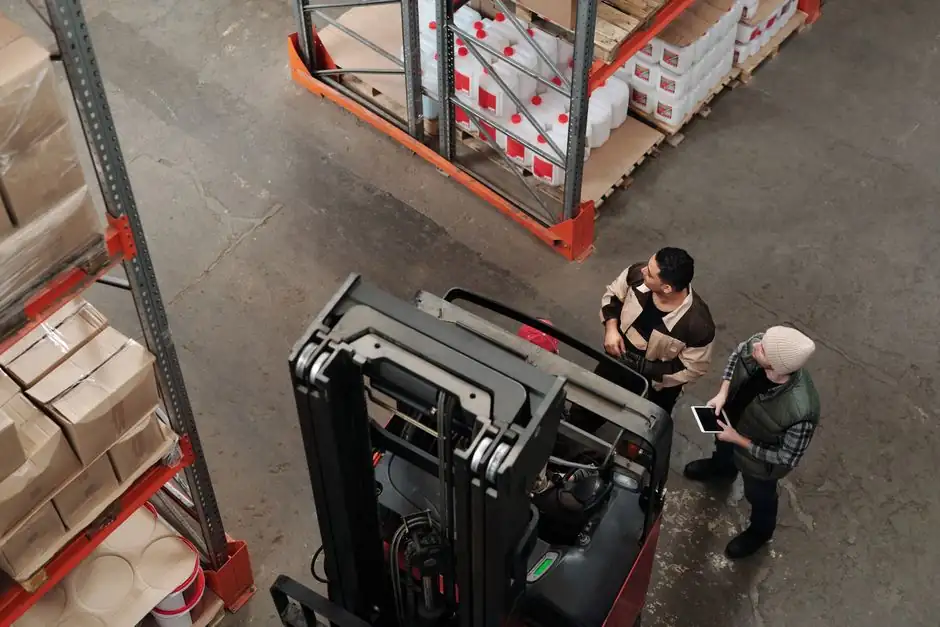
A rough terrain forklift with a fixed vertical mast lifts straight up only, while a telescopic-reach rough terrain telehandler lifts up and forward over obstacles [S1][S2]. The mast forklift typically tops out near 10 to 20 ft, whereas many telehandlers reach 40 to 55 ft, with some models going higher [S4].
OSHA groups both machines into Powered Industrial Truck Class VII ("rough terrain forklift trucks"), splitting Class VII into vertical-mast types and variable-reach types, the latter being what the industry calls telehandlers [S5]. The choice is mechanical, not semantic: mast rigidity versus boom articulation, with capacity-at-distance as the deciding trade-off.
Mast vs Boom Architecture: Why the Geometry Forces the Job
A single-stage forklift mast is a set of fixed vertical beams with no telescopic structure, giving high rigidity but zero forward reach, while multi-stage masts add nested channels that let the carriage climb higher without changing the lift axis [S7]. A telehandler replaces that mast with a single boom pivoting from a turret at the front of the chassis, with a telescoping section that extends along the boom's axis, which is why the load can travel in an arc up and over a gap rather than straight up [S1][S4].
Because the fixed mast carries the load only along its vertical axis, the truck's stability comes from the rear counterweight acting through a short wheelbase, which keeps the lift capacity essentially flat from floor to top of mast. The telescopic boom changes the load's lever arm with every inch of extension, so capacity falls as reach grows, and the operator must read a per-position load chart rather than a single number [S4][S6].
Decision Criteria: Where Each Machine Wins
On flat, repetitive pallet cycles the fixed-mast rough terrain forklift keeps full rated capacity at every lift height and runs a tighter turning radius because the load stays close to the front axle [S4][S5]. On a construction site where the boom has to reach over a trench, place a bundle on a second-story deck, or feed a mason's scaffold, only the telescopic reach machine can physically put the load where the work is [S1][S5].
For terrain alone, both classes qualify as Class VII and use pneumatic tires with four-wheel drive, but mast forklifts are favored for inside-and-outside post-construction material movement on the finished pad, while telehandlers dominate the open, unfinished site during the build phase [S5]. A practical boundary: if any lift requires horizontal travel of the load greater than about 1 m beyond the front tire line, a fixed-mast unit is the wrong tool [S1][S2].
Capacity, Reach, and the Load-Chart Reality
Mast forklifts deliver a single rated capacity that holds across the full lift envelope because the load center stays a constant distance from the truck's stability line, a behavior that simplifies operator training and load-securement paperwork [S4]. Telehandler capacity is a stepped function: maximum at low lift and short boom extension, dropping as the boom elevates and extends, and dropping again as the load center moves outboard [S4][S6].
For a like-for-like comparison, a typical rough terrain mast forklift on 4WD pneumatics will lift roughly 2,500 to 6,000 lb at its full 10 to 20 ft mast height, while a comparably sized telehandler in the same Class VII envelope will lift 5,000 to 12,000 lb at low height but may drop to half that at full 40 to 55 ft extension [S4]. Buyers should compare the load chart at the worst-case radius the job actually requires, not the headline number on the nameplate [S6].
Attachments, Footprint, and Site Logistics
Telehandlers accept buckets, grapples, truss jibs, lifting hooks, and work platforms, turning one carrier into a loader, crane, and aerial platform, which is why a varied site often runs a single telehandler instead of three specialized machines [S4]. Fixed-mast rough terrain forklifts accept forks, side-shifters, and limited carriage options, with the use case staying close to palletized loads on uneven ground [S1][S5].
Footprint and turning radius are similar between the two classes because both ride on comparable rough-terrain chassis, but the telehandler trades a slightly longer front overhang for the boom cradle and turret [S5]. On congested yards, that extra nose length is the second hidden cost after the load-chart drop, and it is the reason some fleets keep a small mast forklift as a chase truck even after buying a telehandler as the primary lift [S2][S6].
Cost, Training, and Compliance Footprint
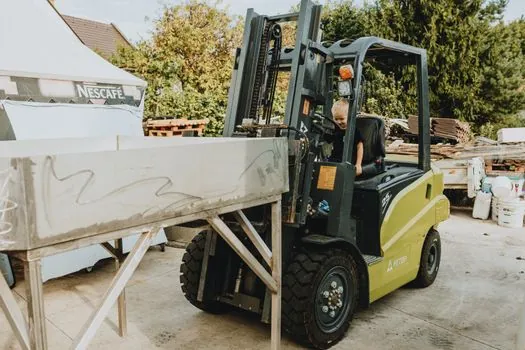
Fixed-mast units are mechanically simpler: no boom lubrication system, no outrigger sequencing, no load-moment indicator with per-radius calibration, which lowers purchase price, daily rental, and routine service cost [S4][S6]. Telehandlers add the load-moment system, two-stage or three-stage boom hydraulics, and often a frame-leveling system, all of which require operator certification that goes beyond standard Class I-VI forklift training.
Because OSHA treats both as Class VII, basic operator training follows the same powered industrial truck framework, but site-specific telehandler training covering load-chart reading and outrigger deployment is normally required for variable-reach units and is typically not required for a fixed-mast rough terrain forklift [S5]. For a buyer comparing total operating cost, factor in the higher training hours and the higher insurance line item that usually travel with the boom machine, not just the rental rate [S6].
Where Mast and Boom Overlap, and Where They Don't
The two classes overlap on rough, unpaved ground with palletized loads under about 20 ft of lift, and on that overlap zone the fixed-mast machine usually wins on cycle time, capacity retention, and rental cost [S2][S5]. They diverge once the lift requires any forward reach over a barrier, any height above roughly 20 ft, or any non-fork attachment such as a bucket or work platform [S1][S4][S6].
Rotating telehandlers, a sub-class of variable-reach machines, push the envelope further with slewing turrets that let the operator place loads around the machine rather than only in front of it, trading added weight and complexity for the ability to work inside a building footprint from a single set-up position [S3]. For most outdoor industrial sites, however, the choice collapses back to two questions: does the load need to travel forward, and does the load need to travel above 20 ft, and the fixed-mast machine answers "no" to both [S1][S4]. For a deeper look at how lift-height decisions intersect with working reach on adjacent equipment, see pick aluminum ladder height by working reach, not by ladder length. The mast-vs-boom trade-off also mirrors the same reach-versus-capacity logic that shows up when sizing hydraulic motors for swinging attachments, covered in gerotor vs vane vs piston hydraulic motor: design tradeoffs and selection.
Track the next fleet-purchase cycle for two signals: whether telematics packages on new Class VII machines start logging per-radius load events as structured data, and whether rental fleets publish load charts as machine-readable files rather than PDF placards; both would compress the spec-to-job matching time on rough terrain sites [S4][S6].
Detailed specification references: rough terrain forklift, reach truck, and fixed gas detector.