
FHWA Class 6 covers three-axle single-unit trucks, while Class 7 covers single-unit trucks on four or more axles in contact with the road [S1][S5]. For a dump truck, the classification flips the moment a tag or pushdown axle is lowered at the job site, which is why weigh-in-motion and WIM-based class counters see so much Class 7 dump traffic in aggregate [S2].
Gross vehicle weight rating (GVWR) is a separate, EPA-aligned scheme that splits the 19,500–26,000 lb band (Class 6) from 26,001–33,000 lb (Class 7), and the same physical truck can sit in either GVWR bucket depending on how the OEM rate it [S3][S10]. The FHWA 13-class scheme, by contrast, is purely a configuration and axle-count taxonomy and is what most state DOT classifiers actually use [S1].
Where the dividing line sits on a real dump truck
A tandem rear axle with a single steer axle is the textbook three-axle single-unit truck, and that is FHWA Class 6, with three axles total [S5]. Adding a non-steering front pusher axle, or a liftable tag axle behind the tandems, pushes the same truck into Class 7 the moment that auxiliary axle is in the down position and in contact with the road [S1][S5]. FHWA is explicit that floating, lift, drop, and tag axles only count when they are down, which is why a truck that registers as Class 6 empty can re-register as Class 7 loaded [S1][S5].
The most common Class 7 dump truck in the field is a single-axle steer, single pusher, tandem drive, plus a tag or belly axle, a six-axle single-trailer combination once a trailer is attached [S2]. The four-axle single-unit dump truck, steer-tandem-tandem or steer-tandem with a single tag, is the lower bound of Class 7 and is the configuration most city and county public-works fleets run for street and utility work, as detailed in the dump truck classification reference.
GVWR band vs FHWA class: two schemes, same truck
EPA's eight-class GVWR scheme places medium-duty in Class 3-6 and heavy-duty in Class 7-8; AFDC aggregates this as Light Duty (Class 1-2), Medium Duty (Class 3-6), Heavy Duty (Class 7-8) [S3]. UTI's March 2026 guide lists Class 7 at 26,001-33,000 lb GVWR and notes that most Class 7 vehicles carry three or more axles [S10]. That word "most" is the trap: the EPA GVWR band is a weight rating, not an axle count, and Class 7 GVWR trucks can be either three-axle or four-plus-axle single-units.
For fleet spec work, the practical rule is to look up both numbers. A 33,000 lb GVWR three-axle dump truck is a Class 6 in FHWA's axle-count scheme but a Class 7 in the EPA weight scheme; a 26,001 lb GVWR four-axle dump truck is FHWA Class 7 but EPA Class 6. The two systems are not interchangeable and procurement language should always name which one is being used [S3][S10].
Why the 13-class scheme splits Class 6 and Class 7 at three axles
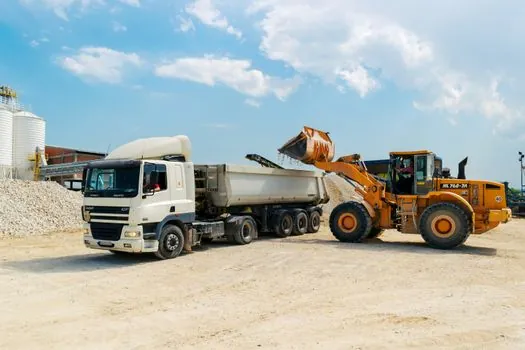
FHWA's 13-class taxonomy was built for pavement and bridge design, where axle load and axle spacing govern fatigue damage, and where a third axle changes the load distribution curve enough to warrant a separate ESAL calculation [S2]. Classes 4 through 7 cover buses and single-unit trucks, and within that group Class 6 is the three-axle single-unit bucket while Class 7 is everything on a single frame with four or more axles [S5][S9].
This is also why the ORNL mapping of the 2002 VIUS to FHWA 13 classes treats three-axle and four-plus-axle single-units as distinct classes, and it is why camera-based AVC systems resolve trucks to the exact FHWA class once an axle count is available [S4][S8]. A four-axle mining dump truck with twin steer axles and twin drive axles, for example, is firmly Class 7 even though its loaded GVW can exceed any Class 7 GVWR ceiling; for those heavier off-highway configurations the mining dump truck reference documents the separate on/off-highway split.
Lift axles, tag axles, and the WIM-counting problem
Floating, lift, drop, and tag axles are only counted when in the down (engaged) position, per FHWA's TMG guidance [S1][S5]. On a typical Class 7-ready dump chassis the driver raises the tag when running empty to save tire wear and fuel, and lowers it when loaded to meet bridge-formula weight limits; the same physical truck then flips between Class 6 and Class 7 inside a single shift [S1][S2].
That behaviour breaks naive axle-based classifiers, which is why the TMG recommends that visual classification counts and axle-based counts be reconciled with operator logs [S1]. For long-haul dump-and-tow configurations, a three-axle dump truck pulling a non-liftable two-axle trailer, the combination is a Class 8 four-or-fewer-axle single-trailer truck, and the dump tractor alone, when uncoupled, reverts to FHWA Class 6 [S1][S5]. The handling of axles on heavy-haul tractor units pulling foundation, concrete, or lifting equipment is covered in the foundation vehicle, concrete vehicle, and lifting vehicle reference pages.
Selection criteria: which class fits which job
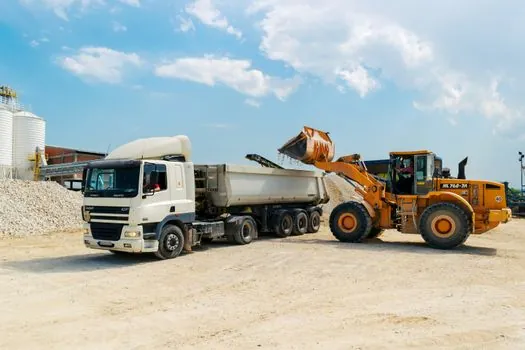
For street maintenance, utility trenching, and small-site aggregate haul, a three-axle single-unit dump (Class 6) is the default: 19,500-26,000 lb GVWR, one steer, one tandem, 6-9 yd body, and no tag axle to manage [S10]. For heavier municipal work, snow plowing, or any payload over the three-axle bridge-formula limit, a four-axle single-unit (Class 7) is required: 26,001-33,000 lb GVWR, steer-tandem-tandem or steer-pusher-tandem, with a tag or belly axle that is down under load [S10].
For construction sites needing 10-20 yd bodies on a single chassis, a four-or-five-axle Class 7 dump with a steerable pusher is standard. For quarry-to-crusher off-highway hauls, the on-road Class 7 chassis is not enough and operators move to purpose-built off-highway rigid haul trucks, mapped separately in the haulage access vehicle reference. The decision is governed by payload target, bridge-formula compliance, and whether the truck ever leaves the site road; a comparison of the common configurations against the four key criteria, axle count, GVWR band, typical body size, and bridge-formula posture, lines up as follows. Class 6 three-axle single-unit: 3 axles, 19,501-26,000 lb GVWR, 6-9 yd body, always under bridge formula without permit. Class 7 four-axle single-unit: 4 axles, 26,001-33,000 lb GVWR, 8-12 yd body, under bridge formula with tag down. Class 7 five-or-six-axle single-unit: 5-6 axles, often above 33,000 lb GVWR and into Class 8 weight, 12-20 yd body, requires permits in some states. The same chassis, same lift-axle layout, can slide between these rows depending on tag-axle position, so procurement language should pin both the FHWA class expected and the expected operating configuration.
For related cross-industry decision work, a bearing-steel cleanliness comparison and a PLC migration cutover map follow the same shape of problem: pick a class, document the criteria, and freeze the configuration in the spec.
Verification signals to track through 2026
Watch for any TMG revision in 2026 that tightens the lift-axle-counting rule, since the current language still leaves a gap between empty-axle and loaded-axle classification [S1]. Watch for state DOTs publishing Class 6 vs Class 7 distribution shifts in their annual traffic monitoring reports, since the pusher/tag-axle market is growing on new vocational chassis. Watch for camera-AVC vendors to publish Class 7 dump truck reclassification rates, as that is the field-level signal of how often lift axles are down at the classifier station [S8].