Flat belts and V-ribbed belts (also called poly-V or multi-rib belts) solve overlapping but distinct problems in industrial and automotive drive trains, and the 2026 component market still lists 91 ribbed-belt SKUs from 22 manufacturers on DirectIndustry alone [S1]. The selection call is driven by pulley diameter, speed ratio, torque density, and the geometry of the driven accessory cluster, not by which belt "looks modern."
Flat belts historically dominated low-cost line-shaft drives; V-ribbed belts — a hybrid that uses a flat elastomer backing as its tensile member carrier with longitudinal 40° trapezoidal ribs moulded across the contact face — have displaced flat belts wherever packaging, ratio flexibility, and compact idler geometry are required [S3][S4]. Buyers should treat the two as complements, not substitutes, and let the load/speed envelope pick the winner.
Construction, Profile Geometry and Material Stack
A V-ribbed belt is, by its own manufacturer description, a circular rubber transmission belt with a flat belt as the base and a longitudinal 40° trapezoidal wedge arranged on the contact face — explicitly marketed as combining "characters of V belt and flat belt": the soft, tough property of a flat belt with the tight, effective wedging of a V-belt [S3]. That 40° wedge is the working face; the flat backing carries the tension cords and provides the lateral flexibility a pure V-belt cannot match.
Standard compounds for both belt families in 2026 industrial sourcing are Neoprene (CR) and EPDM rubber; EPDM has effectively become the default heat-and-ozone-resistant compound for ribbed profile drives in washing machines, machine tools, and serpentine automotive auxiliaries, while CR is still offered where oil resistance or lower cost is the lead constraint [S4]. Tension members are typically polyester or aramid cords, with aramid specified where shock load or small-diameter pulleys demand lower elongation.
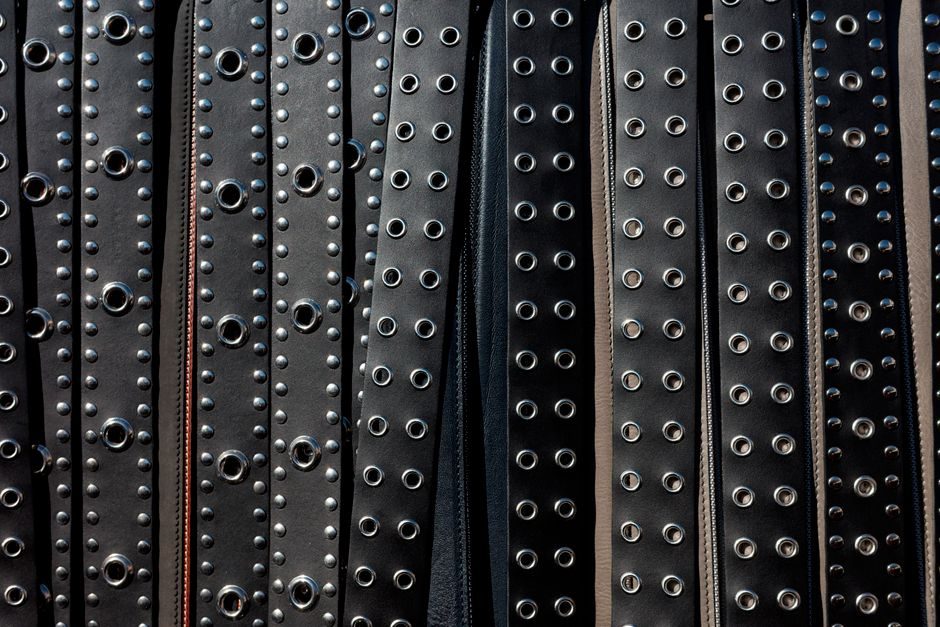
Flat-belt construction in industrial use still runs leather, polyurethane flat-cog, and rubber-coated fabric; a polyurethane flat belt with moulded teeth (a "flat-cog" or "cogged flat" belt) is a frequent choice where a true flat belt is needed but slip under start-up shock has to be suppressed. The buyer should not confuse a cogged flat belt with a V-ribbed belt — the contact face, the wedging action, and the pulley-groove requirement are different.
Load, Speed and Pulley-Diameter Envelopes
Flat belts can run on pulleys down to roughly 15-30 mm diameter at peripheral speeds above 30 m/s when the construction is a thin polyurethane flat-cog or a high-quality rubber flat belt; they tolerate misalignment better than V-ribbed belts because there is no groove to climb out of, but they slip under oil contamination and under transient torque peaks above their rated coefficient of friction. [S1]
V-ribbed belts are specified for compact serpentine drives with very small pulleys — typical 60 mm outer diameter and up — and for accessory clusters that require bending around idlers at tight radii. Real catalog data on 2026 replacement tensioners confirms typical ribbed-belt idler diameters in the 60-70 mm range: STC T405484 (Renault/Volvo) is 60 mm OD, TRISCAN 8641 113033 (BMW) is 70 mm OD x 26 mm width, and BREDA LORETT TOA3459 (Renault) is 65 mm diameter x 25.5 mm height [S2][S6]. Those dimensions map directly to the minimum bend radius the belt must survive, not to its load rating.
On torque density, a ribbed belt with 3-6 ribs (PK, PL, PM sections) typically transmits more power per unit width than a single V-belt of the same top width because the contact area is distributed across many small wedges; the trade-off is that the belt is now sensitive to misalignment and to rib-by-rib wear, so a worn ribbed belt is a scrapped belt rather than a re-tensioned one. Standard V-belt drive practice still applies where shock load, contamination, or large centre distances dominate — those are the cases where a flat belt or a classical V-belt is the cheaper, more forgiving choice.
Selection Criteria: Flat Belt vs V-Ribbed Belt

The decision reduces to four gates. A flat belt wins when: (1) the smallest pulley diameter is above the ribbed-belt minimum and speed is high, (2) misalignment of 1-2° is unavoidable, (3) the drive is a long-centre, low-horsepower line-shaft or conveyor, and (4) cost-per-metre is the dominant constraint. A V-ribbed belt wins when: (1) the drive is a compact serpentine with small idlers in the 55-75 mm OD band, (2) multiple driven accessories must be clutched together, (3) shock load is moderate and predictable, and (4) the operator wants the slip-resistance of a V-belt with the flexibility of a flat belt [S3][S4].
Failure modes are not symmetric. A flat belt fails by stretch, slip glazing, and edge fray; it usually gives audible warning. A V-ribbed belt fails by individual rib shear, backing cracking at small-diameter bends, and tensioner-pulley bearing wear; it can go from intact to snapped in one cycle if the belt tensioner has seized, which is why every ribbed-belt service kit on the 2026 aftermarket includes the tensioner and not just the belt [S5].
Sourcing Reality: 2026 Manufacturer and Distributor Map
DirectIndustry's 2026-06 snapshot lists 22 manufacturers and 91 SKUs in the ribbed-belt category, dominated by BANDO, GATES, HUTCHINSON Belt Drive Systems (6 SKUs), MEGADYNE (5 SKUs), and MITSUBOSHI, with BEHA Innovation (BEHAbelt), DEREMAUX, COLMANT CUVELIER, Keiper, KraussMaffei and EBI Bearings filling specialised niches [S1]. Aftermarket service parts run through a parallel channel: STC, MABYPARTS, TRISCAN, BREDA LORETT, RUVILLE, MAXGEAR, DAYCO, SWAG, CALIBER, AUTEX, STELLOX, KM International, BTA and SASIC are all live on 2026-05 niparts listings for v-ribbed-belt tensioners, each with a cross-reference to OEM part numbers for BMW, Renault, Volvo and Mini platforms [S2][S5][S6].
Pricing on tensioner assemblies sits in the €15-€60 band at trade level; the belt itself is the cheaper consumable, but the tensioner dictates the service interval. Spec sheets for replacement tensioners consistently list OD, width and a 1-piece required quantity, with the tensioner pulley itself being a sealed bearing that is not field-serviceable — the practical consequence is that a ribbed-belt change on a modern automotive auxiliary drive is always a tensioner-and-belt change, never just a belt change.
Use-Case Mapping by Industry
Machine-tool spindle drives, packaging-machine conveyor take-ups, and long-centre textile line-shafts are the natural flat-belt territory. HVAC fans with small motor pulleys, washing-machine drum drives, automotive serpentine accessory drives, and any compact multi-pulley arrangement with idler pulleys in the 55-75 mm OD band are ribbed-belt territory — the 2026-05 aftermarket tensioner data above is dominated by exactly those automotive auxiliaries [S2][S5][S6].
Industrial conveyor lines are a hybrid case: a belt conveyor carrying product uses a flat carrying belt (often PVC or PU) that is not the same article as a power-transmission flat belt; the head pulley's drive side, however, may use either a flat belt or a V-ribbed belt depending on motor frame size and starting torque. For general line-shaft drive in light industry, a flat-belt drive remains the lowest-cost option where speed and misalignment permit.
Standards, Spec Codes and Cross-Reference Discipline
Ribbed-belt profiles follow the PJ/PK/PL/PM family (PJ = light, PK = most common, PL = heavier, PM = heavy industrial), with rib count from 3 up to 8 for industrial drives. The 2026 replacement-tensioner cross-reference listings confirm that an OEM belt-tensioner part number — e.g. BMW 11281748131 or Renault 77 00 102 395 — maps to a family of aftermarket equivalents (RUVILLE 55556, LYNXauto PT-3201, DAYCO APV3016, SWAG 40 92 2370) that all declare "v-ribbed belt" as the drive type, confirming the profile is the same across the aftermarket [S2][S5].
Buyers should always cross-check three numbers: ribbed-belt profile letter, rib count, and effective length (or, for the tensioner, OD and width). A tensioner at 60 mm OD will not accept the same belt as a 75 mm OD tensioner even if the rib count matches, because the belt's minimum bend radius is set by the smaller of the pulleys in the system. For flat belts, the equivalent cross-check is belt width x thickness x effective length plus the pulley crown or face width.
Limits, Misconceptions and Failure Traps
Three traps repeat. First, a flat belt is not "more efficient" than a V-ribbed belt in absolute terms — efficiency depends on tension, wrap angle, and slip; a properly tensioned ribbed belt with adequate wrap can match a flat belt and add grip. Second, a ribbed belt is not a drop-in upgrade for a V-belt: the pulley grooves are different (the ribbed belt needs a smooth pulley with very small ribs, not a deep V-groove), and a V-belt pulley will destroy a ribbed belt. Third, ribbed belts do not tolerate the contamination envelope of a V-belt — oil on a ribbed belt's flat backing migrates into the cords and the belt delaminates; this is why CR compounds still matter for machinery-side oil exposure [S4].
For process engineers building or rebuilding a v-process line or any multi-station drive, the practical rule is: default to V-ribbed when the smallest pulley is below 75 mm and the drive is multi-axis; default to V-belt for heavy industrial shock loading; default to flat belt for long-centre, low-torque, speed-critical lines. The 2026-05/06 component market still supports all three choices with healthy aftermarket depth, but the specification discipline — profile, rib count, length, tensioner OD — is what separates a 30 000 km service life from a 3 000 km one.
For follow-up sourcing, verify the profile letter (PK is the 2026 default) and rib count against your smallest pulley diameter before quoting, and check the tensioner OD against the existing bracket — these two gates catch the majority of mis-orders. Track the 2026-06 DirectIndustry SKU count as a proxy for supply health: if that 22-manufacturer / 91-SKU figure holds into late 2026, the market remains liquid and aftermarket tensioner cross-references (STC, MABYPARTS, TRISCAN, BREDA LORETT) will continue to be reliable second-source options [S1][S2][S5][S6].
For related coverage, see 2026 Dump Truck Buying Guide: Chassis, Body and Price Bands.