
Bridge deck and approach slab grinding is sized by machine class, not by brand: 720–880 mm working-width walk-behind planetary grinders, 80–400 kg mass, 5–15 HP motors at 300–1,750 RPM, matched to an M-class dust extractor and a diamond tooling sequence running 30 to 400 grit [S1][S3].
Edge perimeters, rebar-cover pockets and parapet returns sit in a different envelope: 115–230 mm angle grinders, 2–12 kg, 8,000–11,000 RPM, 1,400 W minimum, used for under 50 m² of perimeter detail [S2][S3]. Treating these two envelopes as one procurement line is the most common spec error on bridge jobs.
Where a Floor Grinder Fits on a Bridge Job
Bridge construction uses a floor grinder on the deck slab, the approach slabs at both abutments, the median and sidewalk strips when cast separately, and any cast-in-place wear surface before membrane or overlay placement. The work is overwhelmingly flat-slab stock removal and profile preparation, not polishing, so the machine envelope is the 5–15 HP walk-behind planetary or driven class with 80–400 kg of head pressure [S3].
On a typical 200–500 m² deck pour per shift, a single 720–880 mm head clears 100–300 m² per 8-hour shift on C30–C40 concrete at 150–1,500 RPM, before polishing is even in scope [S2]. The job rarely needs more than one walk-behind, but it always needs a second, smaller machine for the kerbs, expansion-joint rebates and upstand returns where a 400 kg grinder physically cannot reach.
Floor grinder selection lives next to a wider set of construction-tool decisions; the construction tools reference covers the surrounding machine classes. Demolition-stage prep, by contrast, runs on a different head-mass envelope, which the floor grinder spec map for demolition breaks out separately.
Selection Criteria: Width, Power, Mass, and Voltage
For bridge deck grinding, the four binding spec fields are working width, motor power, head mass, and supply voltage, in that order. Working width between 720 mm and 880 mm is the productive sweet spot: narrow enough to clear rebar mat joints and 1.2 m formwork bays, wide enough to keep passes per m² below 1.5 [S1].
Motor power below 5 HP starves the diamond plates on C40+ deck concrete; above 15 HP the electrical service on most bridge sites (typically 380 V three-phase temporary supply) cannot feed two machines on one transformer tap. Mass between 80 kg and 400 kg is the range that keeps diamonds flat against the slab without bouncing, and within that range every extra 50 kg of head weight roughly trades for 10–15% higher stock-removal rate on the same grit [S3].
Supply voltage is the constraint most often missed: 220 V single-phase machines cap out around the 720 mm width class; the 800–880 mm remote-control planetary units on bridge tenders are almost always quoted at 380 V three-phase, with 480 V as a US-spec alternative [S1][S3]. Specifying 220 V on an 880 mm head is a quiet way to lose 30% productivity on day one.
Floor Grinder vs Angle Grinder: When Each Earns Its Slot

A walk-behind floor grinder earns its slot on any continuous slab area above roughly 50 m², because its 80–400 kg mass and 300–1,750 RPM torque envelope level the slab rather than scratch it, and because a 5–7 inch footprint angle grinder on a 1,000 m² deck behaves like "painting a house with a toothbrush" in production terms [S3].
An angle grinder earns its slot on the same bridge job in three places: perimeters under 50 m² where wall proximity rules out the walk-behind, expansion-joint rebate walls, and any pocket where rebar cover is less than 40 mm and a heavy head would spall the concrete [S2][S3]. Handheld units in the 115–230 mm class run 2,000–11,000 RPM and clear roughly 5–10 m² of detail per shift.
The comparison below is the one specifiers actually use on a bridge tender:
Walk-behind floor grinder: 5–15 HP, 80–400 kg, 300–1,750 RPM, 250–880 mm head, 220/380/480 V or propane, best for slabs above 50 m² and deck-grade flatness. Handheld angle grinder: 1,400 W minimum, 2–12 kg, 8,000–11,000 RPM, 115–230 mm disc, 110/220 V, best for perimeters, rebates and cover-critical pockets. The 80 kg entry-level walk-behind and the 12 kg handheld overlap only on the smallest pours; for bridge work they are complementary, not substitutes [S3].
For a full angle grinder duty envelope beyond bridge detail, including disc selection and RPM bands, see the reference page. Where the job tilts more toward masonry finish than deck prep, the floor grinder selection for masonry map covers the narrower head and finer bond choices.
Edge Work, Parapet Returns, and Joint Rebates
Edge grinding on a bridge deck is its own production line: 30–40 grit metal-bond diamond discs for coating and laitance removal, 60–80 grit for general prep, 100–150 grit for smoothing, and 100–400 grit for any polished or sealed finish, with the sequence run on a 115–230 mm handheld at 2,000–11,000 RPM [S2]. Skipping grit steps is the documented path to early sealer and coating failure at the slab edge.
Parapet returns and upstand walls are where the angle grinder is non-negotiable: a 720 mm planetary head cannot reach inside a 150 mm rebate, and forcing it against the formwork edge is the fastest way to chip the corner that the inspector will look at first. The 1,400 W handheld threshold matters because below that, the wheel stalls on aggregate and burnishes the surface rather than cutting it [S3].
A dedicated edge grinder with a 250–400 mm head sits between these two for runs of 50–500 m² of continuous perimeter, holding 150–1,500 RPM and clearing 100–300 m² per 8-hour shift, and is the right call for long median strips or full-length kerb lines on approach slabs [S2].
Diamond Tooling and Bond Selection

Bond hardness has to track deck concrete hardness, not the grinder model. Soft bonds (metal-bond diamond with high wear rate) suit hard C40–C50 deck concrete; hard bonds suit the greener, softer C30 pours common on approach slabs, and using a hard bond on hard concrete just glazes the segments and stalls the machine [S1].
Grit progression on a bridge deck is usually capped at 80–150 grit for a membrane-ready profile; the 100–400 grit polished sequence only enters the scope when the deck doubles as the finished riding surface, which is rare outside pedestrian and cycle bridges [S2].
Resin polishing pads only enter the picture after the metal-bond sequence is fully run; jumping straight to resin on ungrounded laitance is a standard rework trigger. Stocking one set of metal-bond plates per grinder and one set of resin pads per polishing pass is the usual 1:1 consumable ratio on these jobs.
Dust Collection: M-Class, Not a Shop-Vac
Concrete grinding dust carries respirable crystalline silica, and bridge deck grinding in a partial enclosure with wind across the deck is one of the worst-case exposure scenarios on a construction site. The dust collection envelope that fits bridge work is a sealed M-class industrial extractor connected through a fitted dust shroud and heavy-duty hose, not a general-purpose vacuum [S5].
An M-class extractor is rated for dust with OEL below 0.1 mg/m³, which is the band that covers silica-bearing concrete dust, and it integrates filter cleaning and sealed disposable collection so emptied dust does not re-aerosol on the bridge. The grinder, shroud, hose and extractor must be specified as one package: a 720 mm planetary head with an under-spec extractor loses suction at the shroud within minutes and the operator stops wearing the shroud because it is not capturing [S1][S5].
Wet grinding is an alternative on some deck systems but introduces slurry handling and water-recovery costs that dry M-class extraction usually beats on a bridge site, and it is incompatible with most resin polishing steps that follow.
Limitations and Failure Modes Specific to Bridge Work
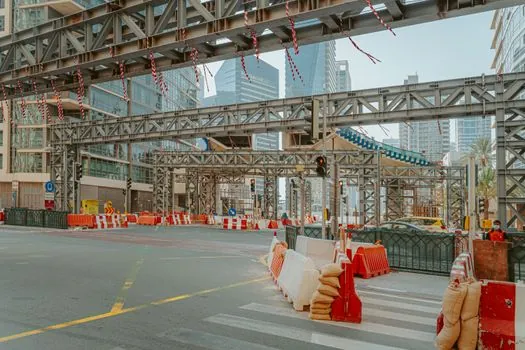
Three failure modes show up repeatedly on bridge deck grinding and are worth pricing into the spec from day one. First, low-voltage drop on long temporary cable runs: a 380 V supply at the site transformer can arrive at the grinder at 340 V once 100 m of cable is laid out, which trips the overload on 15 HP planetary heads within an hour. Cable sizing or a generator tap closer to the deck is the fix, not a smaller machine [S3].
Second, rebar shadowing: grinding across a rebar mat at less than 40 mm cover produces a wavy surface that the membrane layer will later telegraph. The spec fix is a pre-grind cover survey with a pachometer, and a 720 mm head rather than an 880 mm head so the operator can steer around dense mat zones [S1].
Third, dust-extractor mismatch on cold mornings: HEPA filters load faster in cold, damp air, and the extractor that passed acceptance at 25°C can lose half its airflow at 5°C. A standby set of dry filters and a sheltered storage box for the extractor is the cheap mitigation, and is more effective than buying a larger unit [S5].
Standards, Sourcing, and What to Put in the Tender
Two standards families govern the safety side of this spec and should be cited in the tender rather than left to the contractor's discretion. Workplace dust control falls under national variants of the silica OEL framework, with M-class extraction (IEC 60335-2-69 Annex AA) as the de facto equipment floor for concrete dust. Operator noise and vibration fall under the EN ISO 5349 and EN ISO 28968 envelopes for hand-arm vibration on grinders, which set the daily exposure limit that drives how long a handheld operator can realistically work a perimeter in a shift [S2][S5].
On the machine side, the procurement line should read: one walk-behind planetary or driven grinder, 720–880 mm working width, 5–15 HP, 80–400 kg, 380 V three-phase, with one matching M-class extractor, one set of metal-bond diamond plates per grit step, one resin pad set if a polished finish is in scope, one 115–230 mm angle grinder above 1,400 W for edge and rebate work, and one dedicated 250–400 mm edge grinder if perimeter runs exceed 50 m². The Trowel Max model set commonly matched to this scope is the 880, 850Pro, 850, 800, 720Pro, 720 and 630 series, with the final pick driven by floor area, supply voltage and working width [S1].
For interior finishing projects that share the same machine envelope but a different finish target, the floor grinder selection for interior finishing reference is the closest cousin to this spec map. Track the 850Pro and 880 series release notes, the IEC 60335-2-69 M-class amendment cycle, and any tightening of the silica OEL in the operator's jurisdiction as the next spec-moving signals.
For the relevant spec sheets and selection criteria, see floor grinder.