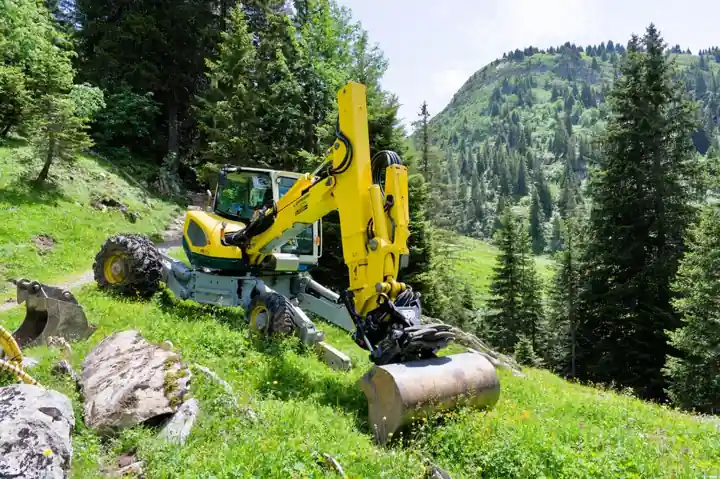
Forestry mulching attachments for skid steers and compact track loaders require minimum 70 HP engine output and high-flow hydraulic circuits delivering 20-50 GPM at 3,000-5,000 psi to maintain productive rotor speeds of 1,500-2,500 RPM on disc heads and 1,800-2,400 RPM on drum heads [S3][S4].
Disc and drum mulcher architectures dominate the 2026 forestry attachment market, with cutting widths spanning 50-84 inches (60 inches most common) and standing-timber capacity capped at 10-12 inches for disc units versus heavier brush grinding for drum designs [S3][S4]. Operators pairing a shield machine carrier with forestry-grade mulcher heads must match hydraulic horsepower, calculated as flow multiplied by pressure divided by 1,714, to avoid under-utilizing the attachment or stalling the carrier [S3].
Disc vs Drum Mulcher Head Architecture
Disc mulchers use a horizontal spinning disc at 1,500-2,500 RPM with fixed carbide teeth that slice standing timber up to 10-12 inches in diameter, producing a fine, even mulch finish suited to residential lot clearing where aesthetics matter [S4]. The slicing action works parallel to the ground, material passes over the disc, and chips distribute behind the head, but disc units perform poorly on ground-level material because the disc rides above grade [S4].
Drum mulchers employ a cylindrical rotor rotating at 1,800-2,400 RPM on a horizontal axis perpendicular to the carrier, with rows of replaceable carbide-tipped teeth that grind and shred material through brute force, producing coarser chips and chunks [S4]. Drum designs excel at heavy brush, dense undergrowth, right-of-way maintenance, and light stump grinding, with the mass of the drum enabling aggressive material processing at grade level [S4].
Carrier Hydraulic Requirements and Engine Matching
High-flow skid steers for forestry mulching should carry a minimum 70 HP engine, with most current production units falling in the 70-100 HP range paired with high-flow hydraulic circuits [S3]. Hydraulic horsepower, the product of flow and pressure divided by 1,714, is the true measure of work capacity; some machines deliver less flow at higher pressure, others more flow at lower pressure, and the resulting hydraulic HP determines mulching productivity [S3].
Forestry mulcher heads run on hydraulic flows as low as 20 GPM on 50 HP carriers for the lightest disc units, scaling up to 50 GPM or higher on dedicated high-flow machines [S4]. Torque matters as much as raw horsepower, and high-torque machines consistently outperform higher-HP but lower-torque platforms in dense material [S3]. Tracked undercarriages have become the popular platform in the mulching industry due to lower ground pressure, improved traction, and slope stability, though wheeled machines retain advantages in speed and lower acquisition cost [S3].
Safety Systems and Operator Protection

Forestry attachments incorporate multiple debris-management features: hydraulic doors, chain guards, and polycarbonate cab doors deflect high-speed airborne material away from the operator station [S3]. Paladin's Ground Shark brush cutters use a patented hinged debris shield that protects operators while improving cutting performance in medium to heavy density brush and hardwoods up to 10 inches in diameter [S1].
Turnkey forestry solutions from major OEMs ship fully outfitted with safety guards, fire suppression systems, and integrated tool storage for jobsite-ready deployment, a configuration increasingly specified for fire-mitigation work in fire-prone regions [S1][S2]. Forestry protection packages offered by skid-steer manufacturers dramatically increase machine and operator safety during mulching operations, and buyers should confirm polycarbonate door rating, chain curtain coverage, and OEM-supplied fire suppression compatibility before delivery [S3].
Compact Carrier Classes and Mini Excavator Attachments
Compact forestry attachments designed for mini excavators in the 3-10 metric ton class, such as the Paladin MX Series brush cutters, feature bolt-on mounts and multi-coupler compatibility for clean vegetation removal in tight spaces [S1]. These compact units sacrifice some of the cutting capacity of full-size skid-steer attachments but enable forestry work in confined sites where larger carriers cannot operate, including urban edge-of-pavement clearing, narrow firebreaks, and selective underbrush removal in partially developed land [S1].
Compact forestry mulchers and brush cutters for mini excavators share hydraulic flow requirements proportionally reduced from skid-steer platforms, typically running on auxiliary hydraulics in the 15-30 GPM range at 2,500-3,500 psi depending on carrier class and attachment design. The cutting machine category overlaps here, since brush cutters and forestry mulchers both rely on rotary cutting elements, but forestry-specific units add debris management, fire-resistant guarding, and high-cycle duty bearings that standard cutting machines lack.
Use Case Mapping: Fire Mitigation, ROW, and Commercial Clearing

Fire-mitigation forestry equipment, including FAE construction and forestry machines clearing debris for fire-line construction, includes both wheeled and tracked carrier options matched to terrain access constraints [S2]. Drum mulchers dominate right-of-way maintenance, pasture reclamation, and commercial contracts where processing speed outweighs finish quality, while disc mulchers lead residential lot clearing and primary clearing of wooded properties where the fine, even mulch finish matters [S2][S4].
Brush cutters occupy a different niche: they handle medium to heavy density brush and hardwoods up to 10 inches in diameter, ideal for land clearing, road right-of-way work, and pipeline maintenance where the goal is removal rather than mulching [S1]. Forestry buckets, including high-dump and excavator variants plus ditch cleaning tools, are engineered for clearing, digging, and access road creation, complementing rather than competing with mulching and cutting attachments [S1].
Limitations, Failure Modes, and Sourcing Standards
Common forestry attachment failure modes include tooth loss from impact with embedded rocks and stumps, rotor bearing failure from contaminated hydraulics, and hydraulic motor damage from stalled rotors in oversized material [S4]. Used heads in good working condition typically sell for 40-60% of new dealer price depending on operating hours, tooth wear, and overall condition, making the used market a viable option for budget-constrained operators willing to inspect bearings, rotor balance, and tooth retention systems [S4].
Sourcing decisions should weight carrier compatibility, hydraulic flow range, cutting width matched to carrier lift capacity, and availability of replacement teeth and rotor components. For buyers evaluating broader equipment lifecycle, the wheel loader lifespan spec map covers hours, components, and replacement triggers that overlap with forestry carrier maintenance planning. Buyers specifying forestry attachments for tracked carriers in 2026 should request verified hydraulic flow at the auxiliary couplers (not just engine HP), confirm forestry protection package contents with the skid-steer OEM, and verify that mulcher head cutting width falls within the carrier's rated operating capacity at the expected lift height [S3].
Spec-level background on the components involved: face shield.