Powered industrial trucks are divided into seven classes (I through VII) under OSHA's Powered Industrial Trucks framework and the underlying ANSI/ITSDF B56.1 standard, with the grouping driven by power source (electric vs internal combustion), tire construction (cushion vs pneumatic), and intended environment (smooth indoor floor, mixed surface, or rough terrain) [S1][S2].
Operators must be trained on the specific class they will run, not on "forklifts" generically: under OSHA 29 CFR 1910.178(l)(3), a Class IV counterbalance certificate does not authorize Class II narrow-aisle or Class VII rough-terrain operation, and CSA B335-15 in Canada enforces the same equipment-specific training rule [S2].
Classes I, II, III: electric-powered trucks for indoor use
Class I covers electric motor rider trucks, sit-down counterbalanced units, three-wheel electrics, and stand-up riders, all battery powered with no tailpipe emissions, making them the default for warehouses, cold storage, and food processing where air quality matters; published capacity bands run roughly 3,000 to 40,000 lb with electrical systems from 24 V to 80 V [S5].
Class II covers electric motor narrow-aisle trucks, reach trucks, order pickers, turret trucks, and side loaders, designed to operate in aisles as narrow as about 6 ft and to lift loads that conventional counterbalances cannot reach in high-bay racking [S2].
Class III covers electric motor hand trucks, hand/rider trucks, walkies, and powered pallet jacks, with lift heights of only a few inches off the floor and typical capacities in the 2,000 to 8,000 lb band, suited to short moves such as unloading trailers or feeding pick stations [S4].
Classes IV and V: internal combustion trucks split by tire type
Class IV internal combustion engine trucks run on gasoline, LPG, or diesel and use solid or cushion tires, which keep the truck low and the turning radius tight on smooth indoor floors; published capacity ranges run roughly 3,000 to 15,500 lb, and Class IV is common in warehousing, distribution, retail backrooms, and automotive plants [S5].
Class V uses the same internal combustion powertrains but fits pneumatic tires, which absorb impacts better and tolerate debris, gravel, and outdoor yards, so Class V is the default where a truck moves between indoor dock and outdoor staging without being a true rough-terrain machine [S5][S4].
Both Class IV and Class V trucks are addressed by the same OSHA hazardous-location designations (D, DS, DY, E, ES, EE, EX, G, GS, LP, LPS) when fitted for flammable atmospheres, but the seven-class training grouping is independent of those explosion-protection letter codes [S2].
Class VI: electric and IC tractors for towing, not lifting
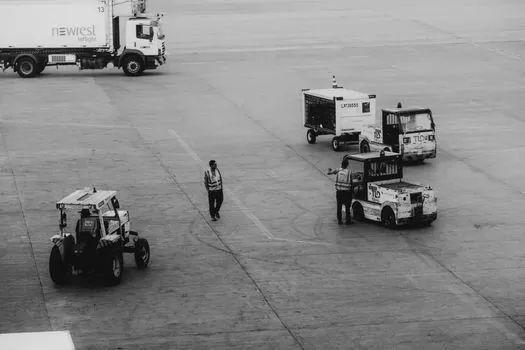
Class VI is reserved for electric and internal combustion engine tractors, including sit-down and stand-up models used to tow carts, trains, or baggage rather than to lift pallets; because they carry no load on the forks, training is centered on trailer handling, drawbar loads, and pedestrian awareness in tow-trains [S4][S5].
Class VI is the smallest class by unit volume in most fleets but is structurally important: a warehousing campus with frequent cart moves between receiving and shipping often deploys a dedicated Class VI unit alongside a Class I rider fleet to keep throughput up without burning rider-truck hours on tow duty.
Class VII: rough-terrain telehandlers and dedicated off-road forklifts
Class VII rough-terrain forklift trucks use large pneumatic tires, higher ground clearance, and four-wheel drive for uneven construction sites, lumber yards, and agricultural or masonry yards; telescopic handlers (telehandlers) are explicitly classified as Class VII machines under the same seven-class system [S8][S1].
Class VII capacity, mast reach, and attachment range differ sharply from Classes I through V: these are the machines specified when loads must be placed onto scaffolding, block walls, or framed structures, and they are the class most often added to a fleet by general contractors rather than by warehouse operators [S4].
How the seven classes compare on the decision criteria that matter

Power source is the first split: Classes I, II, and III are electric and indoor-rated; Classes IV and V are internal combustion, with IV on cushion tires for smooth floors and V on pneumatic tires for mixed surfaces; Class VI covers electric and IC tow tractors; Class VII is the rough-terrain, often four-wheel-drive group [S1][S5].
Tire and surface pairing is the next filter: cushion tires (Class IV, and some Class I) suit smooth, finished floors, while pneumatic tires (Class V, Class VII) absorb impact on broken ground; mismatching a Class IV cushion-tire truck to a yard full of debris is a common cause of chunked tires and bent rims.
Typical capacity bands line up roughly as: Class I 3,000 to 40,000 lb, Class III 2,000 to 8,000 lb, Class IV 3,000 to 15,500 lb, with Classes II, V, VI, and VII spread across a similar range but governed by mast height, aisle width, or terrain rather than by a single capacity ceiling [S5].
Operator training, fire codes, and where the rules bite
OSHA 1910.178(l)(3) requires that operator training, evaluation, and certification be specific to the truck class the operator will run, and the rule is enforced: a Class I certificate does not transfer to a Class II reach truck, nor does a Class IV certificate cover a Class VII telehandler [S2].
Hazardous-location operation is layered on top of the seven-class system through the D, DS, DY, E, ES, EE, EX, G, GS, LP, and LPS designations, and operators working in those atmospheres must be trained on the specific designation and fuel type of the truck they handle [S2].
The seven-class system is universal across the US and Canada because it traces back to ANSI/ITSDF B56.1 and is referenced by CSA B335-15 in Canada, so a US-spec Class IV truck and a Canadian-spec Class IV truck share the same class identity even when their options differ [S2].
Selection logic: which class fits which operation
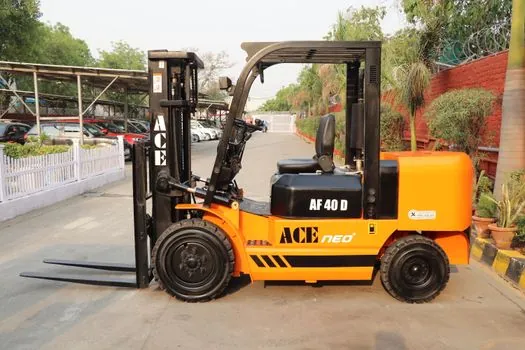
Indoor pallet handling on a smooth floor with a focus on emissions and noise points to Class I counterbalance or three-wheel electric, while tight-aisle high-bay racking points to Class II reach or order picker, and short-distance pallet shuttling at floor level points to Class III walkie or end-rider [S4][S5].
Mixed indoor/outdoor yards with no extreme terrain point to Class V pneumatic-tire IC trucks, and a facility that only needs to pull cart trains points to Class VI tractors; dedicated outdoor construction, lumber, or agricultural work at heights beyond a standard mast points to Class VII rough-terrain or telehandler [S8][S5].
Readers comparing the broader equipment ecosystem around forklifts can cross-reference the construction machinery taxonomy and the rough-terrain forklift entry for the Class VII context, and the general forklift overview for shared terminology used across all seven classes.
For plants that already run conveyor-fed warehouses, a useful adjacent spec is calculating throughput in belt conveyor t/h from belt width and speed, which is often paired with a Class II or Class VI fleet in a green-field DC.
Trackable signals over the next planning cycle: any update to ANSI/ITSDF B56.1 affecting the class definitions or capacity bands, and any OSHA interpretation letter clarifying whether a new lithium-ion powered rough-terrain model still sits in Class VII when used indoors on a smooth floor.