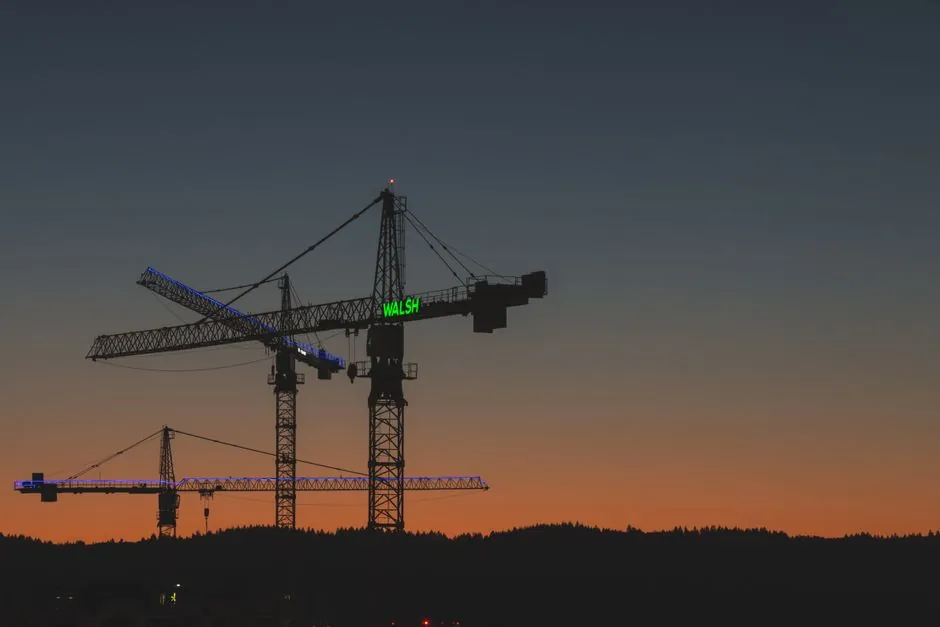
On jobsites running two, three, or more tower cranes in overlapping airspace, the flat top (topless) configuration is increasingly the default, because removing the tower-top cap and pendant lines drops the head height far enough that one crane's jib can pass under a neighbour's jib without boom-to-boom interference [S1][S2][S3].
That geometric advantage translates into hard project outcomes: faster erection, lower assembly labour, simpler transport loads, and the ability to push building designs closer to FAA-style ceiling restrictions on urban and airport-adjacent sites [S1][S3]. The four mainstream tower crane families in current fleets are hammerhead (saddle jib), flat top (topless), luffing jib, and self-erecting, and they differ mainly in jib geometry, head height, and how much room the machine needs to set up and operate [S2].
Why Flat Top Geometry Reduces Airspace Conflicts
Removing the A-frame and cat-head from a hammerhead-style tower crane removes the highest point on the machine: the conventional hammerhead's tower-top assembly and pendant lines sit above the horizontal jib, while the flat top's jib is level with the tower top, which is exactly the profile used to verify multi-crane safety in current OEM guidance [S1][S4].
With that head gone, two or more flat tops can be set on the same site with their jibs crossing at different elevations, which is the common arrangement on tight urban cores and on large footprints such as hospitals, nuclear plants, shipyards, and wind-farm staging yards [S2][S3]. Standard comparison tables from major rental fleets now list flat top as the go-to "where several cranes share airspace or overhead clearance is limited" option, alongside luffing jib for congested downtown work, with hammerhead reserved for open sites that have room to swing [S2][S5]. The structural trade-off is real: with no A-frame to take load, a conventional flat top's tip capacity sits in the 8 to 10 t range, and even high-capacity flat tops are typically 32 to 50 t, with supersized Liebherr models reaching 100 to 125 t [S3].
Side-by-Side: Flat Top vs Hammerhead vs Luffing vs Self-Erecting
The four tower crane types in current North American and European fleets compare on four decision criteria that matter most on a multi-crane project: head profile, best-fit site, erection complexity, and relative capacity. A flat top gives a low head, is best for shared-airspace multi-crane layouts, erects faster than a hammerhead, and matches hammerhead capacity at similar jib length; a hammerhead (saddle jib) has a high A-frame head, suits open sites with room to swing, needs an assist crane, and is the heavy-lift workhorse; a luffing jib trades fixed reach for an up-and-down jib, fits tight urban and congested sites, has more involved setup, and trades working radius for compact footprint; a self-erecting unit has the lowest profile and shortest setup, fits residential and short-duration work, erects without an assist crane, and has the lowest capacity of the four [S2][S5].
Selection then comes down to four practical filters: project duration (long projects can absorb traditional setup costs, short ones favour self-erecting), site constraints (overhead restrictions, adjacent buildings, ground conditions), load requirements (peak lift plus typical working load), and total cost (transport, setup, operation, maintenance), all of which tend to favour the flat top on mid-to-long duration urban and modular builds [S5].
Erection, Transport, and Modular-Construction Fit
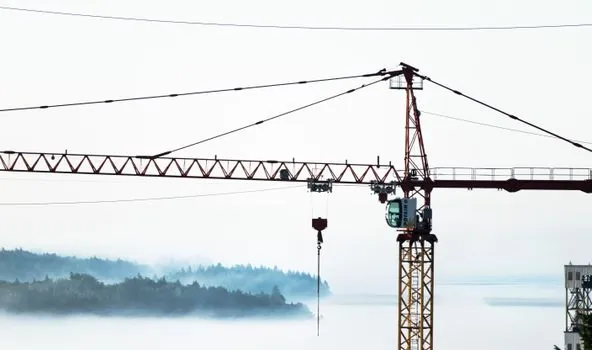
Fewer parts at the top means fewer parts to ship, fewer parts to lift, and a shorter critical-path during erection, which is why multiple OEM and dealer sources frame flat top cranes as a modular-construction enabler rather than just a high-rise lifting tool [S1][S6]. The 2025-04 industry write-up on modular construction calls out the same lack of an apex structure as the core advantage for tight or congested modular yards, where cranes may be relocated or reconfigured multiple times during a project [S6].
Contractor-facing dealer material backs that up with operational numbers: streamlined flat top designs are described as faster to erect, easier to transport, and lower-cost on assembly and disassembly labour than traditional hammerhead models, with the multi-crane benefit named explicitly [S1]. For lift planners, that means the safety case for overlapping jibs (separation distances, anti-collision zoning, slewing limits) becomes easier to argue when each machine's highest fixed point is the jib itself rather than an A-frame several metres above it [S1][S2][S4].
Capacity Envelope and High-Capacity Flat Tops
Flat top capacity has climbed materially over the last several product cycles, and the high-capacity segment is now treated as a distinct buying decision rather than a niche [S3]. The conventional flat top still lifts 8 to 10 t at the jib end, which is the typical use-case on residential and mid-rise work, but newer 32 to 50 t flat tops are now offered by Potain, Terex, Liebherr, Comansa, the Italian maker ENG, and Chinese manufacturer Yongmao, and Liebherr has gone further with supersized 100 t and 125 t flat top variants [S3].
That matters for multi-crane layouts because a single high-capacity flat top can sometimes replace two smaller units, which directly reduces the airspace-segregation problem rather than just managing it. As one industry summary put it, the increasing capacity of flat top cranes lets developers push their permanent structure closer to the same ceiling restrictions that govern the temporary crane, since the crane itself takes up less overhead room [S3]. For background on how the flat top sits inside the broader tower crane family, see the tower crane reference page, and for contrast with crawler-mounted heavy-lift machines on the same project, the crawler crane entry covers the ground-based side of the fleet.
Failure Modes and Limits Engineers Plan Around
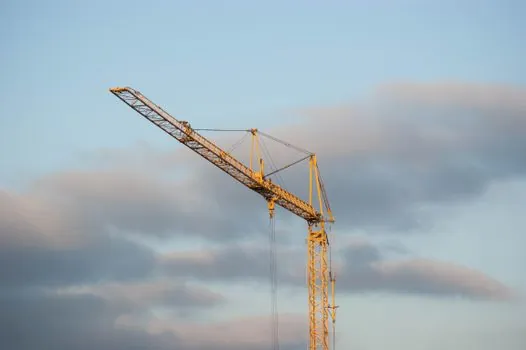
Flat top cranes are not a universal replacement. The same structural simplification that gives a lower head and easier erection also removes the A-frame's contribution to load transfer, which is why conventional flat tops sit at lower tip loads than a similarly sized hammerhead and why any high-capacity flat top in the 32 to 125 t range is a deliberate engineering exercise rather than a routine upsizing [S3].
The jib on a flat top is a single regime: the lower chord is always in compression and the upper chord is always in tension, which makes in-service behaviour easier to predict than a hammerhead's mixed compression and tension regions, but it also means there is no pendant-line redundancy to share the load [S3]. On multi-crane sites, the residual risk is boom-to-boom contact and trolley-to-trolley interference at shared radii, which is why anti-collision systems, zoning, and clear separation between jib elevations remain mandatory regardless of crane type [S2][S4]. For projects that need even tighter overlap, the luffing jib remains the alternate choice, with the trade-off being a more involved erection and a jib that must be raised and lowered to change reach [S2][S5].
Sourcing, Standards, and Decision Signals to Track
Flat top cranes are sold both as new units through manufacturer networks (Potain/Manitowoc, Terex, Liebherr, Comansa, Sany, Yongmao, ENG) and as rental fleet assets through dealers such as Cropac, Maxim, ALL Crane, and Sims, with dealer pages explicitly positioning the flat top as the multi-crane and tight-site default [S1][S2][S3][S4][S5][S7]. For the modular-construction segment, the design case is also tied to FAA and urban ceiling restrictions, since a lower crane head lets the building itself go taller within the same envelope [S3][S6].
Two operational signals to watch on the next planning cycle: the share of new high-capacity flat tops in the 32 to 125 t range entering Western rental fleets, which compresses the case for paired smaller units on shared sites [S3]; and the spread of anti-collision zoning as a default delivery item rather than an option, which changes the multi-crane safety case independent of crane type [S1][S2][S4]. For a different but related heavy-lift comparison, see how heavy-load AGVs are being spec'd for 20 t die and mold transport in 2026, and for the regulatory paperwork that travels with any of these machines into the EU, the CE technical file requirements under Annex VII for 2026 cover the documentation side of bringing a new tower crane onto a European site.
For the relevant spec sheets and selection criteria, see flat belt.