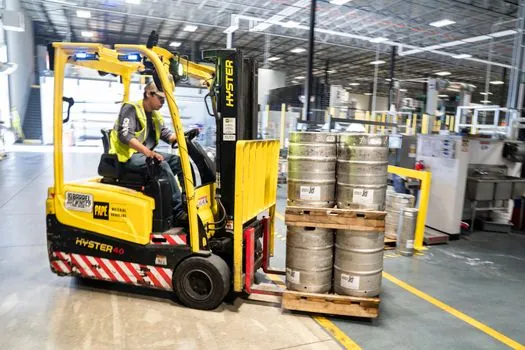
A standard counterbalanced forklift routes the load through four linked parts: forks locked into a steel carriage, the carriage riding inside mast channels, the mast pivoted on the chassis, and a rear-mounted counterweight that offsets the moment of the rated load [S1][S3].
For a typical 2.5–3.5 t sit-down counterbalanced truck, the lift group sits at the front axle, the operator and power unit sit amidships, and the counterweight is bolted to the rear of the frame directly over the steer axle; the load centre is standardised at 500 mm for rating purposes on most ISO-aligned data plates [S2][S5].
Forks: the load interface and wear part
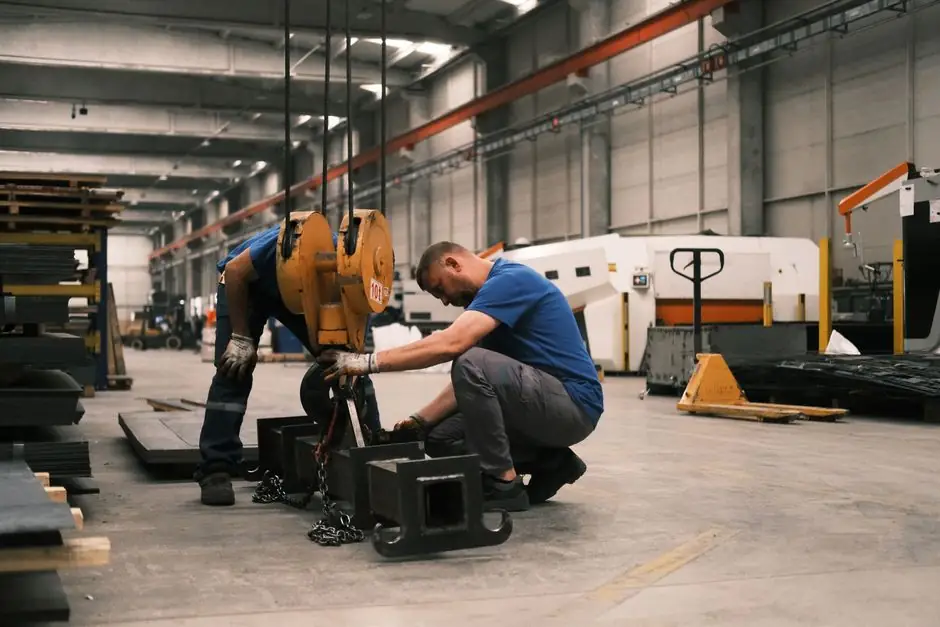
Forks (also called tynes) are forged or rolled steel blades, usually in pairs, that slide under the pallet or load; they hook onto the carriage via a top retaining pin and a lower locking latch so the heel cannot kick upward under load [S3][S6]. Common fork lengths run from 800 mm to 2,400 mm with cross-sections in the 100×40 mm to 150×50 mm range, and ITA / ISO 2329 hook-type mounting dimensions are the de facto interface for hook-on forks and attachments [S3].
Inspection triggers are well documented: cracks at the heel, a bend greater than 3% of the blade length or a 10° spread between fork tips means the fork is out of service, not straightened and put back [S3][S4]. Unequal fork height is a separate rejection condition because it loads one side of the carriage unevenly.
Carriage: the moving steel frame that holds the forks
The carriage is a rectangular welded steel frame that travels up and down the inner mast rails on greasable rollers; it carries the forks and any attachments (side shift, fork positioner, carton clamp) bolted to its face [S2][S6]. Two horizontal fork bars run across the carriage, and the forks are pinned to these bars so the load centre stays on the truck's longitudinal centreline.
Load backrest extension is welded to the carriage, not the mast: its job is to stop a load from tipping back toward the mast and operator when the mast is tilted forward, and it typically extends 1,220 mm or more above the carriage face on Class III-equivalent trucks [S3][S7]. Fault signs are catching, jerking, or visible looseness as the carriage travels; any of those points at worn rollers, bent rails, or a cracked carriage weld [S3].
Mast, rails, chains, and cylinders: how vertical lift is built
The mast is the vertical channel structure at the front of the truck and is built as nested stages: a single-stage ( simplex) mast for low lifts, a two-stage ( duplex) for standard warehouse lift heights of around 3–5 m, and a three-stage ( triplex) with a free-lift cylinder for lifts up to roughly 6–7 m in confined spaces [S5][S8]. Inner and outer mast channels ride on greasable steel rollers, with shim adjustments to take up rail wear before the carriage starts to shudder.
Lift chains transfer cylinder force to the carriage: typically two leaf-type lifting chains (e.g., BL-type or attachment-class chains) anchored at the mast top, wrapped over the lift cylinder sprocket or sheave, and pinned to the carriage [S3][S5]. Unequal chain tension is a warning sign because it means one side of the carriage is binding in the rails. The lift cylinder provides vertical force, while separate tilt cylinders change mast angle forward and backward, usually a few degrees either side of vertical, to keep the load stable under braking and acceleration [S3][S5].
Counterweight and the stability triangle
The counterweight is a dense casting (cast iron or fabricated steel) bolted to the rear of the truck frame, sized so that when the truck carries its rated load at the standard 500 mm load centre, the combined centre of gravity of truck plus load stays inside the stability triangle formed by the front wheels and the centre of the rear axle [S1][S2][S5]. This is the same triangular support area that Sany's working-principle write-up describes as the basis for preventing forward tip-over [S2].
The counterweight is rated to balance only the maximum capacity stamped on the data plate; adding ballast beyond nameplate, or using an undersized counterweight from another model, is a stability violation and shows up in pre-shift inspection as "unauthorised modification" of the rear mass [S3][S5]. On a 2.5 t diesel truck, the counterweight commonly sits in the 3.5–4.5 t range; on a 1.5 t electric three-wheeler it can drop to roughly 2.5–3.0 t, because the battery pack itself acts as part of the rear ballast.
Comparison: simplex, duplex, and triplex mast configurations
Selection turns on lift height, free-lift requirement, and collapsed mast length, not on truck capacity. Simplex masts have the lowest collapsed height and the simplest chain path, so they suit low-clearance docks and container handlers where the lift rarely exceeds 2–3 m. Duplex masts add an inner stage and roughly double the lift height to 3–5 m for general warehouse use, at the cost of a taller collapsed mast. Triplex masts add a free-lift cylinder and a third nested stage, giving 5–7 m of lift plus full free-lift so the forks can rise inside a container or trailer before the mast extends, which is the same trade-off framed in the spec-based selection note for rough-terrain mast configurations [S5][S8].
Chassis context: how the lift group connects to the rest of the truck
The frame or chassis is the welded steel backbone that carries the mast pivots at the front, the front drive axle, the rear steer axle, the engine or battery box, and the counterweight at the rear; the mast is bolted to the frame through heavy pivot pins so the tilt cylinders can rotate the mast forward or back without twisting the chassis [S2][S5]. On a rough-terrain forklift the same layout is used but with a wider wheelbase, larger-diameter lug tyres, and an open-core mast for visibility, and a related spec walk-through on that machine family is the fixed-mast vs telescopic reach rough terrain forklift selection reference.
The operator cab, overhead guard, hydraulic tank, and fuel or battery box all sit between the front and rear axles; the steering system turns the rear axle on most sit-down counterbalanced trucks, which is why the steer axle has to be rated for both the empty truck weight and the dynamic side load during a turn with load on the forks [S2][S5].
Inspection signals worth tracking on a service log

Symptoms travel up the chain: a worn lift chain shows up as slack on one side, a bent mast rail shows up as a shuddering carriage, a leaking tilt cylinder shows up as uneven fork angle, and a damaged counterweight shows up only on the data plate review or after a tip event [S3]. A pre-shift walk-around should cover fork heel cracks, fork tip alignment, carriage roller noise, chain tension equality, mast rail wear, hydraulic hose condition, and the counterweight mounting bolts, because failure in any one of those parts is what generates the "forklift tip-over" statistics cited in safety guidance [S1][S3].
For a deeper look at the surrounding machine family and how a mast-equipped forklift fits into broader material-handling fleets, the forklift category overview and the rough-terrain forklift variant carry the related component breakdowns; the construction machinery and equipment reference frames the heavier-end machines that share the same mast-and-counterweight logic.
Standards and ratings that govern the layout
Counterbalanced forklift design is anchored to ISO 5053-1 for truck terminology and to ISO 2329 for the fork-carriage hook interface; load ratings are quoted at the 500 mm load centre defined in the ISO-aligned rating standard, and ANSI/ITSDF B56.1 covers the safety standard for the same truck class in North America [S3][S6]. These are the documents that the data plate on the carriage or cab invokes, and they are what a maintenance engineer should cite when a fork, carriage, or counterweight replacement is being justified.
For procurement and fleet managers, the next trackable signal is the data-plate rating of each truck in the fleet cross-checked against the heaviest standard pallet actually moved, and the second signal is the chain and rail wear trend logged at each PM interval: rising chain elongation or rising rail shim thickness is the early warning that the front-lift group is approaching a service event.