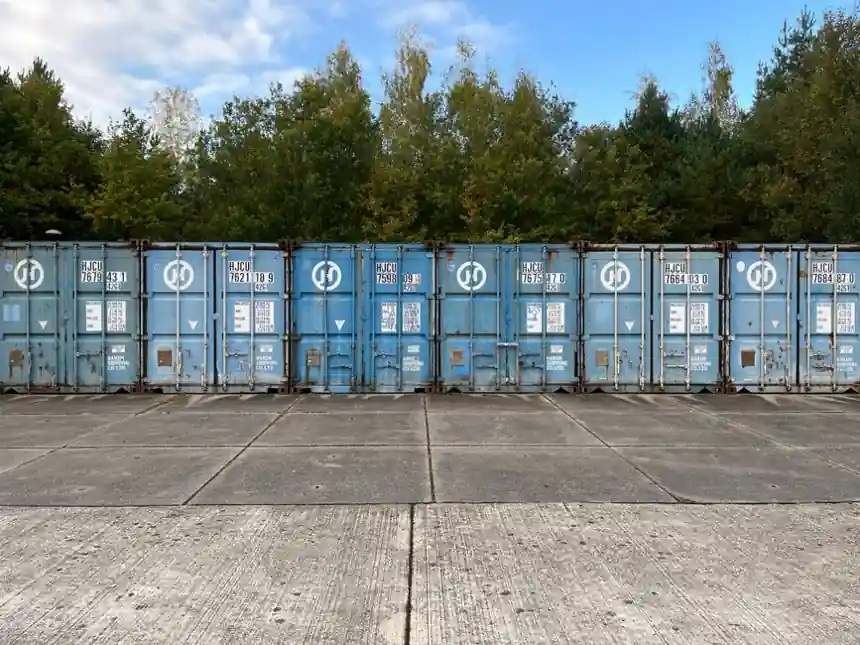
Demolition work generates a narrow but chemically aggressive liquid-handling profile: residual fuels, lubricants, hydraulic oils, acid wash-water, and concrete curing residues that have to be moved out before a structure is cut, and moved in to support decontamination of the slab afterwards. ISO tank containers built on a 20 ft frame with AISI 304 or 316L stainless-steel shells are the dominant specification for this role, with 316L favoured where chloride-bearing wash-water or acid residue is present [S1][S3]. Standard 20 ft units are commonly rated in the 21,000-26,000 L (about 4,000 gal) capacity band, an order of magnitude larger than the 1,100 L (300 gal) IBCs they typically replace on a demolition spread [S4].
The unit is not a barrel in a frame: it is a coded pressure vessel with a calculated wall thickness, a maximum allowable working pressure, top manholes, bottom discharge valves, and a pressure relief valve selected for the carried cargo [S1]. For demolition buyers this matters because the same tank that arrives to take away wastewater can be re-filled on the same day with recovered oil, fuel, or wash liquor without re-tagging, provided the T-Code on the nameplate matches the new cargo [S3][S6].
Selection Criteria: What a Demolition-Grade Tank Container Must Carry on Its Nameplate
A tank container is only fit for demolition service if its data plate, T-Code, and test certificate all line up with the liquids the site actually produces. Demolition contractors typically need three independent certifications visible: the ISO frame dimensional certificate (so it stacks on standard chassis), the IMDG T-Code (so it can carry the listed hazardous liquids on public roads), and a periodic inspection stamp not older than 30 months for the vessel itself, in line with the standard 2.5-year test cycle used across the global ISO tank fleet [S6][S4]. Stainless-steel AISI 316L is the practical default for any chloride-bearing wash water or acid residue, while AISI 304 is acceptable for straight fuel, oil, and neutral water streams [S1].
Wall thickness is calculated from the maximum allowable working pressure and the cargo, not chosen from a catalogue: low-pressure food-grade designs and high-pressure gas designs share the same frame but have very different shells, and a demolition buyer who specifies only "ISO tank" without a pressure class risks receiving a vessel under-built for solvent vapour or over-built (and overweight) for plain water [S1]. The cylindrical geometry is itself a selection criterion, since it distributes internal pressure more evenly than rectangular IBCs, which directly extends fatigue life across the repeated fill/transport/empty cycles of a demolition project [S1].
Capacity Class Comparison: 20 ft Standard vs 20 ft Swap-Body vs Offshore DNV 2.7-1
Three tank-container variants cover almost every demolition procurement scenario, and the choice is driven by transport mode and site access rather than by liquid chemistry. The 20 ft ISO standard unit is the workhorse, swap-body tanks suit road-only European runs with height-restricted bridges, and DNV 2.7-1 offshore-rated units are the right pick when a tank has to be lifted onto a marine barge or a flood-prone jetty next to the demolition site [S1][S3].
On the decision criteria that matter to a demolition engineer, the comparison reads roughly as follows. Capacity: ISO 20 ft standard 21,000-26,000 L, swap-body similar, DNV 2.7-1 typically 10,000-24,000 L because of the heavier offshore frame [S3]. Transport modes: ISO standard covers road, rail, and sea; swap-body is road and short-sea only; DNV 2.7-1 covers road, sea, and crane lift to offshore structures [S3]. Site access: ISO standard needs a reach-stacker or crane, swap-body only needs a hook-arm truck, and DNV 2.7-1 is required wherever a crane-lift certification is mandated by the port or platform operator [S3]. For most building and bridge demolition work, the ISO 20 ft standard gives the best capacity-per-freight-cost; for inner-city demolitions with weight-restricted bridges, the swap-body variant usually wins [S7].
Specialised variants also exist for the narrow demolition edge cases: lined ISO tanks for acid-based wash water, peroxide-rated tanks for any cleaning chemical above standard concentration, and reefer (heated/cooled) tank containers for any bitumen or wax-based recovery stream that has to stay above its pour point during winter demolition [S3]. These specialisations are typically ordered as a single dedicated unit per site rather than mixed into the general fleet.
Who a Tank Container Is For, and Where It Is the Wrong Tool
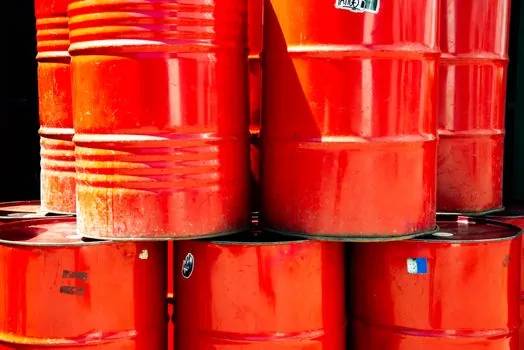
Tank containers are the right call on a demolition site when liquid volumes are sustained, when the liquid is compatible with stainless steel or an available lining, and when the same tank will be moved at least twice (site to transfer station, transfer station to disposal or recovery) [S1][S7]. They pay back against 205 L drums and 1,000 L IBCs once a project generates more than about 40-50 m^3 of a single liquid stream, because the per-litre handling cost drops sharply and the intermodal frame means one tank can be loaded by truck, transferred to rail, and offloaded at a treatment plant without intermediate decanting [S1][S4][S7].
They are the wrong tool for very small spill volumes (under about 5 m^3 in total), for highly corrosive reagents outside the lined-tank catalogue, for any cargo that is solid at ambient temperature and not covered by a heated/reefer variant, and for sites where there is no reach-stacker, crane, or hook-arm truck available for handling [S1][S3]. The demolition hammer side of a job, the breaking and cutting of concrete and steel, sits in a different equipment universe; tank containers only enter the picture on the liquid logistics flank, and they are a poor substitute for bunded pallets or drum stacks when the volume does not justify the mobilisation cost.
Limitations, Failure Modes, and Standards Discipline
The hard limits on a tank container are the ones written into its nameplate: maximum allowable working pressure, maximum gross weight (typically around 36,000 kg for a 20 ft unit), and the list of approved cargoes defined by the T-Code [S1][S3]. Running a tank outside its T-Code, or filling a unit that has not been gas-freed after a previous reactive cargo, is the single most common cause of in-service failure, and on a demolition site that failure mode is amplified by the presence of cutting sparks, hot work permits, and ignition sources [S1][S6].
Inspection discipline is therefore the controlling constraint. The vessel must carry a valid periodic inspection, the manhole seals and gaskets have to be replaced at every cargo change involving a different chemical family, and any tank that has carried an unknown prior cargo must be rejected at intake rather than risk cross-contamination of the new demolition stream [S4][S6]. Wall-thinning under repeated corrosive service is a known wear pattern across the global ISO tank fleet and reduces the useful service life well below the two-year minimum that a new stainless-steel shell is designed to deliver, so buyers should request shell-thickness records on any used unit offered for demolition service [S4].
Use Cases From the Demolition Field, and What the Sources Confirm
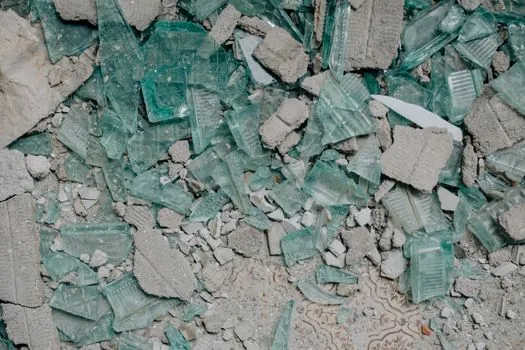
Tank containers move in and out of demolition sites in three recognisable patterns. First, residual liquids are pumped out of the structure being demolished: fuels, lubricants, and process chemicals from a tank farm, an industrial plant, or a ship being broken up, and the same ISO tank that arrives for recovery is then routed onward to a licensed treatment or recycling facility [S1][S7]. Second, decontamination liquids are generated by washing the slab, the bund walls, and the steelwork before cutting, and the resulting wash water is held in lined ISO tanks until laboratory analysis clears it for discharge or routes it to a hazardous-waste receiver [S3][S4]. Third, water and dust-suppression fluids are staged on site in standard ISO units, often as a pumped supply to demolition crews running hydraulic breakers and pressure transmitter-instrumented spray rings during concrete crushing.
For larger structural cuts and tank-on-tank demolition work, the same fleet routinely pairs the tank container fleet with a flow meter-calibrated discharge line, so the contractor can prove to the regulator exactly how many litres of each waste stream left the site on each day. The tank cleaning machine requirement between cargoes is the gating step that keeps the nameplate T-Code valid and the periodic-inspection clock from being reset by an unplanned reactive service.
Sourcing, Standards, and Procurement Signals
The procurement signal worth tracking in 2026 is the widening split between new-build and converted ISO tanks. Most of the active global fleet continues to be manufactured in China and Germany, with shell-wall thicknesses trending thinner over time as cargo profiles have shifted toward less corrosive liquids, and as a direct consequence the second-hand market is dominated by younger tanks with thinner shells rather than older heavier ones [S4]. For a demolition buyer this means the cheapest available used unit is not always the safest option, and shell-thickness verification at intake is a real engineering step, not paperwork theatre.
Trackable signals for the rest of 2026: how many used ISO 20 ft tanks in the trader's yard are offered with full IMDG T-Code documentation versus generic "suitable for water and oils" descriptions, and whether rental fleets are offering DNV 2.7-1 offshore units at inland demolition sites in coastal regions (a useful indicator that the offshore-energy slowdown is releasing specialist capacity into the civil-demolition market). For a parallel view of how the same 20 ft ISO frame is specified for reagent-bearing sites outside demolition, the mining spec map for tank container selection lays out the capacity, lining, and certification matrix that the demolition reader can borrow directly.