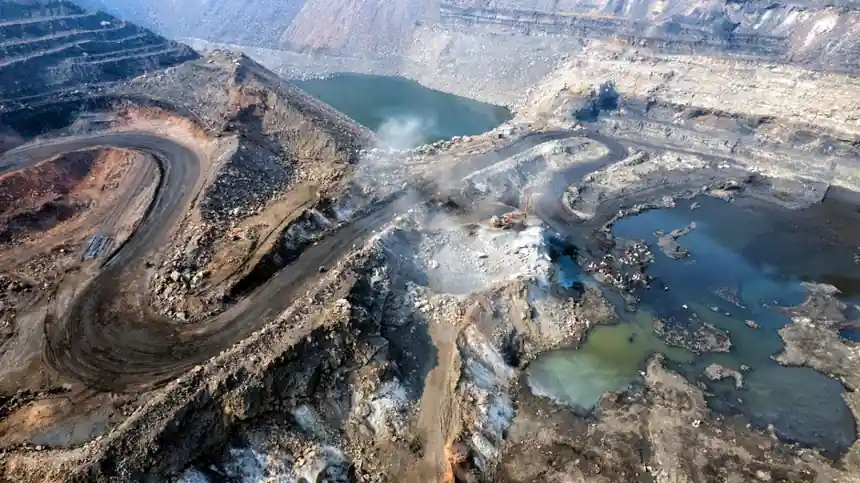
For ore processing, smelting, and mineral-handling halls, a double girder overhead crane in FEM/ISO duty class M5–M7 is the engineering starting point, not the ceiling, with mine-grade unit prices running $25,000–$350,000+ depending on capacity, span, and the level of environmental protection specified [S1].
Mining sites concentrate four concurrent stressors, abrasive dust, corrosive moisture, potentially explosive gas, and continuous heavy cycles, so the right overhead bridge crane is selected for duty class and ingress protection first, and only then for nominal tonnage [S1][S7].
Configuration Comparison: Single Girder vs Double Girder vs Gantry
Single girder overhead cranes typically cover 1–32 t at M3–M4 duty and price at roughly $8,000–$45,000, suiting light maintenance bays and workshops adjacent to the mine rather than the main ore flow [S1]. Double girder units span 5–800 t at M5–M8 and price from about $25,000 to $350,000+, which is the envelope most crushing plants, concentrator halls, and main production bays actually need [S1]. For open-pit stockyards and outdoor ore handling, a double girder gantry crane in the same 5–800 t range at M5–M7 pushes the envelope to $30,000–$500,000+, trading building cost for ground-level flexibility [S1]. The selection is therefore not simply a tonnage question: it is a question of span, headroom, duty, and whether the crane sits inside a clad structure or runs on outdoor rails.
Six-Factor Selection Framework for Mining Conditions
Duty class must be specified before capacity: M5 covers general production lifting, M6 covers heavy-cycle ore handling, and M7 covers intensive multi-shift mineral processing where the hoist is on the hook for most of the operating window [S1]. IP rating and explosion-proof classification are not interchangeable, so buyers have to call out both an enclosure rating (typically IP54 or higher for dust-laden mills) and a hazardous-area classification (ATEX or IECEx) where methane or coal dust can accumulate [S1]. Span and runway design must absorb building settlement common to mine structures, which means welded-box girders with verified deflection limits rather than rolled I-beams on long spans. Wire rope and hook block selection should match an abrasive atmosphere, with larger rope diameters, rotating blocks, and forged hooks rated for the full capacity plus the block weight. Control systems for dusty conditions usually combine a wired pendant with a radio backup, plus filtered enclosures on VFD panels so conductive dust does not coat the electronics [S1][S7]. Maintenance access is a long-term cost factor: a crane designed with platform-mounted hoists, removable gearbox covers, and standard grease points typically cuts mean-time-to-repair in half compared with sealed structural layouts, which matters once the unit is in year five of a 20-year service life.
Where Mining Overhead Cranes Are Used, and Where They Are Not
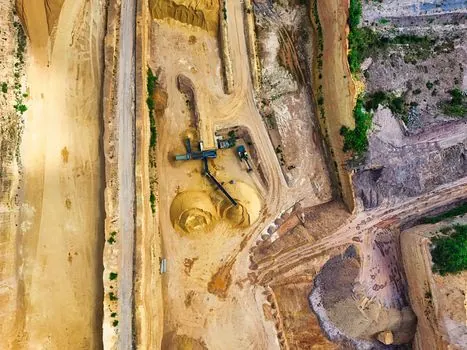
Mining overhead bridge cranes are well matched to enclosed ore-handling halls, concentrator floors, crusher maintenance bays, smelter anode handling, and refinery crane bays, anywhere the load is repeatable, the cycle is heavy, and the building can carry the runway reaction loads [S5]. They are not the right tool for haul road or stockpile work where rubber-tyred flexibility matters, and that is the slot filled by a mining dump truck on a haul road or by a gantry crane on ground rails [S5]. A common mistake is sizing a single girder workshop crane to 25 t because a gearbox occasionally lands on the floor, when the actual production flow is downstream and a 50 t double girder would be the correct, not the oversize, answer.
Certification and Compliance: What to Verify Before Shipment
CE marking under the Machinery Directive is the basic gate for European and most export-bound units, but for mining, the certificate must explicitly cover the chosen hazardous-area classification (ATEX category 2 or 3) and the rated duty class [S1]. Buyers should request the design verification documents, not just the data plate, including FEM/ISO duty calculations, wire rope safety-factor check, and the weld procedure specification for the girders. For North American projects, CMAA duty classification is the equivalent language to FEM M-class, and a unit rated CMAA Class D or E maps closely to M6 or M7. Beyond the paperwork, suppliers should provide documented factory load testing at 1.25× rated capacity and a documented overload device set point, since the load chart is only as good as the test that backs it [S1][S3].
Price Reference and Total Cost of Ownership
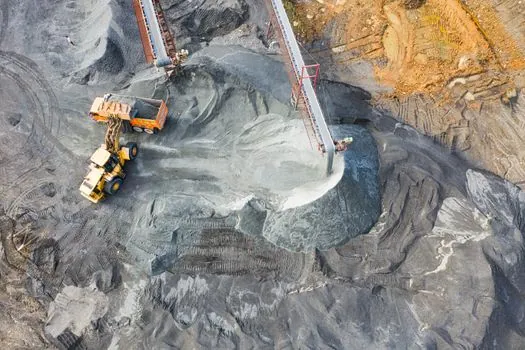
The market reference range for a mine-grade double girder overhead crane runs $25,000–$350,000+ for indoor units and $30,000–$500,000+ for outdoor gantry configurations, with the wide band driven by capacity, span, and the environmental-protection package selected [S1]. The gap between a competitive quote and the actual landed cost can exceed 40% once freight, runway installation, electrical infrastructure, explosion-proof pendant, commissioning, and operator training are added on, so a like-for-like bid comparison must fix all of those line items first [S1]. For adjacent material-flow equipment on the same site, tank container selection for mining follows a comparable spec-map discipline around reagent, capacity, and certification, and the procurement logic is the same: lock the duty class and certification before comparing price. For concrete placement inside the mill, concrete pump truck selection for mining applies the same ground-pressure and outrigger logic that an overhead runway has to handle.
Limitations, Failure Modes, and Sourcing Constraints
The most common failure mode in a mining overhead crane is not a broken hoist rope but premature wear on the bridge travel wheels, caused by abrasive dust ingesting into the bearings and by runway rail misalignment from foundation settlement [S1][S7]. The second most common is electrical: VFD panels fail when dust infiltrates cooling fans, which is why most mine-grade specifications call for sealed heatsinks and positive-pressure purged cabinets in the most exposed zones. Sourcing constraints in 2026 are real: lead times for mine-grade double girder units with full ATEX or IECEx certification run 6–9 months from major Chinese and European suppliers, and expedited airfreight on the hoist alone can add 8–12% to the unit price. A spare wire rope set, a spare hoist motor, and a documented preventive-maintenance schedule should be priced into the contract at the RFQ stage, not negotiated as a change order after the unit is in service.
Trackable signals for the next six months include any supplier disclosure of lead-time compression for M6/M7 mine-grade units, and any published revision to ATEX or IECEx guidance that touches hoist motors in dust-laden mills, both of which will move the procurement calculus for new mining builds.