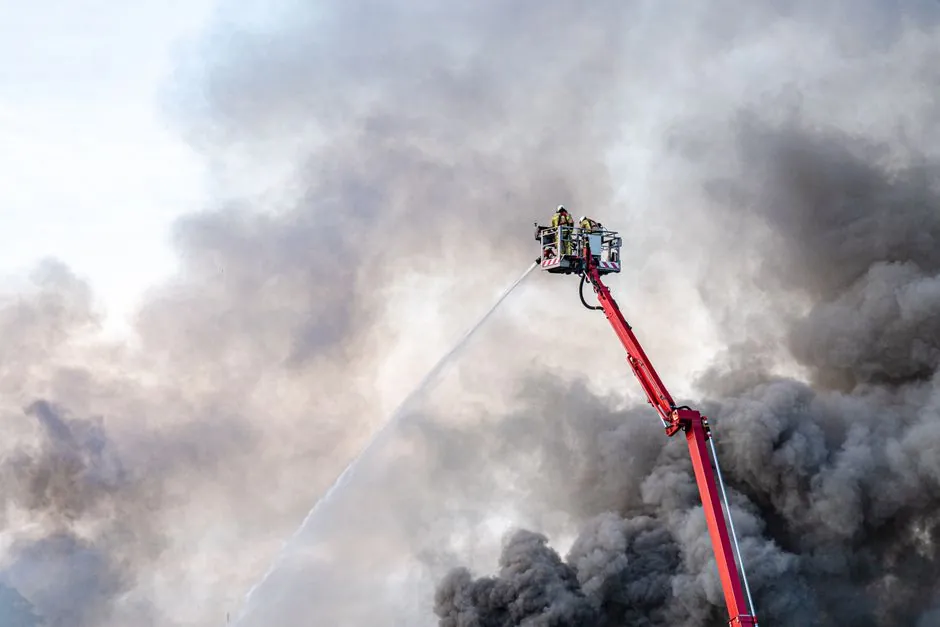
Construction-site gas fire suppression is a temporary-life problem: the protected enclosure is often a site office, switchroom, or server cabin that must be guarded before permanent fire-water infrastructure is energised, and the agent family chosen dictates pipe size, cylinder count, and whether humans can be in the room at discharge.
For a 100 m³ temporary site IT or switchgear cabin, an inert IG-541 system typically needs roughly 40 to 50 high-pressure cylinders at 200 to 300 bar, while a chemical clean agent like FK-5-1-12 reaches the same suppression envelope from a single cylinder bank discharging in about 10 seconds [S5][S2]. That single ratio (cylinder count vs discharge window) is the first gate in agent selection on a green-field or refurbishment site, where floor-loading limits, cranage access, and re-charge logistics all run before a permanent fire hydrant ring-main is on line.
Three Agent Families, Three Site Profiles
Modern gas suppression groups into three families: halocarbon clean agents (HFC-227ea, FK-5-1-12), inert gas blends (IG-541, IG-55), and carbon dioxide, each extinguishing by a different physical mechanism and answered by a different design standard (NFPA 2001, ISO 14520, EN 15004, and NFPA 12 for CO2) [S2]. The agent choice is governed by whether the protected room will be occupied at the moment of discharge, because CO2 at the 34% to 50% design concentrations typical for surface hazards will not support life and is therefore generally ruled out of occupied spaces [S7][S4].
Inert blends like IG-541 (also marketed as Inergen) are designed with a positive safety margin in occupied rooms, and on construction sites are commonly used for large temporary enclosures such as plant rooms, generator cabins, and switchrooms. Halocarbon clean agents, especially FK-5-1-12, are specified when a 10-second discharge window, low cylinder count, and a GWP below 1 are mandatory, often for containerised data centres, BIM server rooms, and pre-fab MCC buildings on site [S5][S3]. CO2 is reserved for unoccupied hazards, typically local-application systems on bitumen boilers, generator day-tanks, or paint-store cabinets, with NFPA 12 mandating the design concentration to be reached in 60 seconds or less for total flooding and within 30 seconds for local application [S4].
Design Concentration, Hold Time, and Envelope Pressure
Design concentration is the percentage of the protected volume that must be replaced by agent to suppress combustion, and it is calculated from the fuel load and the inert or chemical agent selected. For ordinary combustibles, IG-541 typically requires about 34% by volume, with the remaining oxygen held above roughly 12% to keep the atmosphere tenable for occupants [S1][S2]. FK-5-1-12 reaches the same goal at 4% to 6% concentration because it absorbs heat at the flame front and interrupts the chain reaction, and it has an atmospheric lifetime of about 5 days, which keeps the carbon footprint low [S3].
Once discharged, the room must hold the design concentration for a retention (hold) time, which is normally at least 10 minutes and is verified by a door-fan test before the system is handed over [S2]. A positive safety margin for occupied spaces must be documented, meaning the agent's No Observable Adverse Effect Level (NOAEL) exceeds the design concentration by a stated factor. Pressure-relief venting must be sized so the discharge does not over-pressurise the enclosure; inert systems in tight rooms in particular require correctly sized relief dampers, and a 1 kPa peak over-pressure is the typical structural limit for a standard site cabin [S2].
Detection, Double-Knock, and Release Logic
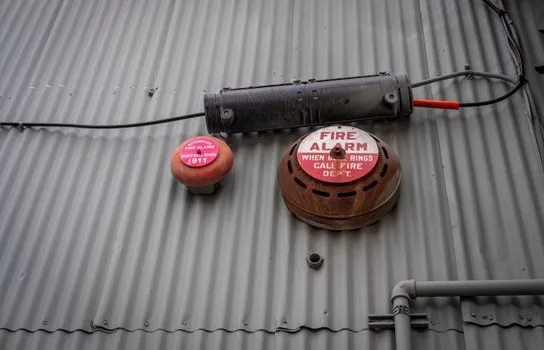
On a construction site the detection layer is usually cross-zoned smoke or aspirating detection feeding a listed releasing control panel, because a general fire alarm panel is not a legal release interface in most jurisdictions [S2]. A double-knock logic, in which two detectors must confirm before the pre-discharge sequence starts, is the standard configuration for high-value temporary enclosures and prevents accidental discharge during dust-heavy construction activities such as grinding, welding, or concrete cutting [S6].
The release sequence runs pre-discharge warning (typically 30 seconds), during which an abort switch can hold the system, then the agent valve fires, the cylinder bank dumps through the pipe network, and the discharge nozzles flood the room. For CO2, NFPA 12 mandates the 60-second (total flooding) and 30-second (local application) limits on reaching design concentration, and the abort switch and time-delayed egress are mandatory because CO2 does not support life at the discharge concentration [S4]. For inert blends, the 60-second discharge window is the same engineering envelope, but the safety margin is in the chemistry: IG-541 holds residual oxygen above the 10% to 12% range that supports life for short exposures [S5][S2].
Side-by-Side Selection Map for Site Cabins
The table below lines the main agent families up against the four decision criteria that actually drive a site supervisor's RFQ: installed cost per 100 m³, discharge window, occupied-space suitability, and environmental profile. [S2]
CO2 is cheaper on agent cost but is generally excluded from occupied site rooms, and its high discharge pressure (around 50 to 60 bar) demands heavier pipe and bracketry, which on a temporary site is a logistics penalty [S4][S9].
Third-Party Listing, Cylinder Logistics, and Site Constraints
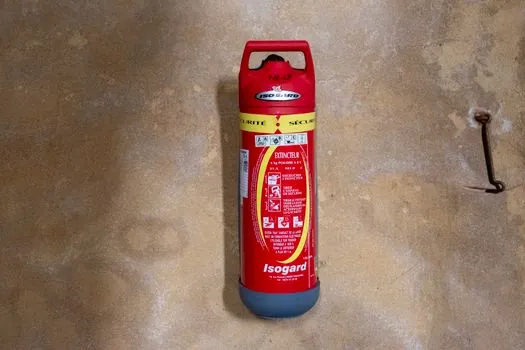
Any release system on a construction project should be third-party listed to UL, FM Approval, or VdS, and the listing mark must appear on both the control panel and the cylinder bank, because the listing is what binds the agent, pipe, nozzle, and detection hardware into a single approved envelope [S2]. A common procurement error is buying a listed cylinder bank but an unlisted pipe and nozzle assembly, which voids the system listing and can void the insurance binder. For inert systems, the cylinder bank is the dominant volume: a 50-litre nitrogen or IG-541 cylinder at 200 bar stores about 10 m³ of gas at atmospheric pressure, so a 100 m³ room at 34% concentration needs roughly 4 m³ of agent per atmosphere of pressure drop, which multiplies the cylinder count quickly [S1][S2].
Construction-site constraints that rarely show up in office design but always show up in execution are: cranage access for the cylinder pallet, floor loading of the cylinder bank (a single 50-litre cylinder at 200 bar weighs about 70 to 80 kg), re-charge turnaround (clean agents ship in factory-sealed cylinders and are usually swapped rather than refilled on site), and the lead time for a listed releasing panel, which can run 4 to 8 weeks from a European or North American OEM [S2][S9]. Where a permanent sprinkler riser is still months away, a construction machinery and equipment staging area often becomes the highest-risk fire zone, and a local-application CO2 system on the generator day-tank or the bitumen boiler is a more proportionate answer than a full flooding system for the whole cabin [S4][S5].
Limits, Failure Modes, and What Gas Systems Will Not Do
Gas suppression is not a substitute for a fire extinguisher held for manual first response; portable extinguishers are required in parallel, and the gas system is the fixed-installation second line that protects the room when occupants are absent or unable to fight the fire [S2]. Gas systems also cannot suppress smouldering Class A fuels reliably without the 10-minute hold time, which is why the retention period is a design input, not an option. If the room envelope leaks faster than the agent can be topped up, the design concentration collapses and re-ignition follows; the door-fan test is the verification that the room can actually hold the agent for the rated retention [S2].
Failure modes that show up on construction sites specifically include: blocked nozzles from dust and overspray, which derate the discharge pattern; cylinder valves left un-installed during fit-out, which leaves the bank incapable of release; and detection that is not yet commissioned because the permanent fire alarm is still pending, which means the system is a mechanical asset with no triggering logic. Modular direct-discharge systems, where a heat-sensitive tube ruptures at the flame seat and dumps a clean agent such as FK-5-1-12 or HFC-227ea into the hazard without a control panel, are the common workaround for small enclosures like CNC machine cabins, vehicle engine bays, and electrical cabinets during the construction phase, and they are listed for those small, localised hazards where full-room flooding would be disproportionate [S8].
Where Gas Suppression Fits in the Wider Site Fire Plan
On a live site, gas suppression sits in a layered fire plan that also includes a temporary fire door to separate the protected cabin from the rest of the structure, portable extinguishers at the cabin entrance, and a permanent hydrant ring-main that comes online late in the project. Procurement sequencing should treat the gas system as a long-lead item ordered in parallel with the cabin fabrication, not after the cabin is on site, because the releasing panel lead time and the cylinder bank delivery window are the actual schedule risk, not the install labour [S2][S5]. For containerised data centres and modular switchrooms that are dropped onto a slab, factory-pre-engineered IG-541 or FK-5-1-12 systems are increasingly the default because the room envelope, pipe, nozzles, detection, and panel are listed and tested as a single assembly before the unit is lifted onto the truck [S8][S2].
Two trackable signals to watch through the rest of 2026 are the regulatory tightening of HFC-227ea over its GWP of about 3,500, which has already pushed new EMEA data-centre builds toward FK-5-1-12 and inert blends, and the steady decline in FK-5-1-12 unit cost as Chinese and Korean clean-agent capacity comes on line, which has pulled the per-100 m³ installed figure of $2,800 to $3,800 inside the cost band that inert systems used to own alone [S9][S3][S5].
See also our earlier report, Sand Reclamation Unit Selection for LED Hardscape Fixture Foundries.