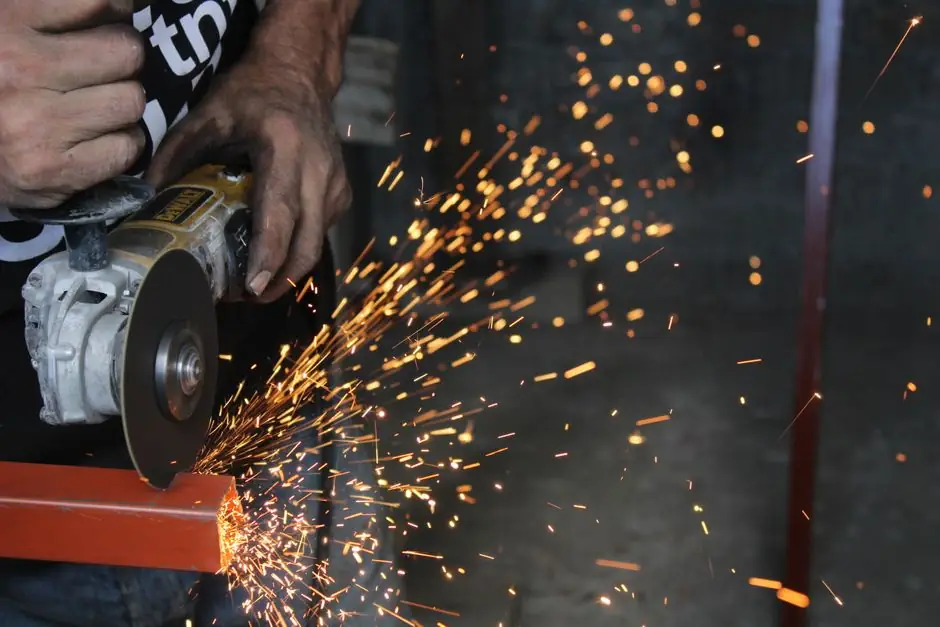
Welding bays expose fire doors to hot slag, spatter, and intermittent radiant heat, so the practical minimum is an FD60 (EI60) steel-clad leaf with a 50-55 mm mineral wool or calcium silicate core, third-party certified to BS 476 Part 22 or EN 1634-1, and the full door set, including ironmongery, must share one certification number under BS 8214 / EN 16034 framework rules [S1].
Selection follows three hard gates: a declared fire-resistance period (30, 60, 90, or 120 minutes), test evidence to BS 476 Part 22 or EN 1634-1, and third-party certification covering leaf, frame, intumescent seals, and ironmongery together [S1]. Welding adds a fourth practical filter, spark and spatter resistance, which is why steel-faced leaves dominate over timber in fabrication shops, while timber at FD30 still has a place in office partitions away from the hot work zone.
Rating Tier and Integrity vs Insulation for Hot-Work Zones
FD30, FD60, FD90, and FD120 designations correspond to 30, 60, 90, and 120 minute integrity ratings under BS 476 Part 22 / EN 1634-1, and integrity (E) measures flame plus hot-gas passage while insulation (I) limits the unexposed-face temperature rise to 180 K average and 360 K maximum at any point [S1]. For a welding bay wall, EI60 is the right default because the unexposed-face temperature cap matters when combustible storage or escape routes sit on the other side.
An E30 integrity-only door paired with BS 476 Part 31 / EN 1634-3 cold-smoke seals is rarely adequate for active welding; it is the cost-effective choice for corridor and stairwell applications where smoke leakage dominates the life-safety risk, not radiant heat and spatter [S1]. FD90 and FD120 are reserved for higher-risk enclosures such as transformer rooms, fuel stores, and cross-corridor sub-compartments in hospitals, and they are usually overkill outside those zones [S1].
Leaf Material, Core, and Thickness for Spark Exposure
Steel-clad fire doors for hot-work areas typically use a 50-55 mm thick leaf with a mineral wool or calcium silicate core, which delivers FD120 ratings while keeping leaf weight under 60 kg/m² so the closer can still swing the door shut against the post-weld air currents [S1]. Timber-based leaves in 44-54 mm thickness with particleboard or solid timber cores routinely achieve FD30 and FD60, but the cellulose-rich face chars faster under repeated spatter, so they belong in office sleeves, not on the welding cell perimeter [S1].
Any vision panel in a rated frame must carry its own test report and be referenced in the door-set certificate, because non-rated wired glass in a rated frame collapses the certification of the entire set, a failure mode that shows up often in retrofits where the original builder swapped the glazing for a cheaper plain glass lite [S1]. For welding-adjacent doors, specify fire-rated ceramic or borosilicate glazing with the same EI rating as the leaf, and keep the lite area small enough that the structural margin of the core is preserved.
Hardware, Intumescent Seals, and Ironmongery Discipline
Self-closing devices are mandatory on all fire doors except where held-open releases are wired to the fire alarm, and the closer must be CE/UKCA marked to EN 1154 with a power size matched to leaf width and weight [S1]. In welding shops, a hold-open tied to the fire alarm is risky because nuisance trips during grinding or hot-work permits will get the closer disabled, so a plain self-closing EN 1154 unit is the safer default.
Hinges must be CE/UKCA marked to EN 1935, with a minimum of three hinges per leaf on 44-54 mm timber leaves and Grade 13 stainless steel ball-bearing hinges as the default for 60+ minute steel sets [S1]. Intumescent seals are typically 10-15 mm wide graphite or sodium silicate strips, edge-mounted in the leaf or frame reveal, and expand at 150-200 °C to seal the gap between leaf and frame, while combined intumescent plus cold-smoke seals to BS 476 Part 31 are now standard in UK commercial specs [S1]. Latches and locks must be EN 12209 Grade 3 or higher for commercial duty, and every piece of ironmongery must be fire-rated and specifically chosen to work with the door set, with three or more heavy-duty, fire-rated hinges as the baseline for door size and weight [S2].
Frame, Wall Interface, and Installation
Frame material must match the certification evidence, with galvanised steel frames at 1.5-2.0 mm thickness for masonry and drywall openings, or hardwood frames at 32-44 mm minimum section size for timber stud partitions [S1]. The wall-to-frame interface requires mineral wool or intumescent-packed gaps of 10-25 mm sealed with fire-rated acrylic or intumescent mastic, and a sloppy packer gap is one of the most common reasons a certified door set fails its as-installed inspection.
For welding cells built into light-gauge stud partitions, swap the stud framing for a hot-rolled steel surround and use a steel frame to EN 16034 evidence, because the thermal mass of a timber frame cannot absorb repeated spatter without charring the reveal. The same logic applies to selection on adjacent plant: a concrete batching plant for demolition projects feeds hot-slag and abrasive dust into the same building services risers that pass through fire-rated walls, so the door set on the riser must hold EI60 even though the batching spec itself is unrelated. Hardware like capping and sealing equipment does not share the door-set certification, so it sits outside the BS 8214 evidence chain.
What to Avoid: Common Failure Modes on Welding-Bay Doors
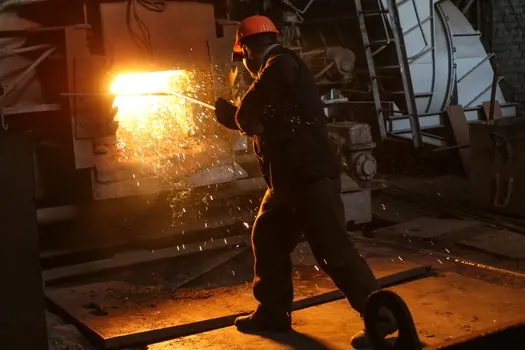
The single most common error is buying a certified leaf and pairing it with non-certified hardware, because under BS 8214 and EN 16034 framework rules the whole set must share the same certification number, and the inspector will fail the door the moment the ironmongery is off-certificate [S1]. A second error is specifying non-rated wired glass in a rated frame, which collapses the certification of the entire set even when the leaf and frame are sound [S1].
A third error is fitting a hold-open magnet without a fire-alarm interlock and then leaving the door wedged open during shifts, defeating both the self-closing requirement and the cold-smoke seal function [S1]. For welding, also avoid timber FD30 leaves on the hot-work perimeter: they meet the test but degrade fast under spatter, so the as-installed rating drifts below design rating within a service interval. The closer must remain functional during a fire, allowing the door to be opened and closed securely even under intense heat, and any closer that needs its hold-open pin engaged to shut is a closer that will fail in a real event [S2].
Comparison: Door Options for Welding-Bay Walls
For the four realistic candidates on a welding-bay perimeter, the decision matrix runs across fire rating, spark resistance, weight, and certification depth. FD30 timber (EI30, 44-54 mm particleboard core) is the cheapest option at roughly 25-35 kg/m², but spark resistance is poor and certification depth is limited, so it is only acceptable on office-side partitions at least 3 m from the weld cell. FD60 timber (EI60, 54 mm solid timber or mineral core) is heavier at 40-55 kg/m², still has mediocre spark resistance, and is acceptable on mezzanine office edges but not on the hot-work wall itself. [S1]
FD60 steel-clad (EI60, 50-55 mm mineral wool or calcium silicate core) at under 60 kg/m² is the workhorse for welding bays, with strong spark resistance and full BS 476 Part 22 / EN 1634-1 evidence on the complete set [S1]. FD120 steel-clad (EI120, 55 mm+ mineral core) at 55-70 kg/m² is reserved for transformer enclosures, fuel stores, and high-value sub-compartments where the extra 60 minutes of integrity justifies the heavier closer and the larger EN 1935 hinge count [S1]. Across all four, the one constant is third-party certification of the complete set, leaf, frame, seals, and ironmongery, because no individual component rating can stand alone.
For procurement teams tracking adjacent MRO spend, the same spec-discipline pattern shows up in FRP composite selection for automotive manufacturing, where a certified resin system paired with off-certificate reinforcement fails the same way a certified leaf fails with off-certificate hinges. Track the door-set certificate number, the closer EN 1154 power size, the hinge EN 1935 grade, and the seal BS 476 Part 31 reference on the as-fitted label, and the next inspection will pass on the first walk-through.
For the relevant spec sheets and selection criteria, see fire door, fire rated door, and welding cutting tool.