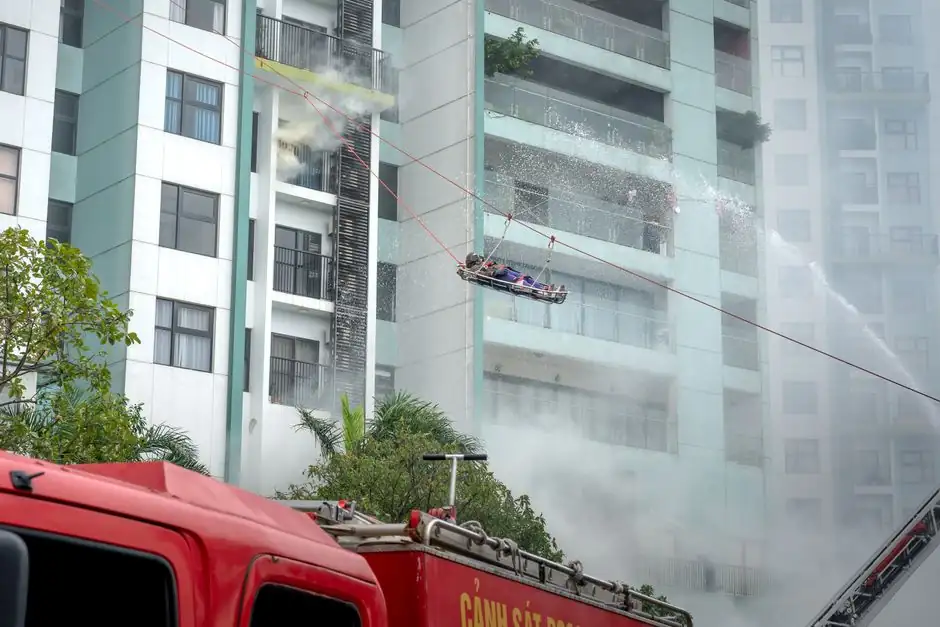
Selection of gaseous fire suppression for work-at-height zones (suspended platforms, aerial lift baskets, tower-crane cabs, mast-climbing work platforms) is governed by four independent constraints: agent toxicity under discharge, post-discharge visibility in the cab or platform envelope, weight budget on the suspended rigging, and recharging turnaround at field depot level [S1][S3].
At the technology layer, three families dominate: inert gas blends (IG-01, IG-55, IG-100, IG-541) stored in steel cylinders at 200-300 bar; chemical clean agents (FM-200 / HFC-227ea) in 4.2 MPa or 15 MPa cylinders; and high-pressure or low-pressure CO2 for unoccupied voids [S3][S5]. Work-at-height envelopes are small, typically below 20 m3 per cage, so a hanging-type or cabinet-type configuration fits where a manifolded network is over-spec [S1].
Inert Gas Blends (IG-01, IG-55, IG-100, IG-541): What Fits a Suspended Cage
IG-541 is a precisely blended mixture of 52% nitrogen, 40% argon, and 8% carbon dioxide, stored at 15 MPa (20 C) with a maximum operating pressure of 17.2 MPa at 50 C and a charging density of 0.21115 kg/L [S5]. At design concentration the agent lowers oxygen in the protected enclosure from the ambient 21% to a band of 12.5-14%, which is below the 15% combustion threshold for most ordinary combustibles yet remains breathable for the brief evacuation window [S5][S3]. The 8% CO2 fraction is the breathable-air trigger, stimulating respiration so operators do not suffer hypoxia during the 60-second hold [S5].
For work-at-height, the relevant parameters are total-flooding discharge time of 60 s or less, ambient operating range of 0-50 C, and activation power of DC 24 V at 1.5 A minimum, which means the system can be triggered from a 24 V battery pack on the platform without a mains feed [S5]. Steel cylinders at 200-300 bar and ANSI SCH80 drawn steel piping with forged fittings keep the agent path inert and mechanically robust for crane-induced vibration [S3].
CO2 (High and Low Pressure): Total Flooding vs Local Application
CO2 works by displacing oxygen to below the level that supports combustion, generally below 15% for ordinary Class A fuels, and it is about 1.5 times heavier than air, so it can pool in low spots and pit areas after discharge [S4]. CO2 is suitable as both a total flooding and a local application system, with the local-application form being the only credible option in normally occupied work-at-height spaces because the gas is toxic to personnel at the concentrations needed to suppress a fire [S4].
For unoccupied voids (hydraulic tank enclosures on a crawler crane, genset cowlings on a boom lift, cable trays in a tower-crane mast) high-pressure CO2 at 5.7 MPa or low-pressure CO2 at around 2.1 MPa with refrigerated storage is the workhorse, with reserve storage sized per local code when five or more protected zones share one system or when the system cannot be restored within 48 hours [S1][S4]. Reserve cylinders must equal or exceed the planned storage and must be switchable with the main container [S1].
FM-200 (HFC-227ea) and Other Chemical Clean Agents
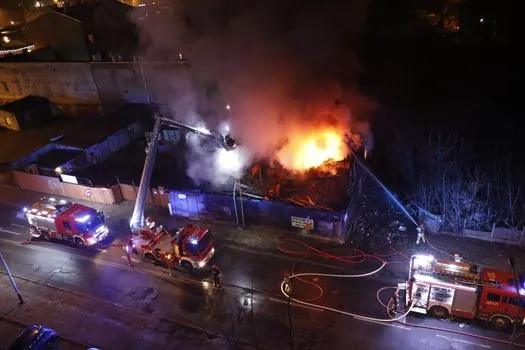
FM-200 systems split into three physical configurations, hanging type, cabinet type, and manifold (networking) type, and the choice is fixed by the protected volume and the number of zones [S1]. Cabinet and hanging types suit small enclosures such as a single operator basket; a manifolded network is only justified when the protecting area is up to 800 m2 with a volume up to 3600 m3, or a pre-engineered variant up to 500 m2 and 1600 m3 [S1].
When multiple FM-200 devices protect the same zone they must fire together with a time difference no greater than 2 seconds, and a single FM-200 system should not cover more than 8 protected areas or have more than 10 devices in any one zone [S1]. The HFC-227ea molecule is a chemical suppressant, not an asphyxiant, so it is the right call where post-discharge oxygen must remain at 21% for a trapped operator, but it carries a non-zero Global Warming Potential, so an environmental review is needed at spec stage [S3][S5].
Comparison Across the Three Families for Work-at-Height
On four decision criteria the families line up as follows. Storage pressure: IG-541 at 15 MPa, FM-200 at 4.2 MPa or 15 MPa, CO2 HP at 5.7 MPa [S1][S5]. Discharge time and oxygen outcome: inert gas reaches 12-15% O2 in about 60 s and remains briefly breathable, CO2 drives O2 below 15% but is toxic at that level for humans, FM-200 extinguishes by chemical chain-break without lowering O2 [S3][S4][S5]. Field recharge: inert gases (nitrogen, argon) are industrial commodities available locally, while HFC-227ea and CO2 may require import or specialist recharge tooling, which matters on remote wind-farm or tower sites [S3]. Post-discharge contamination: inert gas and CO2 are residue-free, FM-200 decomposes to trace HF under prolonged flame contact so electronics should be assessed [S3][S5].
The same comparison shows why suspended work platforms and mast-climbing work platform cabs almost always end up with either a small IG-541 cylinder bank or a local-application CO2 nozzle, never a full FM-200 manifold: the volume is under 20 m3 and the recharge path is the controlling constraint on remote sites.
System Architecture, Venting, and Cylinder Sizing on the Rigging
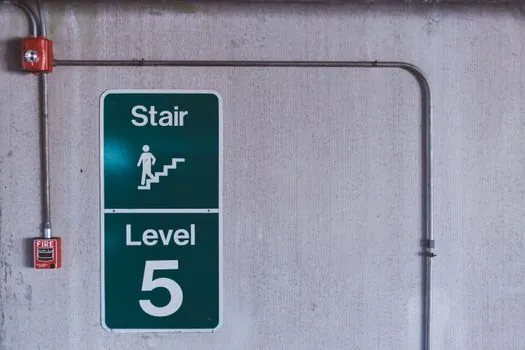
Piping on inert gas systems uses ANSI SCH80 drawn steel with forged fittings, and a header manifold connects the cylinders to a distribution network terminating in open-ended nozzles placed both in the room volume and, where fitted, under the suspended ceiling and floor [S3][S9]. Cylinders are steel drawn pressure vessels charged in the 200-300 bar range, with the cylinder valve actuated electrically or pneumatically and designed to prevent turbulent flow into the manifold [S3].
Because inert gas discharge raises room pressure, every enclosed hazard needs a calculated pressure-relief vent area; on a work-at-height basket this is often achieved by the door or hatch open area plus a louvered panel, sized to NFPA 2001 methodology rather than improvised [S3]. The notification chain is a detection-triggered panel driving a button, flasher, and siren, with three independent activation paths: automatic, manual, and mechanical emergency [S3][S5].
Selection Rules Specific to Work at Height
For occupied suspended cages, an inert blend is the default because it stays breathable at suppression concentration, and the 8% CO2 in IG-541 specifically addresses the hypoxia risk during evacuation [S5]. For unoccupied voids and hydraulic enclosures on the same machine, local-application CO2 keeps cost and weight low while delivering the oxygen-displacement effect that inert gas would also deliver but with heavier cylinders [S4]. FM-200 is reserved for the narrow case where electronics must see 21% O2 after discharge and the protected volume is small enough to fit a cabinet-type unit, which is also the configuration that matches a single basket [S1].
A practical field rule: cabinet and hanging-type gas suppression suits small protected volumes typical of work-at-height enclosures; the networking gas suppression configuration is for the large-volume, multi-zone plants and is over-spec for crane or platform cabs [S1]. For broader aerial work platform spec context including basket load class and hoist rating, the rigging side of the equation is covered in the platform's own selection path; the gas suppression layer only needs the agent weight, cylinder envelope, and pipe entry point to be agreed before procurement.
Limits, Failure Modes, and What Not to Specify
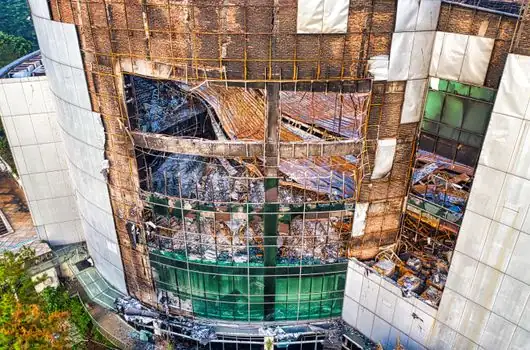
CO2 cannot be used in normally occupied spaces at suppression concentration because of the health risk, and any later change to equipment, pipework, or nozzle positions needs written sign-off from the design engineer, not a field retrofit [S4]. Inert gas systems need pressure-relief venting because discharge pressurises the enclosure, and they need a hold time long enough to prevent re-ignition once the fire is knocked down [S3].
FM-200 manifolded systems should not be specified for a single small platform because the area and volume limits (800 m2 / 3600 m3 networked, 500 m2 / 1600 m3 pre-engineered) make the hardware disproportionate, and exceeding the 8-zone or 10-device cap is a direct code breach [S1]. For a non-gaseous comparison baseline, fire extinguisher classes and placement rules for the same work-at-height zones are addressed separately, and the gaseous system is layered on top of, not in place of, portable extinguishers.
Trackable next signals for spec work in this area: vendor release of sub-15 MPa IG-541 cylinders under 25 kg empty for basket mounting, and any update to NFPA 2001 clean-agent limits that tightens the maximum allowable O2 drop for occupied enclosures. Until those move, the IG-541-at-15-MPa default plus a local-application CO2 backup for unoccupied voids remains the engineering-conservative spec for new builds through 2026.
The underlying component specifications are covered under gas fire suppression.