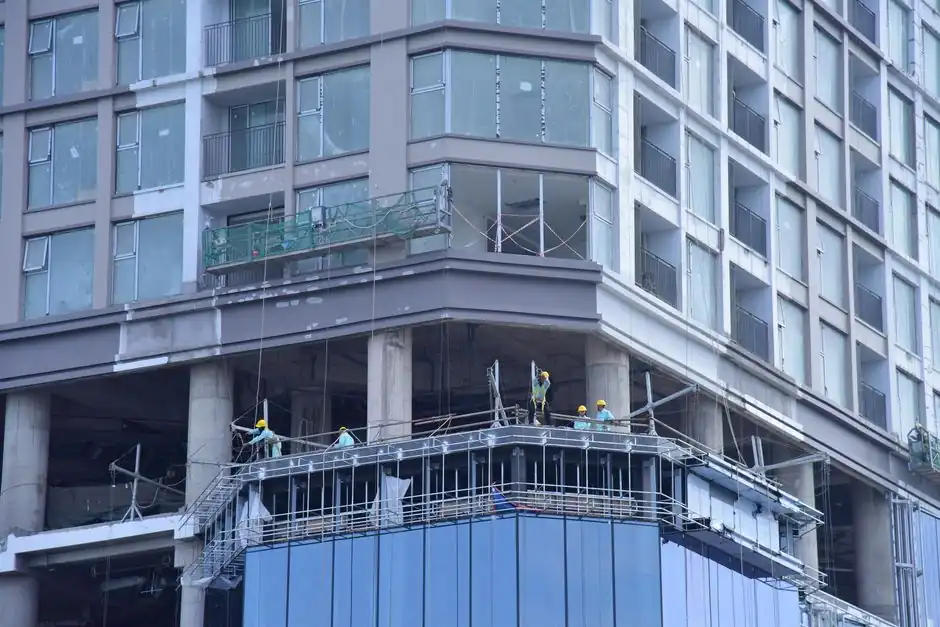
Selecting a suspended working platform for concrete repair, façade remediation and underdeck bridge work in 2026 comes down to four binding numbers: platform length, hoist power, rated capacity, and wire-rope specification, with regulatory cover under Hong Kong Cap. 59I for cross-border Asian sites [S1][S3][S5].
Modular electric suspended platforms such as the SEKLIFT SM-GAP-101 ship in 1.5, 3, 4.5 and 6 m working lengths, pair with twin 1.1 kW hoists, lift 500 kg at 0.15 m/s, and run on 380 V supply, a configuration that lines up with the light-to-medium concrete patching envelope rather than heavy demolition [S3].
Platform Types and Where Each Fits on Concrete
A two-point adjustable swing stage remains the default for high-rise façade concrete repair, restoration and window-washing because two suspension ropes are simple to rig and quick to relocate up a tower face [S1]. For underdeck work on bridges, wharves and conveyors, an engineered V-Deck suspended platform delivers 60-75% fewer installation and dismantling man-hours than conventional scaffold and runs 80-85% lighter in self-weight, which directly cuts imposed load on aged concrete soffits [S4]. Single-point adjustable (boatswain's chair) platforms stay restricted to inspection and light patch work in narrow vertical shafts, while multi-point adjustable rigs cover tanks, chimneys and silos where concrete crews need frequent height changes [S1]. A V-Deck rig is the right call when the asset geometry is linear, the concrete soffit cannot accept heavy scaffold dead load, and the programme cannot absorb a multi-week scaffold erection cycle [S4]. A swing stage is the right call for vertical façade patching where anchor points are abundant and platform re-positioning is the main productivity lever [S1].
Rating, Hoist Power and Rope Specification
The 500 kg rated capacity of the SM-GAP-101 covers two workers plus handheld tools and a small concrete mortar bucket, but it is not sized for moving wet concrete in volume; crews running larger pour volumes or carrying demo shears need to step up the deck length rather than overload the hoist envelope [S3]. Twin 1.1 kW hoists at 0.15 m/s vertical speed give a controlled ascent that matters when patching overhead concrete, since jerky hoist behaviour translates directly into spalling risk at the patch interface [S3]. The platform's specified 10 mm 6×19 galvanized wire rope, electromagnetic brake plus two block-stop brakes, and 14° tilt limit form a layered safety envelope, with secondary rope protection remaining active even if the primary hoist brake is held open [S3]. On the regulatory side, Hong Kong's Cap. 59I Construction Sites (Safety) Regulations frame suspended working platform duties, including the suspended-working-platform provisions, and must be read together with site-specific rescue planning [S5].
Payload, Reaction Forces and Tool Pairing

Basket payload for concrete work must be calculated as persons plus tool plus accessories plus hose bundles, with a safety margin and a moving-centre-of-gravity allowance, because cutting and splitting tools generate reaction forces on the worker, the platform and the surrounding structure [S2]. Low-vibration methods such as splitting with a rock wedge splitter or shearing with a concrete demolition shear reduce structural vibration into the deck, which protects both the patch substrate and the worker's stance on a suspended platform [S2]. Articulating-telescopic booms and crawler or spider platforms are generally better matches than rope-suspended decks when the concrete crew needs lateral reach across projections, shafts, or uneven ground, since rope-suspended platforms are repositioned vertically, not laterally, during the lift cycle [S2]. Mast platforms with a small footprint and optional jib are the better fit for interior concrete column or ceiling work where ground access is tight, while a suspended platform remains the right pick for vertical exterior surfaces.
Comparison: V-Deck vs Swing Stage vs Mast Platform
Side by side, V-Deck underdeck systems win on installation labour (60-75% fewer man-hours) and self-weight (80-85% lighter) compared to conventional scaffold, but require engineered rigging from the soffit structure itself [S4]. Two-point swing stages win on reusability across many façade elevations and on simple two-rope rigging, but cannot reach underdeck geometry without a rigging change [S1]. Mast platforms win on interior accessibility and small footprint, but cannot match the linear working length of a 6 m suspended deck on long façade runs [S2]. Crews running heavy concrete demolition shears also need to look at an aerial work platform when the work basket must carry the reaction loads of high-force cutting tools.
What Suspended Platforms Are Not Good For
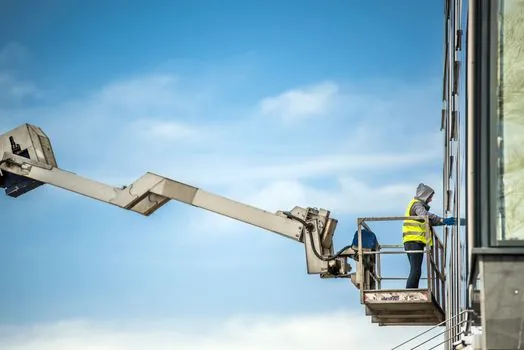
Suspended platforms are not designed to carry heavy materials or wet concrete in bulk, and the published guidance is explicit on that point, so any pour-volume specification has to be solved with a hoist and skip rather than the work deck [S1]. They are also the wrong tool where the overhead structure cannot supply verified anchor capacity, or where the asset geometry rules out a continuous suspension line, since both swing stages and V-Deck rigs depend on a rated overhead support path [S1][S4]. A suspended ceiling terminology match is worth flagging only because procurement searches sometimes conflate interior ceiling-hung access with exterior rope-suspended work decks, and the two are governed by different load and rigging regimes.
Standards and Sourcing Trail
Site-specific suspension rig, anchorage, counterweight, installation and rescue planning must be reviewed against the actual asset, and the manufacturer explicitly stops short of certifying any one rigging layout as universal [S3]. Hong Kong Cap. 59I is the verified regulatory anchor for sites under that jurisdiction, with the text consolidated to 23 August 2026 and last revision dated 11 June 2026 [S5]. Platform selection is the same logic used for an aerial work truck or a platform trolley: match the load chart and reach diagram to the concrete task, not the other way round. Trackable next nodes: confirm hoist duty cycle against expected lifts per shift, verify wire-rope certification traceability per batch, and lock the rescue plan before the first ascent on every concrete job.
See also our earlier report, Modified Bitumen Membrane Selection for Hospital Roofs and Wet Zones.