
For open-pit and underground mining equipment, a fully-crowned external-internal gear coupling remains the default high-torque connector between motor and gearbox, and between gearbox and driven machine, with torque densities and misalignment budgets that elastomeric and disc couplings cannot match at the same bore size [S1][S2].
The selection discipline is not exotic: pick a catalogue rating, multiply by a mining service factor, and verify that the unit fits the shaft, the misalignment budget, and the planned relubrication interval. The cost of getting it wrong is documented in the hundreds of thousands of dollars per hour of unplanned crusher or SAG mill downtime [S2].
Mining Service Factor Range and AGMA Basis
Service factor for mining couplings runs 1.75 to 2.5 under AGMA-aligned catalogues, well above the 1.25 to 1.5 used in general industry, because primary crushers apply 3 to 4 times nominal torque on every start, SAG and ball mills run continuous cyclic loading, and slurry pumps add torsional excitation [S2].
A representative calc: an 800 kW motor at 1500 rpm delivers roughly 5090 Nm nominal, and a primary-crusher drive selected at SF = 2.0 must therefore withstand at least about 10,180 Nm [S2]. Sizing on nameplate torque alone, without the service factor, is the most common route to cracked teeth, deformed flexible elements, and premature coupling failures [S2].
Equipment-to-Coupling Map: Crushers, Mills, Conveyors, Drills
Drum and full gear couplings dominate low-speed, high-torque drives on rotary and down-the-hole drills, electric shovel hoists, and the swing, crowd, and propel motions of mining shovels, because they compensate for vibration and structural deflection during the impact load of each drill bit strike [S4].
For ball mills, SAG mills, and primary gyratory or jaw crushers, the same logic applies but the bore grows: drum gear couplings are preferred for heavy, cyclic, low-speed loads, while disc (metal diaphragm) couplings sit on the high-speed motor-to-reducer end where alignment precision matters and lubrication is undesirable [S4].
Long-distance belt conveyors running 24/7 with start-stop dynamic loads also lean to full gear couplings for their torque margin, although unlubricated flexible couplings are often used on auxiliary conveyors, mine fans, and slurry pumps where absorption of torsional vibration outweighs peak torque [S3][S4].
Misalignment Limits and Why 0.25 Degrees Matters

Standard flexible gear couplings tolerate up to about 1.5 degrees of angular misalignment and roughly 0.25 mm of radial offset, but holding installed values to angular of 0.25 degrees and radial of 0.25 mm is what keeps the crowned teeth alive; an installed angular misalignment above 0.25 degrees has been shown to cut tooth life by more than half in mining service [S2].
The coupling cannot be evaluated in isolation: it sits in a driveline whose other flexible element is the gear reducer or helical gear reducer upstream, and the alignment procedure must respect the reducer shaft position, the pillow-block growth under thermal load, and the structural deflection of the mining skid under ore bin pressure [S1][S2].
Lubrication, Sealing, and Inspection Intervals
Grease-lubricated gear couplings in mining should be re-lubricated every 2000 to 3000 hours using a high-viscosity NLGI 2 grease with EP (extreme-pressure) additives, because abrasive dust contamination of the lubricant is the dominant wear accelerator on crowned tooth flanks [S2].
Unlubricated flexible couplings, whether elastomeric jaw type, composite element type, or metal diaphragm type, eliminate the grease path and the seal failure mode but cap continuous operating temperature near 90 degrees Celsius, with typical elastomer life of 1 to 3 years before the element must be replaced [S2].
Selection Criteria Comparison: Gear vs. Elastomeric vs. Disc
On torque density, gear couplings lead by a wide margin at any given bore; on misalignment tolerance, gear and elastomeric couplings are broadly comparable (around 1.5 degrees angular) while disc couplings trade some misalignment range for zero backlash; on maintenance burden, disc and elastomeric couplings are essentially maintenance-free in the mining sense, while gear couplings demand a scheduled re-grease every 2000 to 3000 hours [S2][S4][S5].
On environmental exposure, sealed gear couplings and stainless-diaphragm couplings handle dust and corrosive ground water best, whereas open elastomeric spiders degrade quickly in oily or solvent-laden atmospheres; on speed ceiling, disc couplings are the right answer for turbines, compressors, and high-speed gear-reducer inputs where gear pump style lubrication is impractical [S2][S4][S5].
Who Gear Couplings Are For, and Who Should Pick Something Else
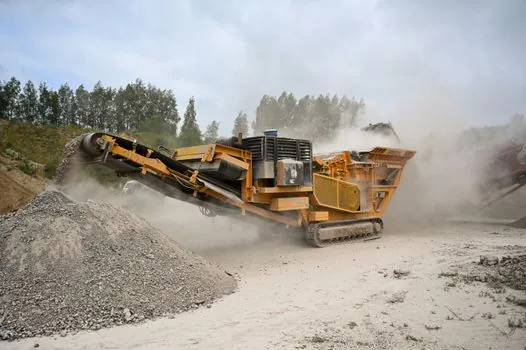
Gear couplings are the right answer for primary and secondary crushers, SAG and ball mills, long overland conveyors, and the heavy-duty motions of electric shovels, where torque per millimetre of bore and the ability to swallow shock loads are the binding constraints [S1][S2][S4].
Elastomeric or disc couplings are the better answer for auxiliary conveyors, mine ventilation fans, slurry pump drives, and any motor-to-industrial gear reducer input where zero lubrication, vibration damping, and rapid element replacement outweigh peak torque, and where the expected duty cycle and ambient temperature stay inside the elastomer's roughly 90 degrees Celsius cap [S2][S5].
Failure Signals and Replacement Triggers
Common field indicators that a mining gear coupling is at end of life include excessive backlash measurable at the shaft, worn or polished tooth flanks visible at inspection, oil or grease leakage past the seals, cracked sleeves, hub fretting or damage, elevated vibration, lubrication contamination by dust or water, and repeated seal failures despite replacement [S1].
For mining shovels, drills, and mills, retrofits to interchangeable form-fit gear couplings from FLENDER, KTR, Falk, and Bibby patterns are a common path when the original brand's lead time exceeds the maintenance window, provided bore, keyway, overall length, and lube ports match the existing hardware [S1].
Standards, Sourcing, and Spec Discipline
Coupling ratings and service factors in this article are drawn from AGMA-aligned manufacturer catalogues, and the 1.75 to 2.5 mining service factor range is a catalogue convention rather than a single AGMA table, so spec sheets should cite the specific catalogue edition used [S2].
For related selection logic on the driveline side, the sprocket and timing-pulley sizing rules for adjacent drives follow similar service-factor and teeth-engagement logic, as mapped in the sprocket selection guide for textile mills and the timing pulley selection guide for packaging lines, which can be useful cross-references when a mining conveyor or pump skid also carries a chain or belt section.
Track these two signals over the next planning cycle: AGMA service factor updates for mining drives (revision history usually published in the spring cycle), and mill-side vibration-monitoring thresholds for crowned-tooth wear, typically flagged when broadband vibration at the coupling frequency climbs above roughly 1.5 to 2 times the new-equipment baseline.