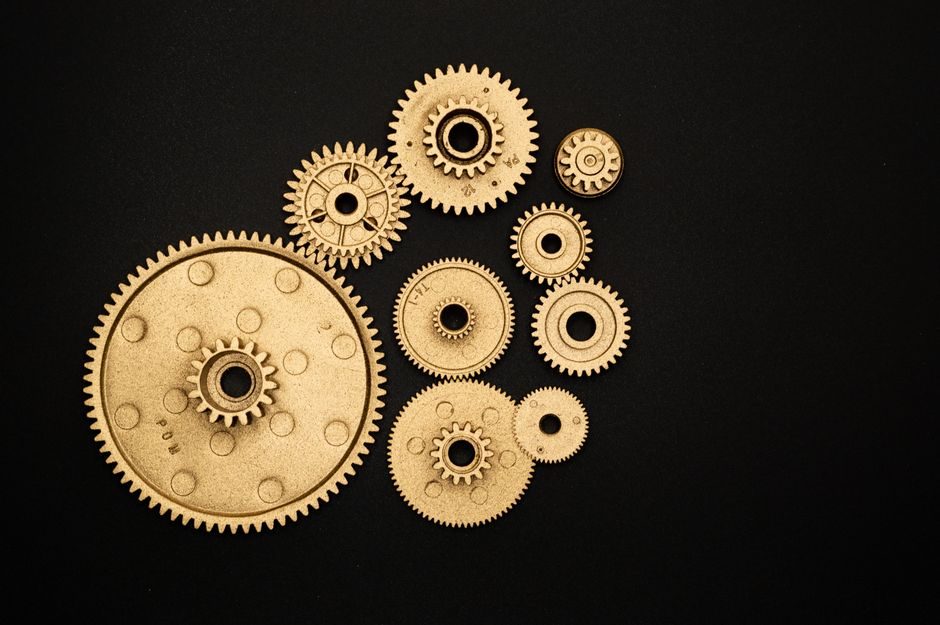
Backlash in a gear pump is not a single number — it is a stack of three tolerances that must close simultaneously for the pump to deliver rated flow, hold rated pressure, and survive the fluid it is asked to move [S1][S2].
The first layer is the drive interface: motor shaft, coupling, and pump input geometry. The second is the gear-tooth geometry: tooth profile, helix angle, and the centre-distance allowance that defines volumetric slip. The third is the fluid-side material window, which sets the maximum permissible wear rate before backlash drifts out of spec. Two 2026 OEM data sheets — Diener's Silencer Series [S1] and Micropump's GJR [S2] — illustrate the full range of where real products sit on that stack.
Defining the Three Backlash Layers a Spec Sheet Actually Controls
Tooth-flank backlash in a gear pump is the small radial gap between the driving gear and the idler that lets the gears mesh without binding under thermal growth and hydrodynamic load. Diener's Silencer Series uses a "robust helical gear design" with a flow range of 50–6500 ml/min and a magnetic coupling that decouples the motor from the wet end [S1]. That magnetic coupling adds a deliberate axial air gap on top of the tooth-flank gap, and the pump is rated for differential pressures of 4 bar, 6 bar and 15 bar (58–218 psi) on stainless-steel and EPDM wetted parts [S1]. For a background primer on what a gear pump is and where it sits in a process line, the encyclopedia entry is the quickest cross-reference.
Micropump's GJR is the opposite end of the stack: solid nickel-carbide spur gears, a magnetic drive, side-port cavity, and three displacement options of 0.316 ml/rev (N21), 0.64 ml/rev (N23) and 1.23 ml/rev (N27) [S2]. It is rated for pressures from 5.5 to 21 bar (80–305 psi) and fluid temperatures from –46 °C to +132 °C [S2]. Spur teeth on a fixed centre distance leave less room for thermal expansion than helical teeth, which is one reason the GJR leans on a nickel-carbide wear surface rather than a wider tooth-flank gap to manage life. The same trade-off shows up in any industrial gear train: tighter centre distance means tighter backlash budget.
Mechanical Interface: Coupling Selection That Will Not Eat Your Backlash Budget
The first number to close on a VFD-driven gear pump is the coupling's angular and parallel misalignment allowance, measured against the pump shaft's first critical speed and the motor's torque ripple. A typical precision gear pump from the Silencer Series has "low drive inertia" specifically so it can be "rapidly accelerated/decelerated" for precision flow control [S1] — meaning the coupling must transmit that responsiveness without introducing torsional wind-up that would mask backlash errors. A gear coupling is the usual match for parallel-shaft gear pumps because it carries higher torque per millimetre of envelope than a jaw or elastomer coupling and tolerates a defined angular misalignment in degrees, not thousandths of an inch.
For small-frame magnetically-driven pumps like the GJR (0.34–0.45 kg, OEM-configured) [S2], the coupling is often the magnetic drive itself plus a clamp-style adapter to a NEMA or IEC motor frame. The risk to watch: the magnetic drive's axial air gap adds a non-contact torsional spring in series with the gear teeth. If the motor-side coupling is too stiff, the gear mesh sees the full torque ripple; if it is too soft, the flow loop never settles. Backlash compatibility at this interface is therefore about matching coupling stiffness to the gear set's torque-to-inertia ratio, not about picking the most rigid coupling on the shelf.
Gear-Set Geometry: Helical vs. Spur vs. Internal-Gear, by the Numbers
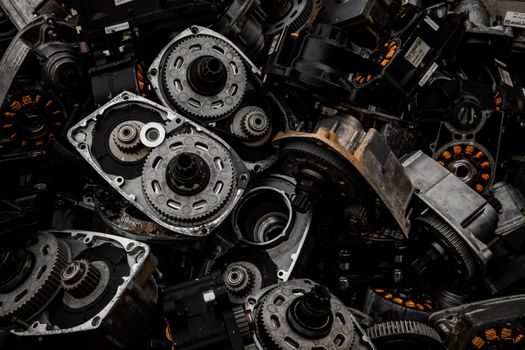
The Diener Silencer uses helical gears, a profile that splits each tooth's load across a line of contact rather than a single point, which is why OEM literature leans on "low noise" and "long life" claims [S1]. Helical geometry also allows a slight axial thrust component, so the pump's thrust bearings — not the tooth mesh — are usually the first wear point. In a spur-gear pump like the GJR, the load is concentrated on a single tooth pair at any moment and the thrust bearing does not see the gear mesh; instead, the side-port cavity and the nickel-carbide wear surfaces carry the punishment from abrasive fluids such as pigmented paints, inks, and metal-loaded chemistries [S2].
For comparison, an internal gear pump (often labelled a "helical gear reducer" style positive-displacement unit) typically runs cooler than a spur pump because the idler gear is smaller and rides partly inside the rotor — a configuration that tolerates a wider centre-distance drift before the tooth tip scuffs the case. By contrast, a precision external-gear pump like the Silencer is built around tight centre-distance control and a magnetic coupling that isolates the motor entirely [S1]. The practical rule: helical for noise and life, spur for simplicity and cost, internal-gear for hot or viscous fluids where thermal growth of the housing would otherwise close the tooth gap to zero.
Fluid-Side Limits: Pressure, Temperature, and Chemistry That Re-Open the Backlash Window
Fluid specifications decide how fast backlash opens up in service, and the published limits on the two reference pumps are a useful bracket. The Silencer is rated 0–95 °C with EPDM and stainless wetted parts for "aggressive media" [S1] — aggressive is a wide claim, but EPDM is a known weak point against petroleum and aromatic hydrocarbons, so the pump is implicitly not specified for oils and solvents. The GJR is rated –46 °C to +132 °C in metal-and-nickel construction [S2], which extends both downward (cryogenic and chilled-water loops) and upward (hot oil, polymer melts) compared with the EPDM-bounded Diener unit.
Pressure ratings reinforce the same split. Diener publishes 4 / 6 / 15 bar options on the same magnetic-coupling frame, allowing a buyer to pick the gear set and magnet strength rather than oversizing the housing [S1]. Micropump publishes a single 5.5–21 bar envelope on the GJR with three displacement gear sets that cover 0.316 to 1.23 ml/rev [S2]. In both cases, the higher the differential pressure, the tighter the backlash budget the gear set can tolerate before volumetric efficiency collapses, because higher pressure widens the pressure-loaded flank and pushes the unloaded flank open. Sizing the wrong pump for the system pressure curve is the fastest way to turn a one-time commissioning adjustment into a chronic slip-rate problem.
Who a Precision Gear Pump Is For — and Who It Will Bite
Specify a helical, magnetic-drive precision gear pump like the Silencer [S1] when the job is clean-in-place chemical dosing, beverage metering, or lab/medical transfer at 50–6500 ml/min, and the fluid is compatible with EPDM and 316L stainless. The compact envelope and low drive inertia make it the right answer for OEM skids where panel space and noise matter more than raw pressure. The Silencer is the wrong tool for slurries, abrasive pigments, or any petroleum-based fluid, because EPDM will swell and the tight helical mesh will trap particles.
Specify a spur-gear, nickel-carbide magnetic-drive pump like the GJR [S2] for abrasive paints, inks, metal-loaded chemistries, and OEM modules that need a small, serviceable pump in the 2.5–53.4 US gal/h range with system pressures up to 21 bar and fluid temperatures from cryogenic to 132 °C [S2]. It is not the right tool where low flow pulsation is critical (spur meshing inherently pulses) or where the fluid attacks nickel — strong oxidisers and some halides will pit nickel-carbide surfaces. The use cases are largely non-overlapping with the Silencer, which is the most important back-compat lesson: backlash specs only matter once the right pump class is on the shortlist.
Comparison: Helical Magnetic-Drive vs. Spur Magnetic-Drive vs. Internal-Gear
For a buyer comparing the main positive-displacement options on backlash-relevant criteria: (1) typical flow band — Silencer 0.05–6.5 l/min [S1], GJR 9.5 l/h–3.4 l/h, internal-gear typically tens to hundreds of l/min and up; (2) pressure ceiling — Silencer 15 bar, GJR 21 bar, internal-gear commonly 10–25 bar with larger frames higher; (3) temperature window — Silencer 0–95 °C, GJR –46 to +132 °C, internal-gear often 200–300 °C with appropriate seals; (4) abrasive-fluid tolerance — helical poor, spur with carbide good, internal-gear moderate to good depending on idler material. The takeaway: a tighter backlash budget raises volumetric efficiency but lowers abrasive tolerance, and the OEM has already pre-traded that for you by choosing the gear profile.
Common Pitfalls That Pass a Datasheet Check but Fail on Site

Three integration mistakes show up repeatedly. First, ignoring magnetic-drive heat rejection: the GJR is rated to 21 bar [S2], but at sustained maximum differential pressure the eddy-current losses in the magnet canister can heat the fluid above its viscosity curve and the apparent backlash will drift as the housing expands. Second, mounting a precision pump on a flexible coupling that is too soft for the application's torque ripple; the gear mesh sees torsional oscillations the OEM never tested. Third, specifying EPDM against trace hydrocarbon contamination because the catalog only lists "aggressive media" [S1] — "aggressive" is the OEM's word for acid/alkali, not solvent, and a compatibility matrix for the specific chemical family is the next step before purchase. A final cross-check that catches most of these is a maintenance walkthrough of the centrifugal pump and diaphragm pump entries in the encyclopedia to confirm a PD pump is even the right class for the duty.
For adjacent spec writing on related rotating equipment, the coding machine TCO driver map and the oil seal certification checklist both touch the same shaft-and-seal integration questions from a different angle.