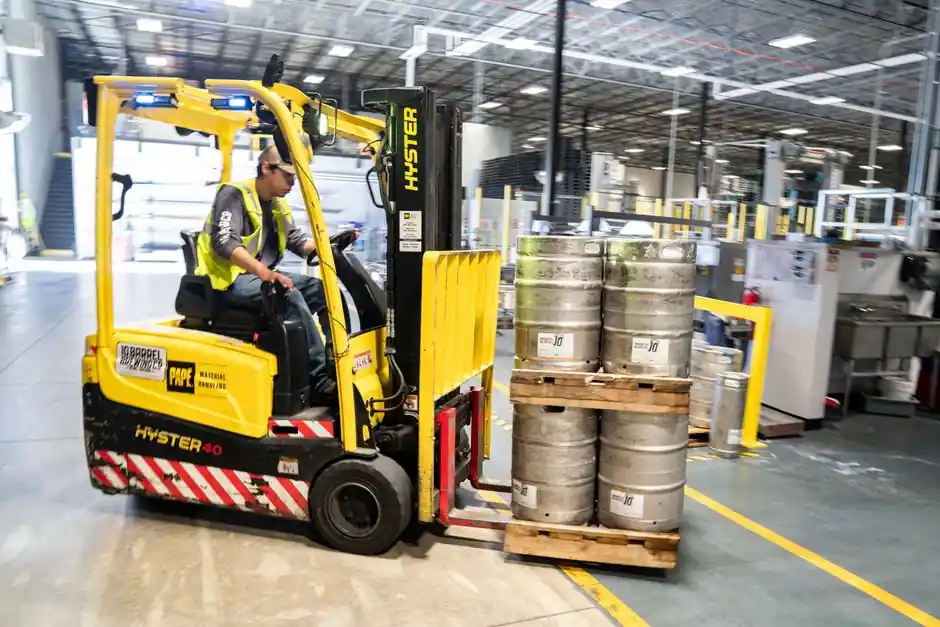
Material handling gearbox selection in 2026 is governed by AGMA 6034 service-factor class, ISO 6336 stage-count rules, and a thermal-plus-overhung-load verification that most catalog-only sizing routines skip. A conveyor gearbox spec runs on four inputs: motor RPM (1450 at 50 Hz, 1750 at 60 Hz), output RPM at the head pulley, conveyor archetype with hours-per-day duty cycle, and material shock-load character, per August 2026 engineering guidance [S1].
These four inputs drive four lookups: AGMA 6034 service-factor class, ratio bracket with stage count, gearbox family, and thermal-plus-overhung-load verification. The dominant failure mode remains sizing to running torque at SF 1.0, then seeing gear-tooth fatigue at 18 months on a 24-hour shock-loaded belt. For a material handling line that handles bulk ore or palletised goods, the spec math starts before any vendor selection. Engineers working cement, mining, and packaging lines can apply the same four-lookup discipline, and the cement-kiln-mill edge case is covered separately in a cement-plant gearbox spec map.
Service Factor Per AGMA 6034, Not Catalog Defaults
Per AGMA 6034, the service factor for a 24-hour shock-loaded conveyor is 2.0, not the 1.4 most catalogs default to [S1]. The class definitions cover three duty bands: Class I (min SF 0.8) for steady load 8-10 h/day; Class II (min SF 1.4) for steady 24 h/day, or moderate shock (≤1.25× rated) at 8-10 h/day; Class III (min SF 2.0) for moderate shock 24 h/day, or heavy shock (>1.25× rated) at 8-10 h/day.
Design HP equals Prime Mover HP times the applicable SF, so SF 2.0 doubles design HP versus SF 1.0. A 24-hour belt conveyor sized at SF 1.4 instead of 2.0 sees gear-tooth fatigue at the bearing-replacement interval, not at design life. A uniformly loaded screw conveyor at 3-10 h/day sits at Class II. A general conveyor duty recommendation of SF 1.4-1.6 is appropriate for moderate overload peaks and speed fluctuations on long-duty operation [S5].
Gear Ratio, Stage Count, and the ISO 6336 Ceiling
Gear ratio is i = n_in / n_out. An industrial belt-conveyor head pulley turns 20 to 80 RPM; packaging lines up to 150; heavy bulk handling 5 to 30 [S1]. A worked example: a 1.5 m/s belt on a 0.4 m drum needs n_out = 1.5 × 60 / (π × 0.4) = 71.6 RPM. Ratio from a 1450 RPM motor is 1450 / 71.6 ≈ 20:1, which is two-stage helical.
Per ISO 6336 / DIN 3990 cylindrical-gear geometry, a single-stage helical caps near i = 7:1 before center-distance and tooth-profile constraints force a second stage. Two-stage reaches roughly 50:1; three-stage extends past 200:1. Each stage takes 2 to 5 percent off mechanical efficiency. A 29:1 single-stage helical quote is physically incorrect; a 29:1 two-stage worm at 65% is correct on ratio but wrong on energy economics. For low-speed, high-torque work, multi-stage reductions become necessary; for high-speed, light-duty conveyors, single-stage reductions are sufficient [S2].
Family Fit by Conveyor Archetype

The archetype determines which family fits the layout, not just the duty rating. Straight horizontal belt conveyors map to inline helical (R/MD) at 0.12-160 kW and 30-150 RPM. Shaft-mount on head pulley maps to parallel-shaft helical (F/MP) at 0.12-200 kW and 20-100 RPM, with the hollow output bore mounting directly on the drive-pulley shaft to eliminate foundation rebuild on a retrofit. Inclined, curved, or right-angle layouts need bevel-helical (K/MJ) at 5-60 RPM. Heavy-duty mining and steel mills run MTH helical or B-MTB bevel-helical up to multi-MW. Packaging and light-duty applications use worm (NMRV) or helical-worm (S/MN) below 2.2 kW [S1].
Comparing the main options against four decision criteria clarifies the trade space:
* Helical inline: 95+% per-stage efficiency, ratio 5:1 to 300:1, best for continuous horizontal belt, but longest footprint.
* Worm (NMRV): 65-85% efficiency, ratio 10:1 to 100:1 in a single stage, self-locking at ≥30:1, best for inclined conveyors where back-driving is unacceptable.
* Bevel-helical: 90-94% per stage, ratio up to 200:1, right-angle output, best for compact transfer stations and inclined layouts.
* Cycloidal: shock-resistant, ratio up to 100:1 per stage, used where many starts and stops occur [S2][S3].
Worm gearboxes carry a self-locking characteristic at ratios ≥30:1 that eliminates the need for external backstops, and their 90° right-angle output allows motor mounting parallel to the frame, reducing installation footprint by up to 40% [S3]. For washdown and packaging zones, the same right-angle-plus-self-locking logic is used but with stainless hardware and food-grade lubricant, a case covered in the packaging-line gearbox map.
Thermal Capacity, Overhung Load, and the 5,000 USD/h Downtime Anchor
Downtime in material handling operations can exceed $5,000 per hour, which is why thermal-plus-overhung-load verification matters more than catalog headline torque [S3]. Three-stage helical at 94% per stage delivers roughly 83% overall efficiency, and that loss compounds in the thermal math. A gearbox rated 20-30% above the calculated torque achieves longer life under continuous duty, a margin that absorbs dynamic peaks during startup and material accumulation [S5].
Overhung load on a head-pulley shaft-mount needs separate verification, since the belt pull creates a bending moment that the output bore and bearing stack must carry. For heavy machines like screw conveyors and bucket elevators, radial and axial loads need review during sizing, and finding a good service factor keeps all parts within safe limits [S2]. Carburised and ground gears can reach up to 98.5% mechanical efficiency with bearing life exceeding 25,000 hours in 24-hour environments, but only when oil temperature stays inside the thermal limit [S5].
Feeder and Sorter Spec Bands: Where Precision Rules
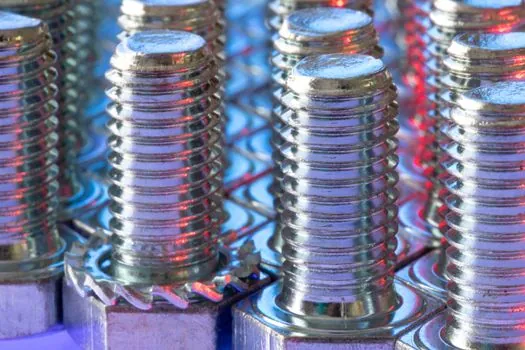
Feeders and sorters sit at the highest-precision end of the material handling gearbox application spectrum. A vibratory feeder that over-delivers product by 5% introduces a batching error in a pharmaceutical fill line; a divert sorter that mis-times by 50 ms sends a carton to the wrong destination.
A screw feeder uses a rotating helical screw in a trough, where feed rate (m³/min) = screw cross-sectional area × pitch × RPM × fill factor, and this linear relationship makes screw feeders highly amenable to VFD flow rate control. A worm gearbox with inherent non-back-drivability resists the tendency of material pressure to slow or reverse the screw, keeping the screw at commanded speed under momentary load spikes from bridged material breaking away from the hopper wall. For continuous-duty industrial screw feeders above 5 kW, helical-bevel gear motors with lower heat generation are preferred over worm types, particularly in warm environments [S4].
Roller Conveyor Zone Drives and Mounting Choices
Roller conveyors in e-commerce sortation centres and automotive pallet transfer lines run one gearbox per driven zone, so the unit must be compact, quiet, and rated for frequent start-stop cycles. Output torque typically sits at 50-1800 N·m for the MRV worm series at 10:1 to 60:1 ratios, while the SRV worm series reaches 200-2500 N·m at 15:1 to 100:1 [S3]. Self-locking engages at ≥30:1 for MRV and ≥25:1 for SRV.
Mounting choices split three ways: foot-mounted for stability on heavy-duty conveyors, flange-mounted (B5/B14) for compact integration with motor shafts, and torque-arm plus shaft-mounted for cutting bearing stress in complex layouts [S2]. Proper alignment of motor and gearbox is critical to prevent misalignment of the gear and excessive wear, and flexible couplings and pulleys are designed to compensate for small amounts of misalignment only when set up correctly. All exposed rotating parts should be guarded per local industrial safety practice.
Standards, IP Ratings, and Long-Term Reliability
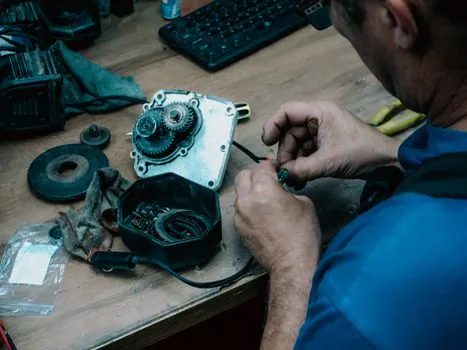
Material handling worm reducers in this class are manufactured to ISO 9001 and AGMA 6034-B92, with bronze worm wheels and tapered bearings specified for shock-load resistance, and OEM worm shafts, bronze wheels, tapered bearings, and seals all meet DIN 3974 tolerances for service life exceeding 20,000 hours [S3]. Sealed to IP54-IP55 with optional forced lubrication, the units are RoHS/CE compliant with recyclable housings.
Spare-parts availability matters: complete OEM worm shafts, bronze wheels, tapered bearings, and seals from stock cut mean-time-to-repair from weeks to days. Lifecycle cost is a function of the maintenance interval: worm gearboxes run 24-36 months between service events versus 12 months for helical units in equivalent duty, and worm gearboxes win on lifecycle cost when self-locking removes the need for a separate fail-safe brake [S3]. For tracked signals worth watching, monitor the next AGMA 6034 update and the IEC 60079 dust-zone certification for any gearbox specified in combustible-dust environments such as grain, coal, or chemical plants.
Detailed specification references: gearbox, and storage handling.