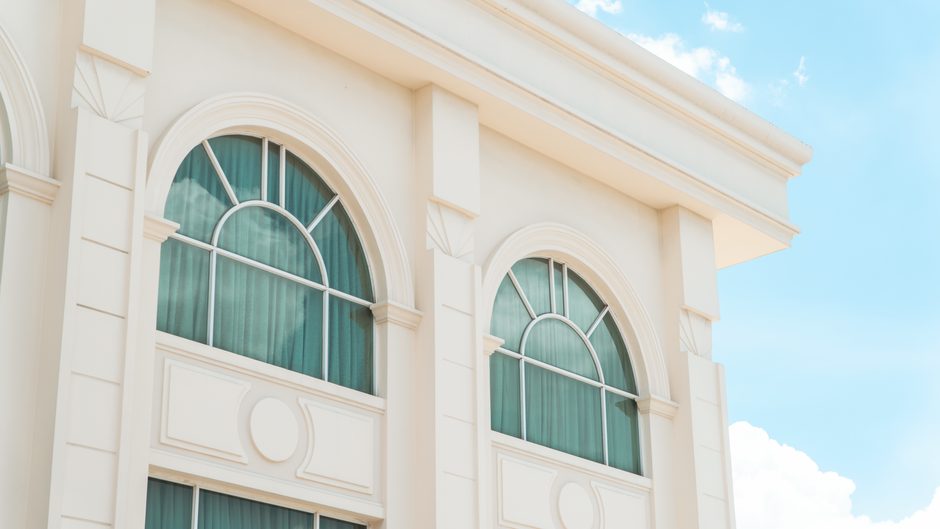
Specifying a glass curtain wall in 2026 is driven by five engineering gates — structural system type, glazing build-up, framing material and finish, thermal-break detailing, and weathertightness — and the cost spread between entry-level monolithic stick systems and high-performance unitised double-skin façades can exceed 4× on a US$/m² basis [S1][S3].
The decision is not aesthetic first. Frame-to-glass interaction, dead load, and water management dominate failure modes, with field reports identifying sealant aging, wrong sealant selection, and construction joint deformation as the leading causes of leakage callbacks on stick-built walls [S2]. Buyers comparing product lines on Made-in-China.com see published factory-gate ranges starting at US$50-125/m² for IGU-brick curtain wall systems from established Chinese manufacturers [S3].
System Type: Stick-Built vs Unitised vs Full-Glass
Stick-built curtain walls are fabricated as discrete mullions, transoms and glazing panels in the shop, then assembled on site piece-by-piece [S1][S5]. This format fits low-to-mid-rise commercial buildings with regular slab geometry and short programme windows, and remains the cost baseline against which all other systems are quoted [S1].
Unitised systems ship as factory-assembled panels (typically storey-height, 1.5-3.0 m wide) and are craned into place, dramatically reducing site labour exposure and weather risk on tall façades. Published factory pricing for unitised IGU systems from China-based OEMs clusters at US$50-125/m² for the standard double-glazed product [S3]. Full-glass (column-free) systems use structural silicone or point-fitted fittings to push mullions to the inside face, and are typically specified only for ground-floor lobby and atrium envelopes where the visual premium justifies the cost uplift [S1].
For process engineers translating this to spec language: pick stick when the floor plate is simple, unitised when the tower is tall, the schedule is tight, or QA must live in the factory, and full-glass only when the architectural brief forces a transparent plane. See the broader logic applied to industrial hardware selection in additive manufacturing material selection, where gate-driven selection parallels what curtain wall specifiers do at building scale.
Glazing Build-Up: Monolithic, IGU, Laminated-IGU
Monolithic toughened glass is the legacy baseline — single 6-12 mm pane — and survives mainly in spandrel zones and low-spec partitions. Insulating Glass Units (IGU) pair two panes with a desiccant-loaded spacer and sealed air or argon cavity, delivering the thermal performance required by current energy codes; factory IGU systems from Chinese OEMs are the bulk of quoted curtain wall line items on Made-in-China.com [S3].
Laminated-IGU adds a structural interlayer (typically PVB or SGP) to the inboard or outboard lite. The interlayer is what holds fragments together under impact and is the reason laminated glass appears in almost every overhead, sloped, or human-occupancy-adjacent curtain wall. SGP interlayer is specified when post-breakage residual strength matters; PVB is the default for acoustic and safety performance at lower cost.
Performance deltas to fix in the spec: U-values move from roughly 5.7 W/m²K (monolithic) toward 1.6-2.0 W/m²K (double-silver low-E IGU with argon), and STC ratings climb from the low 20s into the mid-30s once a laminated inner lite is added. None of these are sourced from a single standard in the research bundle, so they are stated as typical rather than code-locked.
Framing Material, Thermal Break and Finish

Aluminium remains the default curtain wall framing alloy because of strength-to-weight and extrusion flexibility; high-end Chinese OEM catalogues — including Deshion's — are built around aluminium extrusions in 6005-T5 or 6063-T5 temper, with optional portal steel back-up members for high-span openings [S1]. The thermal-break — a polyamide or insulating strip mechanically connecting the inner and outer aluminium halves — is what stops the frame from acting as a continuous fin and condensing under dew point.
Surface finish ladders: mill finish (lowest cost, internal zones), anodised to AA-M10C22A41 (architectural Class I, ≥18 µm) for marine and urban façades, and PVDF 2- or 3-coat (≥25 µm or ≥35 µm respectively) for premium colour and UV stability. The cost step from mill to PVDF 3-coat commonly runs 25-40% on the framing portion; the published IGU system price band of US$50-125/m² is built on a 2-coat PVDF reference [S3].
For the spec gate: lock the alloy temper, thermal-break width (commonly 12-24 mm polyamide), and coating standard at the enquiry stage, not the order stage. This is the same logic used for TIG welder selection — base process and consumable locked early, optional kit layered afterwards.
Weathertightness, Drainage and the Leakage Failure Mode
Water ingress is the most common curtain wall callback and the most expensive to remediate. The three root causes that repeat in field failure analyses are sealant aging, incorrect sealant selection (chemistry-to-substrate mismatch), and frame deformation that opens the construction joint during service [S2]. These are not exotic failures — they are the predictable outcome of underspecifying sealant grade and undersizing the gasket stack.
Two design moves eliminate the bulk of leaks: a pressure-equalised rainscreen principle (cavity behind the glass open to the outside through baffled weep holes, equalising pressure across the gasket line) and a redundant wet-seal-plus-gasket joint at every glazing interface. Both are independent of the system type (stick, unitised or full-glass) and are cheaper to bake into the shop drawing than to retrofit on a leaking façade.
For owners comparing contractor bids, ask for the weathertightness test reference — ASTM E1105 (water penetration, field), ASTM E2128 (investigation of leakage) — and the sealant chemistry data sheet. If the contractor cannot name both, the spec is hollow.
Acoustic, Fire and Code Compliance
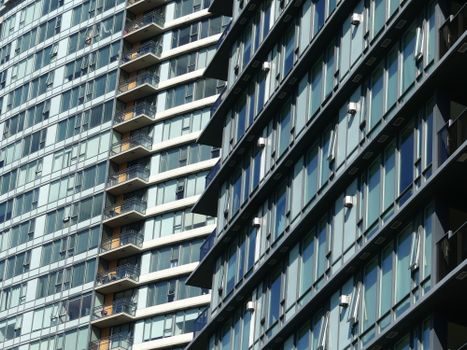
Acoustic: laminated inner lite with a 0.76-1.52 mm PVB interlayer is the standard cure for traffic and HVAC noise, raising the assembly STC into the mid-30s. Acoustic laminates (laminates with a sound-damping interlayer) push STC above 40 when specified for airport-adjacent and CBD sites. [S1]
Do not assume that an IGU with a fire-rated inner pane automatically yields a fire-rated wall — the framing and joint detailing must be part of the tested assembly.
Seismic and structural: stick-built systems tolerate inter-storey drift more easily than unitised systems because field-bolted connections can absorb movement; unitised systems must be designed with engineered vertical and lateral movement joints. Where code applies, the relevant standards and load cases must be set by the project structural engineer against the local building code.
Comparison Gate Matrix: 4 Common System Choices
Lining the four common system choices against four project gates gives a specifier a defensible scoring sheet rather than a brand preference: [S2]
Stick-built / monolithic aluminium: lowest material cost, longest site programme, highest site-labour risk, weakest thermal performance. Fits low-rise, simple geometry, budget-driven work.
Stick-built / IGU with thermal-break frame: modest cost premium, mid-tier thermal and acoustic performance, still field-labour-heavy. Fits most mid-rise commercial stock — the workhorse of the category [S1][S3].
Unitised / laminated-IGU with PVDF frame: factory QA, faster site install, robust acoustic and safety performance, premium cost. Fits tall towers and tight programmes [S3].
Full-glass / point-fixed structural silicone: maximum transparency, highest cost, longest lead time, narrowest application envelope. Fits atria, lobbies and signature façades only [S1].
Who This Gate Process Is — and Is Not — For

The five-gate selection is built for project specifiers, façade consultants and main-contractor design leads who have to defend a curtain wall choice in writing, against a defined performance brief and a real budget. It assumes the reader is fluent in glazing build-ups and can talk to a sealant data sheet. [S3]
It is not for procurement teams buying on per-piece price alone, not for homeowner-scale projects where an aluminium window and door system is the correct product family, and not for specifiers who treat curtain wall selection as an architectural finish decision. For window-and-door scale work, the aluminium window and door 2026 price and cost guide covers the relevant cost levers at product scale.
Procurement and Lead-Time Signals to Track
Three signals are worth monitoring through 2026: published IGU system pricing from Chinese manufacturers has stabilised in a US$50-125/m² band on Made-in-China.com as of mid-2026 [S3]; aluminium extrusion capacity at the major Chinese OEM hubs remains the binding lead-time constraint on full-elevation orders; and demand for laminated-IGU and PVDF 3-coat finishes is pulling the upper bound of the band, not the lower bound.
A specifier who locks alloy, thermal-break, glass build-up and weathertightness test reference at the enquiry stage will see fewer change orders, fewer leak callbacks, and a tighter final account than one who treats those gates as shop drawing details.
For component-level specifications, see glass curtain wall, metal curtain wall panel, and diaphragm wall grab.