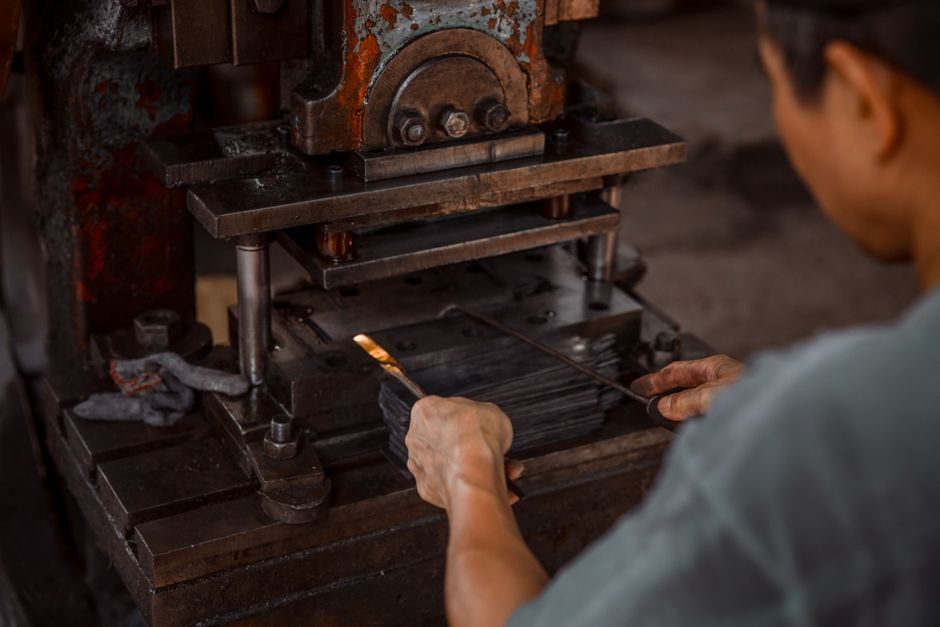
Gravity die casting machine selection is driven by three binding constraints: the alloy being poured (aluminum, brass, zinc), the shot weight / platen clamping class, and the level of PLC/hydraulic automation — with current 2026 supplier catalogs spanning 25T to 280T clamp force and FOB price bands from $10,000 to $50,000 [S2].
The category sits between hand-poured gravity casting and high-pressure die casting machine cells: molten metal is filled into a permanent mold by gravity (or low-pressure assist), the die is water- or oil-cooled, and the machine provides clamping force, mold opening/closing, and timed cycle control. Most 2026 production models are PLC-touched-screen with imported hydraulic valves, individual per-zone cooling timers, and preset piece counters for shift tracking.
Alloy Routing: Aluminum vs Copper/Brass vs Zinc
Aluminum gravity die casting is the dominant 2026 application for non-ferrous structural parts, with aluminum die casting machine cells from Ningbo suppliers commonly built on 25T to 280T cold-chamber frames and priced at $10,000–$50,000 FOB per the 2026 Alibaba catalog of Ningbo Dongfang Die-casting Machine Tool [S2]. Pour temperatures for Al alloys sit near 660–720 °C; copper/brass at 1000–1100 °C; zinc at 420–450 °C — the lower zinc pour temperature is why zinc die casting machine cells can use simpler hot-chamber or low-pressure frames and why small-tonnage 25T–40T zinc units are listed from $10,000–$11,000 per set (MOQ 2) on the same 2026 catalog [S2].
Magnesium is a separate, less-common branch and is usually run on dedicated hot-chamber cells classified under magnesium die casting machine — current 2026 supplier line-ups in the dataset do not surface a magnesium-specific gravity line item, and a buyer should treat any "Mg-gravity" listing as a special-order project rather than a catalog SKU. The same logic applies to vacuum die casting machine variants: vacuum-assisted gravity cells exist for aerospace and high-integrity automotive structural parts, but in the public 2026 supplier pages used here they are referenced as a process capability (low-pressure / vacuum tilt-pour) rather than a dedicated machine family with published tonnage tiers [S6].
Tonnage Class, Clamping Force and Shot Weight
Clamp tonnage in the 2026 Ningbo Dongfang catalog maps roughly as follows: 16T–180T hot-chamber for zinc and lead; 25T–280T cold-chamber for aluminum; the larger 1300 kN (~130T) horizontal aluminum injection cell lists at $20,000–$23,000/set, and a 280T aluminum machine at $43,500–$50,000/set [S2]. A practical rule of thumb, supported by the same catalog tier pricing: as clamp tonnage roughly doubles, machine FOB price in this segment also roughly doubles — a 25T mini aluminum unit is $10,000–$11,000, an 80T is $17,500–$20,000, a 130T is $20,000–$23,000, and a 280T is $43,500–$50,000 [S2].
For gravity (as opposed to high-pressure injection) cells, the tonnage requirement is driven by the projected die area times a closing pressure that is typically an order of magnitude lower than high-pressure die casting; many small gravity cells in the Wuxi MAC-style spec sheet run at single-digit MPa hydraulic pressure and use PLC+touch-screen timing with imported hydraulic valves. Buyers should size clamp force on projected area plus a 1.3–1.5× safety margin, and treat the published "T" rating as nominal rather than peak.
Control Architecture, Hydraulics and Cycle Features

The 2026 gravity-die spec sheet from Wuxi MAC is representative of the mid-tier category: PLC-controlled, touch-screen data entry, imported hydraulic components, individually adjustable per-mold cooling timers, manual and automatic cycle modes, preset piece counter for shift output tracking, and a die-removal/cleaning-friendly clamp geometry. These features matter more than peak tonnage for high-mix, low-to-medium volume runs typical of gravity cells (200–5,000 pieces per day depending on weight and cooling time). [S1]
For higher-mix automotive work, the buyer should verify that the supplier holds IATF 16949 (automotive quality management) — Ningbo Kesui International Trade Co., Ltd. (founded 2012, ISO 9001 + IATF 16949 + TS 16949) and Ningbo Beilun Youyuan Machinery Manufacturing (ISO 9001 + ISO 14001 + IATF 16949 + OHSAS 18001) both surface these certifications on their 2026 vendor profiles, alongside ISO 9001 [S3]. For brass/zinc specialty work, the same PLC+hydro architecture is shared with hot-chamber zinc machines, and J212-class 25T zinc units are listed at $10,000–$11,000/set MOQ 2 on the 2026 Ningbo Dongfang catalog [S2].
Comparison: Gravity vs Low-Pressure vs High-Pressure Die Casting
The selection matrix reduces to four criteria: peak specific pressure on the melt, typical alloy set, achievable internal cavity complexity, and capital cost per clamping ton. By those four axes the 2026 supplier evidence lines up as: gravity die casting (low fill pressure, Al/Cu/Zn, simple-to-moderate cavities, lowest capex), low-pressure die casting (0.3–1.5 bar controlled air pressurization, mostly Al, moderate complexity, mid capex), high-pressure die casting cold-chamber (40–100+ MPa, Al/Mg, complex thin-wall, high capex), and high-pressure die casting hot-chamber (20–40 MPa, Zn/lead, complex thin-wall, lowest capex for Zn) [S2][S6].
In published 2026 price terms, this resolves to: a 25T aluminum cold-chamber at $10,000–$11,000, a 90T brass-copper-zinc pressure unit at $18,000–$20,000, an 80T aluminum injection machine at $17,500–$20,000, and a 280T aluminum injection at $43,500–$50,000 [S2]. For any selection decision, the rule is simple: if the part needs thin walls below 2 mm and tight dimensional tolerance on a complex internal geometry, gravity is the wrong process; if the part is a structural housing, manifold, or brass valve body in the 0.5–10 kg range with moderate complexity, gravity is the lowest-risk, lowest-capex choice and the gravity die casting machine category dominates 2026 sourcing catalogs [S2].
Who It Is For — and Who It Is Not For
Gravity die casting cells are built for: brass valve bodies, water-meter housings, pump covers, automotive structural Al brackets, lighting heat sinks, and decorative architectural hardware in the 0.2–20 kg range where moderate mechanical properties are acceptable and cycle time in the 60–300 second range is workable [S6]. The same process also handles zinc hardware in the 0.05–2 kg range and small brass fittings on J212-class 25T cells [S2].
It is the wrong process for: thin-wall consumer electronics enclosures (use cold-chamber high-pressure), magnesium instrument housings (use dedicated magnesium die casting machine hot-chamber), ultra-large castings above 50 kg where shot weight exceeds what a tilt-pour gravity frame can deliver cleanly, and any part where porosity below 1% volume fraction is required for pressure-tightness (use vacuum die casting machine or low-pressure cells instead) [S6].
Sourcing and Standards Checks for 2026
The active 2026 supplier cluster for gravity cells in China is concentrated in Ningbo, Zhejiang: Ningbo EIL Foundry Equipments (gravity die casting machines + automatic core blowing + polishing, registered 2010), Ningbo Dongfang Die-casting Machine Tool (40+ years history, 40,000 m² plant, 300–500 sets/year capacity, hot-chamber 16T–180T, cold-chamber 25T–280T), Ningbo Kesui International Trade (ISO 9001, IATF 16949, TS 16949, founded 2012), Chuanyue Casting (one-stop mold + casting + machining + surface treatment), and Ningbo Beilun Youyuan Machinery (ISO 9001, ISO 14001, IATF 16949, OHSAS 18001) [S1][S2][S3][S4]. Ningbo Weifeng Metal Products (founded 2007) and Wuxi MAC round out the dataset for the gravity/multi-process category.
For a 2026 buyer, the minimum sourcing checklist is: (1) confirmed tonnage class with measured shot-weight envelope, (2) written alloy list with pour temperature window, (3) PLC + touch-screen control with imported hydraulic brand disclosed, (4) IATF 16949 certificate on file for any automotive tier-1 part, (5) FAT video or sample parts at the buyer's alloy, (6) FOB price + mold cost + tooling lead time quoted separately, and (7) per-zone cooling timer and piece counter confirmed in writing. For buyers sizing a press line alongside the gravity cell, the Hydraulic Press Price & Cost Guide 2026: Tonnage, Frame and Automation Breakdown is a useful cross-reference for trim press sizing, while a downstream cleaning cell should be matched using the Parts Washer Selection Guide: Aqueous, Ultrasonic, Vacuum and Cabinet Platforms Compared.
Track for the next sourcing cycle: (a) any new IATF 16949 renewal or expansion notice from the Ningbo Beilun Youyuan / Kesui cluster, and (b) price movement on the 25T–40T zinc hot-chamber tier, which at $10,000–$11,000/set MOQ 2 in the 2026 catalog is the most price-elastic segment of the gravity-die supply base [S2][S3].