Specifying the wrong parts washer in 2026 typically means overpaying 20–60% of capital cost over a 10-year life, because wash chemistry, drying energy and effluent handling — not the wash tank itself — dominate the operating bill [S5].
This guide covers the four platforms a B2B buyer will be quoted on — aqueous (conveyor, cabinet, rotary), ultrasonic, vacuum-degreaser, and open-top solvent cabinet — and the criteria a process engineer should use to pick one: part geometry, soils, cleanliness spec, throughput, floor space, and air/emissions permits.
Four Platforms, Four Operating Envelopes
Aqueous washers are the default workhorse for general manufacturing: Alliance Manufacturing lists conveyor belt, chain, monorail, drum, indexing, dip-tank and cabinet configurations under one product family, all running water-based chemistry at 100–160 °F wash / 140–180 °F rinse [S1]. Ultrasonic platforms such as Niagara's SonixClean line add 25–80 kHz cavitation to the aqueous step, and are typically reserved for blind holes, threads, and electronic assemblies where spray impingement cannot reach [S5]. Vacuum-degreaser units (Alliance ILSA, for example) are closed-loop systems and are quoted as the modern replacement for open-top vapor degreasing — they handle low-surface-tension solvents and recover >95% of the working fluid under vacuum, which is why they are the path of choice where shop-floor air permits forbid nPB, TCE or perc [S1]. A fourth platform — the open-top solvent cabinet — is still in use but is being retired wherever regional VOC or worker-exposure rules mirror OSHA nESHAP.
Conveyor-style aqueous lines move 50–600 parts/hr depending on basket pitch and belt speed; rotary indexing units move 80–400 parts/hr; ultrasonic benchtop tanks process 1–4 batches/hr at 30–60 min per cycle; vacuum degreasers cycle 6–12 loads/hr because most of the cycle is vacuum dwell rather than spray [S1][S5].
What Comes Off the Part Drives the Chemistry
Chlorinated and paraffinic stamping lubes — long-chain C14–C30 chlorinated paraffins used in deep-draw automotive stamping — are the single most common reason a buyer gets pushed off a "just water" spec into a heated aqueous detergent or a vacuum-degreaser [S4]. Heated aqueous washers at 140–160 °F with low-foam alkaline detergent (pH 9–11) cut chlorinated-paraffin residue below 5 mg/ft² on steel substrates; cold water leaves visible film and pushes the reject rate up.
For electronics and PCB cleaning, the limiting factor is ionic residue, not visible oil: Alliance's Nu/Clean line with the patented FloodBox targets ionic cleanliness below 10 µg NaCl/in², which is the de-facto inline threshold for through-hole and SMT assemblies [S1]. Cutting-fluid-laden hydraulic valves typically need a two-stage process — pre-wash at 160 °F with alkalinity builder, then a DI-water final rinse with closed-loop resistivity ≥ 1 MΩ·cm — to avoid flash rusting on cast-iron bodies.
A rough decision rule: if the soil is water-soluble (coolants, water-based lubes, handprints), aqueous alone wins on cost; if the soil is petroleum oil, grease or wax, aqueous with a 5–8% surfactant + heat is fine; if the soil is chlorinated paraffin, silicone, or a precision-cleaning spec, ultrasonic or vacuum-degreaser is mandatory [S4][S5].
Throughput, Footprint and Loading Style
Cabinet-style front-load and top-load washers suit job shops and rebuild operations at 10–30 parts/hr; rotary indexing and conveyor units fit dedicated production cells at 50–600 parts/hr [S1]. For mid-volume lines — 100–300 parts/hr with mixed short/long parts — a monorail conveyor with overhead lift-and-carry riding on a linear guide rail lets the same washer handle parts from 50 mm to 1.5 m, while a belt conveyor forces a 600 mm max length per basket.
Floor space: a single-station aqueous cabinet needs 4–8 m²; a two-stage conveyor with wash + rinse + hot-air dry typically needs 25–60 m² plus 3–4 m of upstream/downstream clearance; a vacuum-degreaser footprint is 2–6 m² but adds a 1–2 m³ vacuum pump skid and a refrigerated chiller that another platform does not require [S1][S5].
Loading style also drives ergonomics: a top-load cabinet is the safest for a 30 kg forging; a front-load cabinet is faster for 5–10 kg brackets; a monorail removes the lift entirely but needs a robust overhead rail and hoist at the load station. For plants already running collaborative-robot load/unload, conveyor and indexing units expose I/O points cleanly — see the cell-stack notes in Cobots in Smart Manufacturing: Cell Stack, Safety Specs and 2026 Vendor Map for the upstream pick-and-place pattern that pairs with conveyor washers.
Cleanliness Spec, Verification and Drying
Three cleanliness specs dominate 2026 RFQs: (1) gravimetric — total residual soil in mg/ft², typically <5 for precision hydraulics; (2) ionic — µg NaCl/in², <10 for electronics; and (3) particle-count — ISO 4406 codes on hydraulic components, often 18/16/13 or cleaner [S1]. Alliance offers an inline Cleanliness Testing Kit so the line can self-audit against these specs without a lab pull [S1].
Drying is half the cycle and the easiest place to lose. Aqueous conveyors pair a 200–350 °F hot-air knife or radiant IR zone with a 60–120 sec dwell; a vacuum-degreaser "dries" in vacuum by boiling off residual solvent at 28–29 in.Hg, so no separate dryer is needed; an ultrasonic tank with no dryer leaves parts wet and is acceptable only when the next operation is a water-based dip or an assembly that tolerates trace moisture [S5].
Compressed-air blow-off is still common at small shops but reads as a red flag on an OEM audit because it re-aerosolizes oil and pushes it into the operator's breathing zone — a 30–60 scfm air knife also raises plant air demand by 20–30% on a small washer.
Energy, Effluent and Air Permits
An aqueous conveyor at 200 parts/hr draws 30–80 kW (heater, pumps, blowers, dryer); a vacuum degreaser of equivalent throughput draws 15–35 kW; an ultrasonic benchtop draws 2–6 kW. Closed-loop aqueous systems with oil coalescer and oil skimmer extend bath life from 1 shift to 1–2 weeks and cut detergent consumption by 40–60% — the two accessories Alliance lists under "Other Products" alongside the washers [S1].
Effluent rules determine which platform survives the permit review. Aqueous systems discharge oily wastewater that goes through an ultrafilter or a batch-break, with a flow meter on the discharge line logging volume to the holding tank; vacuum-degreasers with sealed solvent recovery typically generate <50 L/yr of still bottoms and no aqueous waste; open-top solvent cabinets generate a continuous VOC exhaust stream that often forces an afterburner or a carbon polisher to meet EPA NESHAP for halogenated solvents. Plants that switched off open-top vapor degreasing between 2020 and 2025 cite OSHA n-propyl bromide (nPB) exposure limits as the trigger [S1].
Standardization, Sourcing and Capital Layout
Industrial washer OEMs now publish their product matrices as a "Machine Selection Guide" — Niagara Systems' 2026 selection guide is the model buyers ask for, and it is built around throughput (parts/hr), max part envelope, and cleanliness spec, with chemistry and dryer options as a configurator [S5]. Buyers should expect standard lead time of 8–14 weeks for a catalog cabinet or rotary unit and 16–26 weeks for a custom-engineered conveyor; a used/reconditioned unit through a buyback program (Alliance's R3 line) is a 3–6 week path that typically lands at 40–60% of new price and is widely used in remanufacturing and firearms/ammo rebuild shops [S1].
On the consumables side, aftermarket pressure-washer and washer replacement parts — drain pumps, lid switches, door-gasket boots — run $14–82 USD list and ship 1–5 day from regional 3PL hubs; pressure-washer piston guides such as the 190646GS OEM part are listed around $60 from major parts portals [S2][S3]. These are not the same supply chain as industrial washers, but they are the supply chain a maintenance buyer will be pulling from once a unit is installed.
For shop floor comparison, aqueous vs ultrasonic vs vacuum-degreaser on four decision criteria:
• Capital cost (per parts/hr): Aqueous conveyor $30k–$250k, Ultrasonic $5k–$80k, Vacuum-degreaser $80k–$400k. • Cycle time per load: Aqueous 5–15 min, Ultrasonic 30–60 min, Vacuum-degreaser 6–10 min. • Solvent/VOC permit risk: Aqueous low, Ultrasonic low, Vacuum-degreaser low–medium (closed loop). • Best fit soils: Aqueous = water-soluble + light oils, Ultrasonic = blind holes + electronics, Vacuum-degreaser = precision + low-surface-tension soils [S1][S5].
Plants that already run a vibratory feeder or a small parts-handling cell upstream should size the washer to a 1.0–1.2× ratio against the upstream dryer or feeder — the washer is almost never the bottleneck; the dryer or the load station is. For higher-volume cells, the throughput logic in Collaborative Robot Manufacturing Process: Cell Stack, Safety Specs and Line Choices applies cleanly: pick the washer first, then size the cobot cell to its cycle time, not the reverse.
Who a Parts Washer Is For — And Who It Is Not
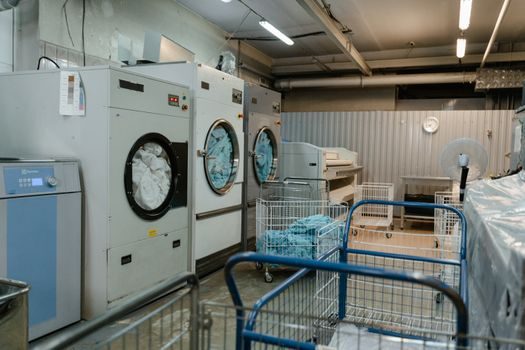
Industrial aqueous and ultrasonic washers are for plant buyers running ≥ 8 hr/day of repeatable cleaning — job shops, rebuilders, automotive tier-1 suppliers, electronics contract manufacturers, and aerospace component shops [S1]. Vacuum-degreasers are for precision and medical buyers with tight residue specs and a board-level commitment to phase out nPB, TCE and perc; capital cost is high, but the closed-loop solvent recovery typically pays back the premium in 3–5 years on solvent savings alone [S1].
An industrial parts washer is not for: a garage / single-vehicle detail operation (use a hot-water pressure washer), a food-line sanitation wash (NSF/ANSI 3-A sanitary design rules are different), or any process where the part is a finished decorative surface that cannot tolerate DI-water spotting — that calls for a final deionized-air blow-off or an IPA vapor dryer, not a washer.
Common Failure Modes and Selection Pitfalls
The most frequent 2026 selection mistake is buying a conveyor when the part mix is dominated by 5+ different geometries in low volume — that buyer should be on a top-load cabinet with quick-change racks, not on a dedicated conveyor. The second is under-sizing the oil-removal side of an aqueous washer: a 200 parts/hr line with no oil coalescer needs a bath dump every shift, which destroys ROI within a year [S1]. The third is skipping the dryer: aqueous washers without a 200 °F+ hot-air zone ship parts that flash-rust within 4 hours, especially on cast iron and hardened steel above HRC 40.
On the ultrasonic side, the dominant failure is over-cavitation: 80 kHz at > 2 W/L damages thin-wall aluminum and soft-soldered joints. The safe band for aluminum and electronics is 25–40 kHz at 1.0–1.5 W/L, dwell 3–10 min, with a 5 µm filtration loop on the tank to keep re-deposition under control [S5]. Vacuum-degreaser buyers frequently under-size the vacuum pump: a 1 m³ working chamber needs a 60–100 m³/hr pump to hold 28 in.Hg under load, which is typically verified by a pressure transmitter on the chamber, and an undersized pump is the single most common warranty claim in the first 12 months.
Trackable Signals for the Next 6 Months
Two verifiable signals to watch through 2026-Q4: (1) the EPA TSCA risk evaluation pipeline for chlorinated paraffins — any final rule will force more buyers off open-top solvent cabinets and onto vacuum-degreasers within 12 months of the rule's effective date; (2) the IMTS 2026 floor (Alliance and other OEM pages already list IMTS 2026 as a 2026 trade-show anchor [S1]), where 2027 model-year aqueous platforms and ultrasonic transducers are typically unveiled — a buyer's RFQ written off IMTS announcements lands 10–15% under the price of a same-spec quote in Q1.