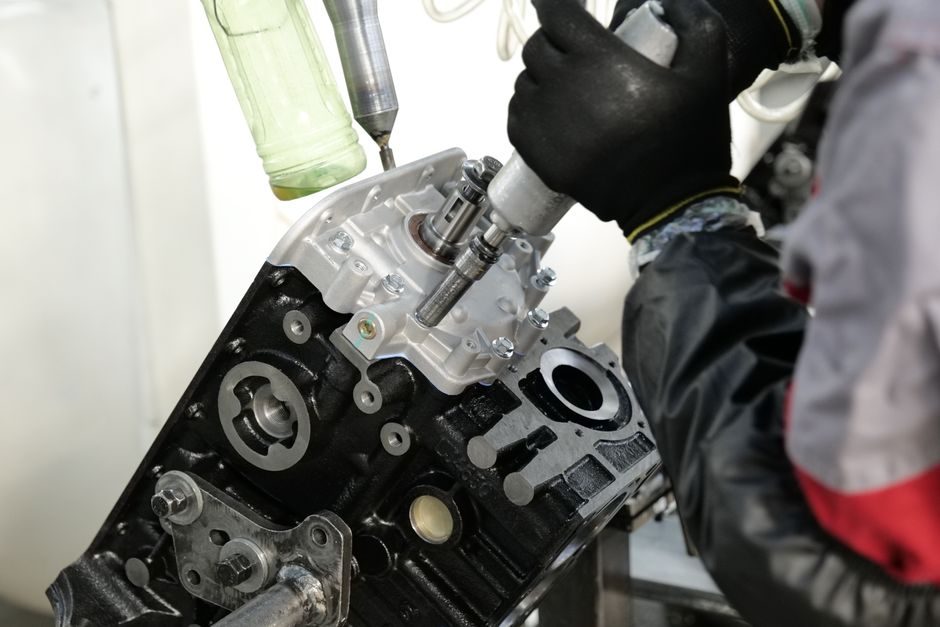
A gravity die casting machine fills a metal die by gravity-fed pour or low-pressure assist, with PLC + touchscreen control and imported hydraulic packs as the dominant architecture on 2026 production cells [S2].
SourceBySpec frames the buying decision around five engineering gates — alloy family, locking force, shot/casting weight, mould envelope, and downstream automation — because those five parameters drive roughly 80% of the machine's bill of materials and the supplier shortlist [S2][S4].
Process Definition and Where Gravity Die Casting Fits
Gravity die casting uses a permanent steel or graphite die mounted on a hydraulically clamped platen, with molten metal introduced through a manual or robotic ladle rather than a high-pressure injection plunger. ELCEE lists the process as a fit for "complex internal cavities" in copper-alloy and aluminum-alloy parts, and groups it with low-pressure die casting because the fill physics — slow, lamellar, oxide-controlled — are the same. [S1]
The process is fundamentally different from high-pressure die casting and from aluminum die casting on cold-chamber machines, where fill times are sub-100 ms and injection pressures run 30-100 MPa; gravity cells operate near atmospheric head pressure (typically 0.05-0.15 MPa) and let the metal seek its own level [S2]. Compared with vacuum die casting, which evacuates the cavity before tilt-pour, standard gravity die casting leaves air evacuation to the die vent and overflow well geometry.
Alloy Family Determines Machine Architecture
Wuxi MAC's product brief specifies that its PLC-controlled gravity cell is "suitable for gravity model casting of brass and zinc alloy" — a deliberate alloy statement, not a generic one [S2]. Brass pours at 880-940 °C and zinc at 410-450 °C, so the same machine frame can be sold for both, but the ladle material, die steel coating and exhaust hood design are not interchangeable.
Aluminum gravity die casting (660-720 °C pour) is the third major alloy family and is the bulk of QS Machinery's Made-in-China listing, where "Aluminum Gravity Die Casting Products for Agricultural Machinery" run US$2.10-2.50 per kg in 2026 spot pricing. Magnesium gravity work is rarer and is usually sold as a custom build rather than a catalogue line, whereas zinc die casting machine cells are a separate hot-chamber product class with locking forces typically an order of magnitude lower than aluminum gravity cells.
For buyers cross-shopping process families, the gravity die casting vs cold-chamber comparison shows that cold-chamber wins on thin-wall aluminum injection, gravity wins on copper-alloy sand-free finish and lower die wear.
Locking Force, Shot Weight and Platen Size
Locking force on gravity die casting machines is far lower than on high-pressure cells because the die only has to resist the hydrostatic head and the metal's momentum, not 70 MPa of injection pressure. The Ningbo EIL range on Made-in-China is built around small-to-medium tonnages, with cells typically quoted in the 200-2000 kN bracket [S4]. The cross-reference is the cold-chamber catalog on Alibaba from Ningbo Dongfang, where 80-ton (≈800 kN) and 25-ton (≈250 kN) hot-chamber aluminum machines price at US$10,000-22,000 per set — useful only as a cost sanity check, not as a direct gravity benchmark [S3].
Shot weight is the better sizing metric for a gravity cell. A typical 800 kN gravity machine can pour 1-5 kg of brass or 0.5-3 kg of aluminum per cycle, with cycle times of 90-180 s including die open, extract, and close [S2]. Buyers should size the shot weight to the heaviest part in the planned family plus 15-20% headroom for sprue and overflow.
Platen size and tie-bar clearance are the silent killers in this category. Many first-time buyers over-index on tonnage and under-size the die envelope; a 900×900 mm platen with 500×500 mm tie-bar clearance will refuse a 600 mm wide mould that the tonnage rating would otherwise accept [S2][S4].
Control Architecture, Hydraulics and Safety
Standard 2026-vintage gravity cells use a PLC with touchscreen HMI for sequence setting, with "all hydraulic components imported" as a typical sales claim — usually meaning Bosch Rexroth or Yuken valves and a domestic tank/motor [S2]. ELCEE notes that modern low-pressure / gravity cells add closed-loop pressure transducers on the intensification cylinder and a tilt-pour envelope, lifting repeatability on shot weight to roughly ±3% on a well-tuned installation.
Safety on gravity cells is dominated by molten-metal splash, hydraulic burst, and pinch points at the platen. The Lanson Imm and Chuanyue Casting sites show that a complete foundry cell includes the machine plus extraction robotics, a die-spray unit, a quench conveyor and downstream trim presses, so specifying the machine in isolation is a common but costly error [S1]. Buyers should request the full safety-category mapping (ISO 12100 risk assessment, ISO 4413 hydraulic rules, and regional equivalents) before PO.
Total Cost, Lead Time and Supplier Selection
Made-in-China spot pricing for finished aluminum gravity castings ran US$2.10-2.50 per kg in 2026, but that is a part price, not a machine price; it sets the buyer's break-even math on capex amortisation. Machine-level capex for a 200-2000 kN PLC-controlled gravity cell typically lands in the US$30,000-150,000 FOB Ningbo band in 2026 quotes, with lead time of 30-60 days for a standard build and 90-120 days for a turnkey cell with extraction and trim [S2][S4].
Supplier shortlist logic: filter on documented ISO 9001 / IATF 16949 certification (Kesui lists ISO 9001, IATF16949, TS16949 — a useful automotive-tier signal) [S5], on the OEM's own foundry versus trading-company status (Chuanyue Casting and Kesui are flagged "Manufacturer/Factory" in their made-in-china records) [S1][S5], and on whether the company publishes cycle-time and shot-weight data on its product page [S2].
The Ningbo cluster — Dongfang, EIL, Kesui, Lanson — is the 2026 centre of gravity for Chinese gravity die casting machine supply, with the Hangzhou Bay New Zone in Cixi as the densest sub-cluster [S4]. For buyers comparing apples-to-apples, the zinc die casting machine buying guide and the squeeze casting machine buying guide sit on the same site and share the sourcing-lever framework; the die casting die selection checklist is the natural next node once the machine is shortlisted.
Limitations, Failure Modes and Decision Triggers
Gravity die casting is the wrong process when wall-thickness falls below 2.5 mm in aluminum or 1.5 mm in zinc, when production volume exceeds roughly 50,000 parts/year for a single SKU, or when porosity-tight radiographic requirements push you toward vacuum assist. It is the right process when the alloy is brass or a high-copper bronze, when a near-net sand-free finish is acceptable, and when cycle-time flexibility matters more than raw throughput. [S2]
Common 2026 failure modes flagged across supplier pages: (1) die-coat buildup causing surface pulls, mitigated by automatic die-spray and a 5-10 cycle cleaning cadence; (2) hydraulic drift on the clamping cylinder causing flash above 0.5 mm, mitigated by closed-loop pressure transducers; (3) ladle-pour inconsistency causing ±10% shot-weight variance, mitigated by robotic ladle or low-pressure conversion [S2].
One trackable 2026 signal: the Ningbo cluster's gradual migration of gravity cells from stand-alone machines to integrated low-pressure die casting (LPDC) cells with vacuum and intensification — ELCEE's page groups the two together for that reason. A second signal is the rise of PLC + touchscreen as a baseline expectation, with older relay-logic cells no longer quoted on the Made-in-China gravity category page [S2].