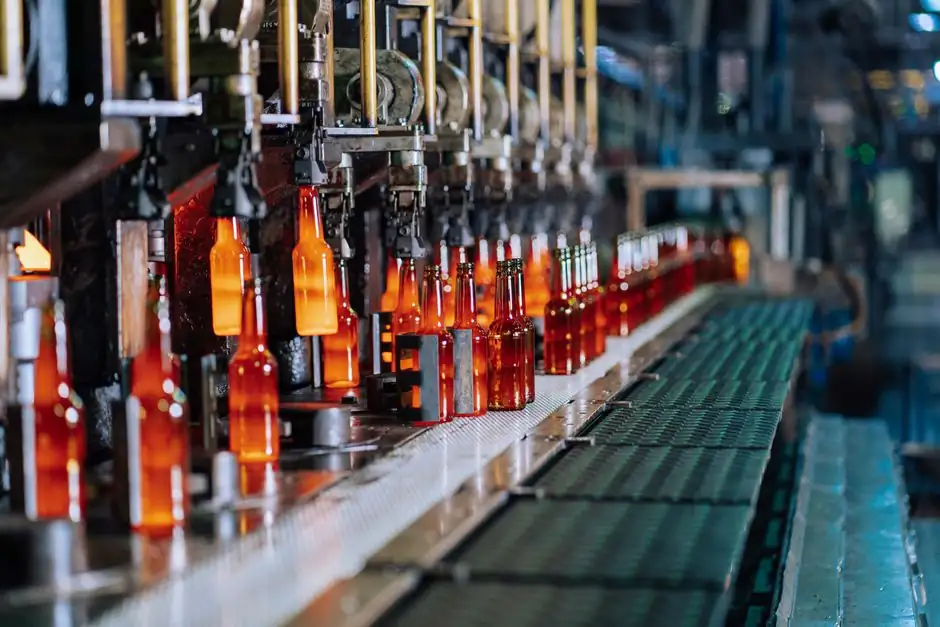
Electronics housings, whether die-cast aluminum enclosures, machined 6061-T6 chassis, or thin-wall stainless shields, sit in a temperature window where furnace choice is dominated by surface chemistry, not peak temperature. Industrial furnaces span roughly 1200°C to over 1650°C, while ovens stop near 480°C; the dividing line is process intensity, not heat alone [S1].
The practical spec floor for housing work is ±5°C uniformity across the load, 10⁻⁵ to 10⁻⁶ mbar vacuum for clean-surface aluminum, and a controlled-atmosphere option (N₂ or Ar) when brazed joints or stainless surfaces must stay oxide-free [S3][S6]. Match those three numbers to the housing alloy and lot size first; everything else is secondary.
Furnace Classes That Actually Compete for Housing Work
Four furnace classes cover roughly 90% of electronics-housing heat treatment: vacuum, controlled-atmosphere batch (bell/sealed quench), pit or bogie, and induction [S1][S3]. Vacuum furnaces lead on clean-surface and low-distortion requirements because heating is radiation-driven in a sealed chamber, eliminating decarburization and oxide scale on stainless and tool-steel shields [S3]. Controlled-atmosphere batch furnaces (often with integral oil or gas quench) handle aluminum solution-and-age cycles (T6) and case-hardening where a specific surface chemistry is needed [S1].
Pit and bogie furnaces are the workhorses for tall, heavy housings or long rectangular chassis, while induction systems suit localized hardening of bosses, flanges, or threaded inserts without heating the whole housing [S4]. In electronics-housing work, induction is a complementary tool, not a primary process: a housing may get a full vacuum anne, then a localized induction temper on a mounting boss to hold a flatness spec. The four classes are not interchangeable; pick the class by the dominant failure mode (distortion, scale, hardness, throughput), then pick the model inside that class.
Material and Refractory Choices Inside the Hot Zone
Electronics-housing furnaces rarely push the refractory limits, but the hot-face lining still drives energy loss and uniformity. High-alumina bricks (Al₂O₃ content 48% to over 90%) carry up to 1750°C without deformation, making them the default working-lining choice for batch and pit furnaces running aluminum T6 cycles at 530–580°C [S2]. Monolithic castables fill complex geometries, repair worn hot-face zones, and reduce joint count, which matters for vacuum furnaces where every joint is a potential leak path [S2].
Heating elements in this temperature band are typically nickel-chromium alloy (for air-atmosphere batch work) or silicon carbide and molybdenum (for vacuum above 1200°C) [S1][S5]. A practical spec rule: spec the hot-face material by max soak temperature plus 50°C margin, and the insulating layer by thermal conductivity (target below 0.4 W/m·K at operating temp), not by brand. If the housing is stainless and the cycle is bright anneal, the radiant-heated muffle or all-metal hot zone must be gas-tight, and ceramic-fiber insulation alone will outgas and contaminate, so prefer a hard-refractory inner skin in that case [S2].
Atmosphere, Vacuum Level, and Clean-Surface Specs
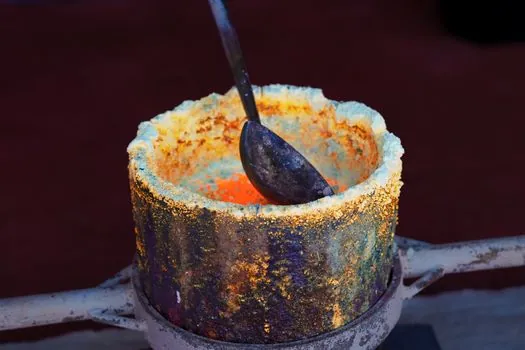
Aluminum housings are almost never heat-treated in raw air: the oxide layer grows, tolerances open, and cosmetic surfaces pick up a gray haze. Vacuum or inert-atmosphere processing at 10⁻⁵ to 10⁻⁶ mbar is the cleanest option for thin-wall parts where post-machining is impractical [S3]. For 6061 or 6063 enclosures going to T6, a two-stage batch cycle (solution at about 530°C, water quench, artificial age at 175–200°C) is commonly run in a sealed-quench furnace under nitrogen to prevent hydrogen porosity and surface staining [S3][S7].
Stainless housings (304, 316) for RF or medical enclosures typically need bright annealing at 1050–1150°C in a hydrogen or dissociated-ammonia atmosphere to restore corrosion resistance after forming. For copper-alloy shields and beryllium-copper springs, a vacuum or dry-nitrogen run below 600°C prevents internal oxidation that would degrade electrical conductivity. In every case, the atmosphere spec is driven by surface chemistry, not furnace class; match the gas system to the alloy, not the other way around.
Throughput, Batch Geometry, and Cost-Per-Part Math
Lot size and part envelope are the second-tier decision gates. Batch vacuum furnaces from 50 L to 1000 L cover most housing work, with 100–300 L being the sweet spot for mid-volume electronics production [S5]. Continuous belt or pusher furnaces beat batch above roughly 500 kg/h throughput, but they lock you into a single alloy and a narrow temperature window, which is rarely acceptable for a mixed-product housing line [S1].
Bottom-lift and double-trolley furnaces are useful when the housing is heavy (over 200 kg) or fragile: the load moves only vertically or on rails, avoiding the door-swing shock that can warp thin-wall sheet-metal enclosures [S5]. For job-shop or prototype runs, a 20–50 L benchtop or muffle furnace at 1200–1700°C is the cost floor, but uniformity across a 100 mm load zone is rarely better than ±10°C, which is marginal for T6 aging on tight-tolerance parts [S1][S5]. The right answer for most housing work is one mid-size vacuum furnace plus one atmosphere batch furnace, sharing a single operator and quench station; that covers 80–90% of housing alloys and geometries without overcapitalizing.
Failure Modes and What Specs Catch Them Early
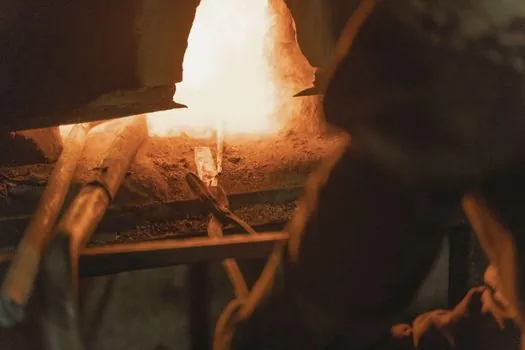
Three failure modes dominate electronics-housing heat treatment: distortion, surface contamination, and missed hardness or strength. Surface contamination is caught by requiring leak-rate specs (typically below 10⁻⁸ mbar·L/s for a high-purity vacuum chamber) and by sampling parts with a nitric-acid passivation test for stainless, or a contact-angle water-break test for aluminum [S3].
One more trap: induction tempering is subcritical, running 120°C to 650°C, and operators can confuse it with full austenitizing, which would put the part through a phase change the housing was never designed for [S4]. Lock the recipe behind a password and require two-person sign-off on any change.
Standards, Documentation, and Sourcing Signals
For housing work, the binding standards are typically AMS 2770/2774 for aluminum heat treatment, AMS-H-6088 and ASTM B597 for heat treatment of aluminum alloys, and Nadcap AC7110/12 for special-process accreditation of any commercial heat-treat supplier doing aerospace or medical enclosures [S3][S7]. For stainless bright anneal, ASTM A380 and A967 cover cleaning and passivation post-treatment, and ISO 9001 plus IATF 16949 are the usual quality-system floors for electronics and automotive customers.
Trackable signals for the next 6–12 months: a measurable shift in mid-size furnace OEM offerings toward all-metal hot zones for hydrogen service (already visible in 2026 catalogues), and a steady increase in quoted delivery times for vacuum furnaces with 10⁻⁶ mbar class pumping packages, currently running 16–24 weeks at several major builders [S5]. Watch for tighter Nadcap audit cycles and for OEM push to ship furnaces with factory-loaded, customer-specific recipe files, which reduces commissioning time but ties the buyer to one software stack.
For component-level specifications, see heat treatment furnace, ballast water treatment, and heat detector.
For related coverage, see Industrial Solvent Selection for Mold and Die Making: 2026 Spec Map.