
Hot chamber die casting machines inject molten metal from an integrated gooseneck furnace, making them the default platform for zinc, magnesium, and low-melting copper alloys under roughly 900 tons of clamping force [S3]. Cycle times for small zinc parts can drop below one second per shot, with full cycle windows of 2-3 minutes reserved for multi-pound castings [S3].
Market supply is heavily concentrated in Chinese OEM hubs (Guangdong, Jiangsu, Anhui), with at least 1,246 Alibaba-listed suppliers of hot chamber die casting machines and one Anhui maker (Bengbu Long Hua) quoting a 15-workday off-season lead time under FOB/CIF Incoterms [S6][S7]. A reference small-frame unit on offer — the SH-25 zinc hot chamber machine — sits at the entry end of the tonnage ladder, while a CNBM-listed Zhenhuan ZL-130 occupies the 5,000 kg / 15 kW mid-range class [S8][S4].
Hot Chamber vs Cold Chamber: Process Boundary and Alloy Fit
Hot chamber die casting machines keep the injection plunger, gooseneck, and nozzle submerged in a molten metal bath, so the wetted path must resist attack by the working alloy; the architecture is therefore restricted to zinc, magnesium, lead, and selected low-melting copper alloys that do not aggressively erode the steel pot and plunger [S3]. Cold chamber machines instead ladle metal into a separate shot sleeve, which is the only option for aluminum and high-melting brass, and they start where the hot chamber line ends — Lanson, for example, defines its medium cold chamber die casting line from 650T to 900T [S2].
For buyers choosing between hot chamber and cold chamber die casting platforms, the decision is almost always alloy-driven: Zn/Mg/low-MP Cu go hot chamber; Al and high-MP Cu go cold chamber. Changzhou LZ and similar Jiangsu/Anhui suppliers explicitly pair the two architectures in the same product family, so a single vendor can often quote both lines [S1].
Tonnage Bands, Frame Sizes, and Reference Machines
Small hot chamber machines in the 25-130 ton class dominate the zinc hardware market. The SH-25 zinc hot chamber die casting machine from CENS-listed suppliers targets small hardware (zinc handles, costume fittings, electrical fuse bodies) at the entry tier, while the Zhenhuan ZL-130 ships at 4,260 × 1,550 × 2,030 mm, 5,000 kg, and 15 kW with a stated 50 sets/month supply capability from a Guangdong OEM [S8][S4].
Mid-range hot chamber units generally span 200-500 tons and overlap with the lower end of the aluminum die casting machine tonnage range, but the alloy rule still applies. Above 650 tons, most Chinese suppliers pivot to cold chamber architecture — the Lanson medium cold chamber line opens at 650T and runs to 900T, with no parallel hot chamber product listed at that tonnage [S2]. This 650T crossover is the practical ceiling for hot chamber zinc/Mg work on standard gooseneck designs.
Component Architecture: Furnace, Gooseneck, Plunger, Die
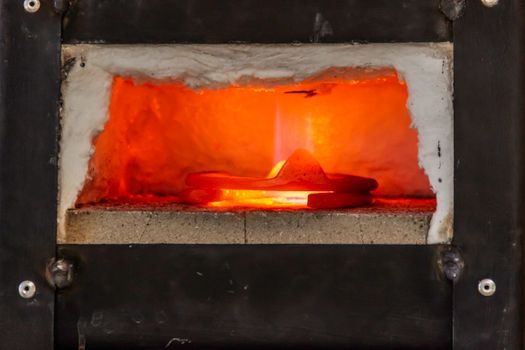
Every hot chamber machine has four coupled subsystems: a metal-holding furnace, a gooseneck feed channel, a vertical injection cylinder with plunger and port, and a two-plate die with clamping tie bars. The plunger rising uncovers a port that lets molten metal refill the cylinder; the next downward stroke closes the port and drives the metal through the gooseneck and nozzle into the die cavity [S3].
Cycle-time levers sit almost entirely in the injection side: plunger diameter, stroke, and port geometry set the theoretical shot volume, while die cooling and ejector design set the practical cycle. Sub-one-second cycles are realistic only on small zinc parts below roughly one ounce; multi-pound castings push full cycle into the 2-3 minute band regardless of machine brand [S3]. For wear-prone parts, the furnace, gooseneck, and plunger are usually built in high-chrome hot-work tool steel or similar grades that resist dissolution in molten zinc — a key reason hot chamber machines are not used for aluminum despite the tonnage overlap.
Application Map by Alloy and Tonnage
Zinc dominates the hot chamber installed base: hardware, locksets, bathroom fittings, automotive sub-assemblies, fuse bodies, and decorative trim are routinely run on 25-500 ton hot chamber units [S3][S4]. Magnesium hot chamber casting covers laptop and instrument housings, power-tool shells, and some automotive seat frames where weight saving matters more than the cost premium over zinc. Leaded brass and tin alloys round out the niche end, typically on small machines for fittings and electrical components.
For comparison, gravity die casting machine and vacuum die casting machine platforms handle the same alloys but with different fill dynamics — gravity for thicker, lower-pressure sections and vacuum for porosity-critical structural parts where the hot chamber cycle is too turbulent. Buyers chasing the lowest porosity in structural magnesium often cross-shop hot chamber and vacuum platforms before deciding on tonnage and shot weight.
Buyer Selection Criteria: Tonnage, Shot Weight, and Supplier Footprint
Four criteria usually drive the spec sheet: required clamping tonnage, projected shot weight, alloy choice, and supplier lead time. On the supplier side, the Alibaba index shows 1,246 hot chamber suppliers, the top tier concentrated in China with Africa (13%), Eastern Asia (10%), and South America (10%) as the largest stated export markets for one major listed OEM [S6]. Anhui-based Bengbu Long Hua quotes FOB/CIF terms, LC/T/T/D/P payment, a 15-workday off-season lead time, and a one-month peak-season lead time, with OEM/ODM and sample availability on the standard product list [S7].
For process-engineer readers, the practical cross-check is: (1) confirm the alloy fits a wetted hot chamber path (Zn, Mg, low-MP Cu) [S3]; (2) clamp tonnage should clear the projected shot area × 30-40 MPa specific pressure rule of thumb for thin-wall zinc; (3) cycle-time target under 1 second requires sub-ounce parts and tight die cooling; (4) for batches above roughly 50,000 parts/month, a 50 sets/month supplier like Zhenhuan is sized to deliver without retooling capacity [S4]. Used-equipment channels name Techmire, Dynacast, Triad Speedcaster, Lama Automation, and Fishercast as multi-slide specialists, and Frech, Idra, Italpresse, Weingarten, Triulzi, NTP, Buhler Prince, HPM, National, Toshiba, KDK, and LK Machinery on the traditional machine side [S3].
Adjacent Process Comparison Table
Hot chamber and cold chamber differ on three decision axes: alloy compatibility, tonnage ceiling, and typical cycle band. Hot chamber: Zn / Mg / low-MP Cu, ≤ ~650T practical, sub-1s possible on small parts [S3]. Cold chamber: Al and high-MP Cu, 650T-900T+ standard, longer cycle from the ladle step [S2]. Gravity: Al and Zn on permanent molds, low pressure, slower fill, no shot sleeve. Vacuum: Al and Mg for porosity-critical parts, fits inside either hot or cold chamber architecture with sealed die and evacuation.
These four cover the bulk of the die casting decision space; other variants (magnesium die casting machine variants, vertical cold chamber, real-time shot-control hydraulic units) are sub-flavors of the same matrix. A spec-first buyer usually locks alloy first, then picks the architecture, then sizes tonnage to the heaviest part plus a 20-30% margin.
Sourcing Signals, Lead Times, and Trackable Next Nodes

Three trackable signals will move the 2026 hot chamber market: (1) Chinese supplier lead times, where the Bengbu Long Hua benchmark of 15 workdays off-season and one month peak season is the public reference point [S7]; (2) export-market mix shifts visible on Alibaba's country split (currently led by Africa, Eastern Asia, South America for the top listed hot chamber OEM) [S6]; (3) unit-class evolution at the entry end, with SH-25-class 25-ton zinc machines and ZL-130-class 130-ton mid-range units both still in active production as of mid-2026 [S8][S4]. A quote round against two Chinese OEMs (one Jiangsu, one Anhui) and one Taiwanese/Japanese brand will surface pricing and lead-time deltas in roughly 2-4 weeks. For a side-by-side with arc-based joining on the same factory floor, the arc welding machine types, process specs, and industrial applications map is a useful cross-reference, while mold base TCO: steel grade, tryout scrap, and downtime drive 5-year cost pairs naturally with hot chamber die selection on long-run zinc programs.