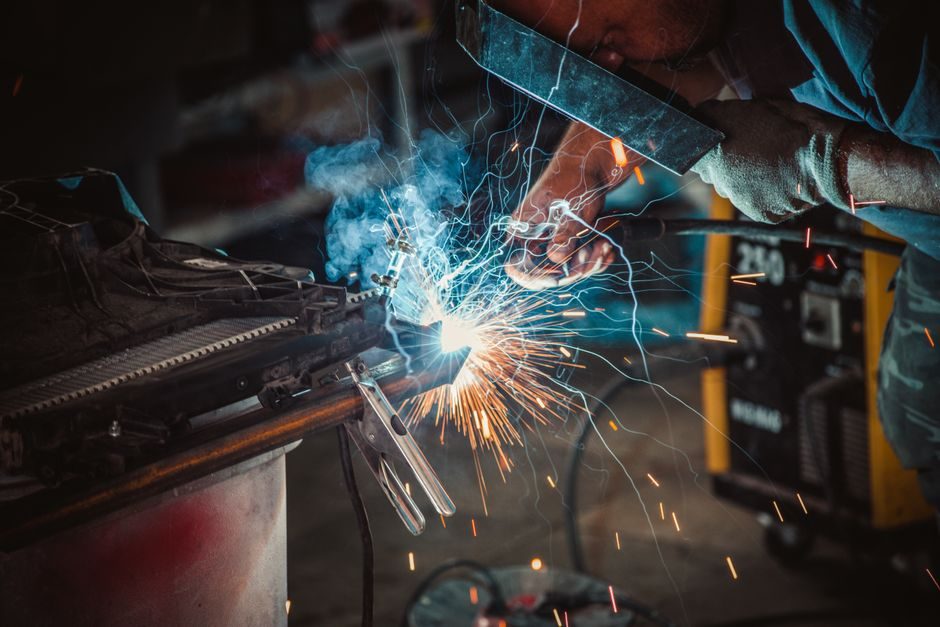
Arc welding is not a single machine but a family of processes unified by one physical fact: an electric arc struck across a 3–6 mm air gap between electrode and workpiece reaches approximately 3500–4000 °C, and in tungsten-arc variants peaks near 6500 °F (≈ 3600 °C), enough to fuse steel, stainless, aluminum, and other engineering alloys [S2][S3].
The process family spans manual stick (SMAW), wire-fed MIG/MAG (GMAW), tungsten-arc TIG (GTAW), submerged-arc (SAW), plasma-arc (PAW), atomic hydrogen, carbon-arc, and stud/capacitor-discharge machines — each trading off deposition rate, weld cleanliness, positional capability, and operator skill [S2][S4][S6][S8]. For a structural overview of one common machine category, see the arc welder reference entry that maps these processes to equipment classes.
SMAW, GMAW, and GTAW: the three workhorse processes compared
Shielded metal arc welding (SMAW, "stick") uses a flux-coated consumable rod; the coating vaporises to form a slag shield, and the rod is replaced as it burns down, making SMAW the most portable but lowest-deposition option [S3]. Gas metal arc welding (GMAW) — known as MIG when shielding gas is inert (typically argon) and MAG when active (Ar/CO₂ mixes) — feeds a continuous consumable wire through a gun combined with a shielding-gas line, and was originally developed for aluminum and other non-ferrous work in the 1940s [S3][S8]. Gas tungsten arc welding (GTAW/TIG) holds a non-consumable tungsten electrode while a separate filler rod is hand-fed, with an inert gas envelope (helium or argon, hence the legacy "Heliarc" name) protecting the pool; it is the dominant process for aluminum, magnesium, copper, and stainless where weld appearance and low contamination matter [S3].
For selection, the practical cut-offs are: SMAW for field repair, thick steel, and dirty/rusty base metal; GMAW for high-deposition production on steel and aluminum where fit-up is reasonable; GTAW for thin sections, exotic alloys, and code-quality welds where a skilled operator is available [S2][S3][S8]. GMAW wins on deposition rate and ease of automation; GTAW wins on weld quality; SMAW wins on portability and tolerance to poor surface condition. For a deeper side-by-side of wire-fed gas-shielded options, the MIG welder selection gates article and the MIG vs arc welding machine spec map lay out the duty-cycle, wire-feed, and shielding-gas criteria.
SAW, PAW, and atomic-hydrogen: high-deposition and specialised variants
Submerged arc welding (SAW) forms an arc between a continuously fed consumable solid or flux-cored tubular electrode and the workpiece, with the arc and molten pool literally submerged under a granular flux bed that blocks atmospheric contamination [S4]. SAW was developed by Linde-Union Carbide and is the standard for thick-plate pressure vessel, ship-panel, and spiral-pipe work because it allows very high travel speeds and current (often 500–1000 A) with no arc glare for the operator [S4].
Plasma arc welding (PAW) constricts the arc by forcing it through a fine water- or gas-cooled copper nozzle, separating the plasma jet from the surrounding shielding-gas envelope; the electrode is typically a sintered tungsten, and the process was discovered by Robert Merrell Gage in 1957 [S6]. PAW delivers higher energy density than GTAW, enabling keyhole-mode welding on thin stainless and titanium at travel speeds that TIG cannot match [S6]. Atomic hydrogen welding (AHW) uses two tungsten electrodes in a hydrogen atmosphere and was historically used for hardfacing and tool-steel repair; it is now a niche process. Carbon arc welding, the earliest electric-arc method, used a carbon rod that supplied no filler and has been "largely abandoned in favor of more sophisticated procedures" — mostly replaced by TIG for non-consumable-electrode work [S3].
Stud and capacitor-discharge welding: short-cycle, high-precision joining
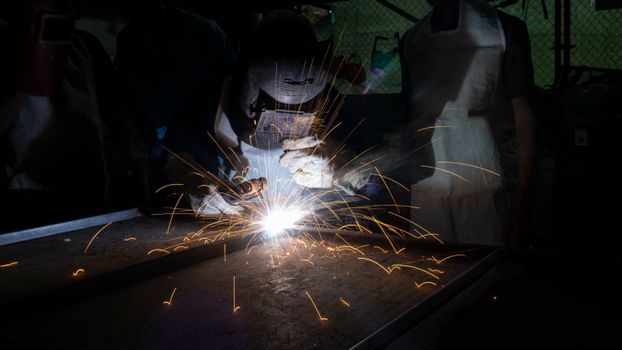
Stud welding is a sub-family where a fastener (stud, pin) is itself the electrode; a capacitor bank discharges through the stud, igniting an arc that melts the stud base and a matching pool on the workpiece, then plunges and forges the stud into place in milliseconds. A representative CNC benchtop system from THOMAS WELDING SYSTEMS welds Ø 3 mm to Ø 8 mm studs over a 500 × 300 mm process area at ±0.2 mm positioning accuracy, ±0.1 mm repeatability, and ±0.025 mm resolution, with maximum traverse rate 8 m/min, on a 230 VAC ± 10% / 50 Hz mains supply [S1].
The same vendor's catalogue also lists a semi-automatic capacitor-discharge / short-cycle SWH-02 head alongside the CNC unit, with manual stud-feeding available as an option on the automated cell [S1]. The defining process spec is weldable diameter range — typically 3–8 mm for light-duty CD studders, scaling to 10–25 mm for drawn-arc industrial stud welders — and the choice between capacitor discharge (CD, for thin sheet down to ~1 mm) and short-cycle/drawn-arc (for thicker base plates). For a structural overview of the parent machine class, the arc welder reference cross-references these duty envelopes.
Power supply, polarity, and machine-class specs
The welding power supply is the heart of any arc machine and can deliver AC, DC, or both, with the choice driven by electrode type and base metal: DC straight polarity (electrode negative) gives deeper penetration for stick and MIG on steel, DC reverse polarity (electrode positive) is preferred for thin sheet and for welding aluminum with TIG, and AC is the only stable option for TIG on aluminum because it cleans the oxide layer during the positive half-cycle [S2].
Concrete machine-class specs vary by type: portable stick (BX-series and similar) units are typically rated 140–250 A at 60% duty cycle and run on single-phase 220/230 V, with the BX6 platform widely listed as a reliable portable option [S9]. Industrial inverter-based MIG power sources commonly cover 200–500 A at 60% duty cycle with pulsed-synergic and spool-gun modes; the WSM-500 is a representative 500 A class inverter specified for heavy-plate carbon-steel work [S10]. CNC stud welders use stepper-driven X/Y tables, 50 Hz mains, and T-slot clamping plates sized around 540 × 340 mm in the reference THOMAS system [S1]. Across all classes, the three buyer-side numbers that actually drive a decision are weldable thickness range, duty cycle at rated current, and input supply tolerance (typically 230 VAC ± 10% for European-spec machines) [S1][S2].
Applications by industry: repair, fabrication, and production lines
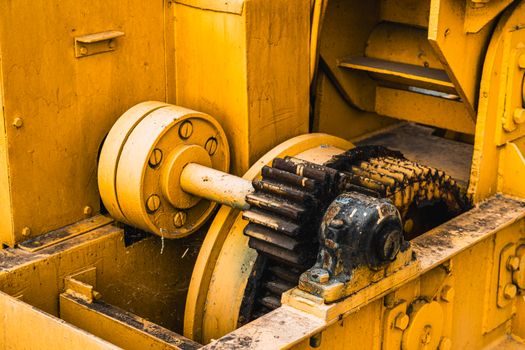
Arc welding is used for repairing broken machine parts, welding cast-iron and steel housings and frames, shipbuilding structural assemblies, automotive body-in-white and chassis components, construction-site steel erection, and pressure-vessel and pipeline fabrication — a list that tracks every heavy-industry sector because no other joining method matches the combination of strength, field portability, and thickness range [S2][S3]. GMAW dominates production-line fabrication because the shielding-gas line and continuously fed wire from a drum can be routed through a welding gun and robotically traversed along the seam [S3]. SAW dominates thick-plate and circumferential pipe welding where the submerged flux can be reclaimed and the high-current arc produces multi-pass joints in a single mechanised pass [S4]. Stud welding via CD machines is the standard for attaching fasteners to sheet-metal enclosures, electrical panels, and automotive body studs because the cycle time is measured in milliseconds and the heat-affected zone is minimal [S1].
For applications where the parent process is GTAW/TIG — aerospace, pharma, food-grade stainless, and thin-wall tube — the TIG welding machine types, current modes, and industrial applications article goes deeper on AC/DC balance, pulse parameters, and HF arc starting that govern clean welds on aluminum and stainless. Factory automation of any of these arc processes typically routes through robot cells rather than fixed CNC tables; the industrial robot cells 2026 spec map covers the safety-rated, payload, and reach-side spec gates that sit around the welder itself.
Limits, failure modes, and selection guardrails
Conventional stick (SMAW) arc welding cannot be used on reactive metals such as aluminum and titanium because the process generates oxide inclusions and the flux chemistry is not designed to clean tenacious oxides; for those alloys the spec must call out TIG (GTAW) or MIG (GMAW) on aluminum with appropriate shielding gas, or PAW for the thinnest sections [S2][S6]. SMAW is also unsuitable for very thin sheet because the operator cannot control heat input finely enough — typical minimum practical thickness for general stick welding is around 3 mm [S2]. Operator skill is the single largest failure-mode variable across the family: a poor TIG fit-up produces porosity and lack of fusion, a poor MIG gas coverage produces soot and porosity, a poor SAW flux handling produces slag inclusion, and a poor stud-weld plunge timing produces blowholes in the stud base.
Process selection for arc welding depends on base metal compatibility, since GMAW was originally developed for welding aluminum and other non-ferrous materials [S8] and SAW uses a continuously fed consumable electrode submerged under a granular flux blanket that shields the arc from atmospheric contamination [S4].
Standards, sourcing, and machine-class cross-references
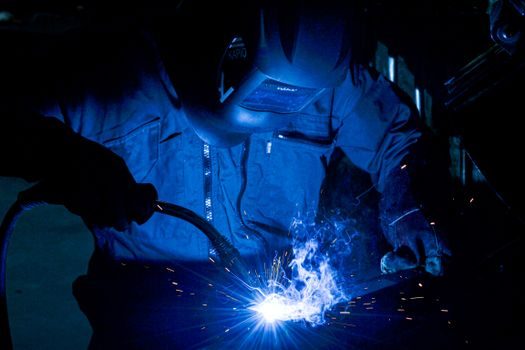
Arc welding equipment in Europe falls under EN IEC 60974 series for safety and performance of arc welding equipment, with EN 1090 governing execution of steel and aluminum structures, and ASME Section IX governing weld procedure qualification in the US. Stud welding to AWS D1.1 and EN ISO 14555 is the common spec for fastener-joining applications. Process selection still drives 80% of the outcome: a WSM-500-class 500 A inverter on a robotic GMAW torch will out-produce a fleet of portable stick machines on any plate over 6 mm, while a CNC stud welder at ±0.1 mm repeatability will out-cycle any manual stud gun the moment stud count crosses a few hundred per shift [S1][S3][S10].
Two adjacent machine families worth cross-referencing when the joining job is not fusion-based are cutting machine classes for thermal separation of plate before welding, and labeling machine classes for the post-weld identification and traceability that code work demands.