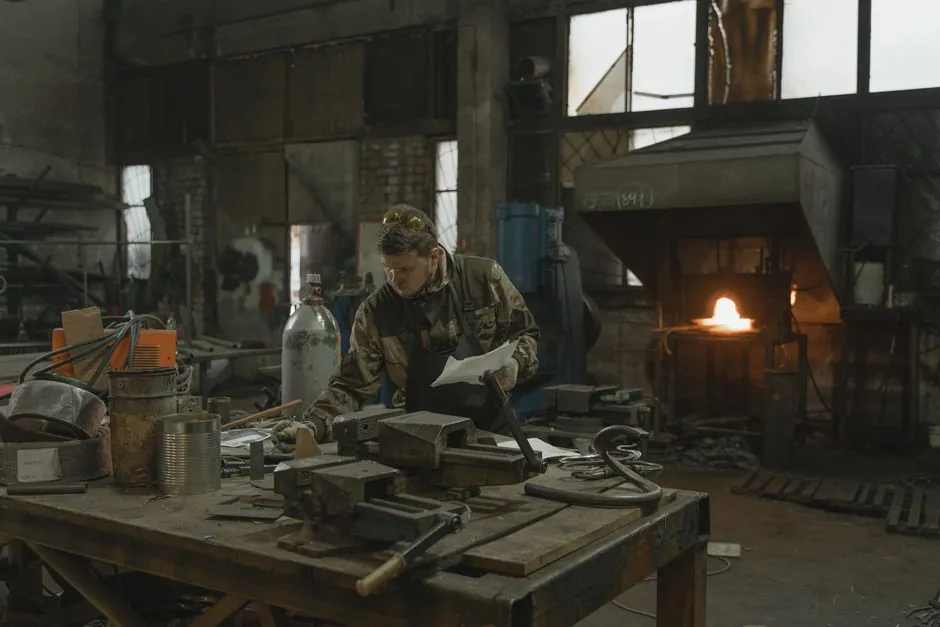
A 1,000 lb (454 kg) steel load heated from 20°C to 850°C in 60 minutes needs roughly 78 kW just for sensible heat at Cp 0.12 BTU/(lb·°F), or about 86 kW once 10% shell and refractory loss is added, and that is before any soak time or transformation overhead is counted [S2].
Heat treaters who size a heat treatment furnace by nameplate rating end up with either a starved oven that never hits soak on time, or an oversized unit that idles at 30% duty and burns money; the right answer is built from mass, specific heat, and the real minutes you actually have to ramp.
The four-variable heat balance you start from
The shop-level formula for the heat the load itself absorbs is Q_load = m × Cp × ΔT, where m is the work weight in lb, Cp is mean specific heat in BTU/(lb·°F), and ΔT is the ramp span in °F [S2]. Converting to kW against a target ramp time t (in hours) gives kW_load = (m × Cp × ΔT) ÷ (t × 3412), with the 3412 constant converting BTU/h to electrical kilowatts at 100% efficiency. SECO/Warwick's Heat Treating Data Book is the reference most U.S. shops still pull for Cp lookups, and it lists 0.10–0.12 BTU/(lb·°F) for plain carbon steel over the 20°C to 650°C range, climbing to roughly 0.16 BTU/(lb·°F) once you cross Ac1 into the austenite field where transformation heat is absorbed [S2].
For a non-ferrous cycle, the same equation works, but Cp changes: aluminum 6061 sits near 0.23 BTU/(lb·°F) and titanium Ti-6Al-4V near 0.13 BTU/(lb·°F), so the same mass and ΔT pulls very different kW. Inconel 718 in the 500°C to 700°C window is closer to 0.12 BTU/(lb·°F), which is why disc spring heat treat recipes for 500°C service use the same steel-style Cp but a much smaller mass per batch.
Losses: shell, refractory, fixtures, and atmosphere
Rated furnace kW is never equal to load kW. An empty, idling 1,200°C box furnace holds 850°C on roughly 30 to 45 kW even with no load, and that idle number has to be added to whatever the load calculation says [S2]. A practical approach is to take the calculated kW_load, multiply by 1.10 to 1.30 for a well-insulated, modern fiber-lined furnace, and by 1.30 to 1.50 for older hard refractory or vacuum units where radiation losses stack on the load-side absorption. Fixtures, baskets, and trays add 10 to 25% to effective mass on a typical heat-treat run, so most engineers fold fixture weight into m with an adjusted Cp, then apply the loss factor on top [S2].
Atmosphere flow on an endothermic gas or nitrogen-purge furnace drags another 5 to 10 kW per 1,000 SCFH of hot gas, since the gas leaves at soak temperature and the heat it carries out has to be re-supplied by the elements. Vacuum furnaces have no atmosphere loss, which is why published vacuum cycle estimates treat 3 hours of labor per load at a $15/hr rate as a separate cost bucket rather than as a kW input [S3].
Soak time and the 1-hour-per-inch rule
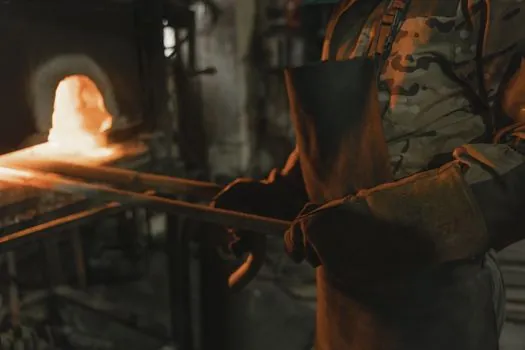
Ramp is only half of the cycle. Once the surface hits soak, the core of the work still needs time to equalize, and that time is what usually decides whether your kW is even on or cycling. The traditional shop rule, 1 hour per inch of section thickness to bring a cold part to soak, has been the planner's default for decades, and 2026 modeling work with HTP Sim on 4140 steel cylinders shows it carries a real safety margin: straight-ramp heating averages about 0.6 hours per inch, and a stepped 700°C to 850°C profile averages 0.8 hours per inch, both inside the 1-hour-per-inch envelope [S5]. That rule of thumb traces back to the 20-minutes-per-inch heat-penetration figure in the SECO/Warwick reference, which works out to the same hour-per-inch once the soak is included [S2].
For a 2-inch cross-section on a 1,000 lb batch, the model implies the load needs roughly 1.2 to 1.6 hours of element-on time after the surface reaches setpoint, and during that window the elements cycle at 20 to 40% duty rather than running flat out. If the cycle is rated for 5 hours total and your kW_load number says the elements have to deliver 78 kW for 5 hours straight, the real demand is more like 78 kW × 1.2 plus 30 kW of background loss spread across 5 hours, which is about 50 kW average and explains why so many production furnaces spec a nameplate roughly 1.4 to 1.8× the simple kW_load number [S5].
Worked example: 1,000 lb of 4140, 20°C to 850°C, 1-hour ramp
Step 1, sensible heat: Q = 1,000 × 0.12 × (850 − 20) × 1.8 = 1,000 × 0.12 × 1,494 = 179,280 BTU. Convert to kW over 1 hour: 179,280 ÷ 3,412 = 52.5 kW for the steel itself. Step 2, fixtures: assume 200 lb of mild steel trays, another 0.12 Cp, that adds about 10.5 kW, so 63 kW against the load. Step 3, transformation heat absorbed near Ac1 (~740°C) is a real term, the latent heat equivalent in the 0.16 Cp envelope adds another 8 to 12 kW average over the climb through Ac1, taking the load number to roughly 73 kW. Step 4, losses at 1.20× on a fiber-lined production furnace: 73 × 1.20 = 87.6 kW, and most spec sheets round up to 90 or 100 kW to give the controller headroom for a stepped profile [S2][S5].
The same arithmetic explains why a 70 A, 480 V three-phase box oven (around 58 kW at full demand) on a 16- to 20-hour anneal cycle has to run a tight recipe rather than freeform: at 58 kW nameplate, a 1,000 lb 4140 anneal from 20°C to 850°C would need a 1.7-hour ramp just for the load, before the 2 to 4 hours of soak that the 1-hour-per-inch rule implies for a 3-inch section [S4][S5]. The control decides zone on-time based on recipe, so unmetered kWh is the only way to capture real cost, and a sub-meter on the element circuit is what the engineer who started that 2015 forum thread was eventually steered toward [S4].
Comparison of sizing methods by decision criterion
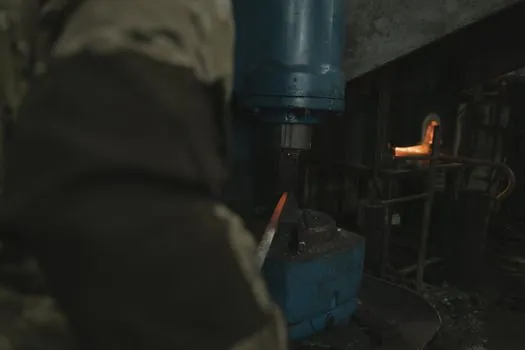
Three approaches show up on real bids, and they line up differently against accuracy, data needed, and when to use them. The nameplate-only shortcut (pick kW from chamber volume) is fast, but it ignores mass, so it under-sizes dense tool-steel loads and over-sizes aluminum annealing by 30% or more. The mass × Cp × ΔT method, with a 1.1 to 1.5× loss factor, is the workhorse for any new furnace quote and is the one SECO/Warwick's data book supports directly [S2]. FEA or 1D simulation with HTP Sim or similar is the only approach that resolves the 0.6-hour-per-inch straight-ramp versus 0.8-hour-per-inch stepped-ramp split and tells you the elements can actually back off during soak, and that is the level you go to for new aerospace or tool-steel recipes where the 1-hour-per-inch rule is too conservative to meet throughput targets [S5].
For a quick mass-only kW number that matches how mold-temperature controllers are spec'd, advantage engineering's FYI 142 uses the same kW-per-hour logic: pick the kW that brings the load to setpoint in the window you have, and that is the spec sheet value [S6]. That convention is what most furnace OEM quotation tools quietly use behind the scenes, with a 1.2 to 1.5× loss multiplier added before the nameplate is printed.
What the calculation does not tell you
Mass-based kW does not catch endothermic gas cracking energy, salt-bath latent heat, or lead-bath recovery after a cold tool drop, and any of those can swing 5 to 15 kW on a real cycle. Vacuum furnaces invert the loss picture because there is no atmosphere mass to heat, but the hot zone has to be recharged every cycle, and published cost models put labor at 3 hours per run separate from the electrical kWh number [S3].
The austenitizing calculator that ships with most heat-treat software today takes actual alloy chemistry (carbon, chromium, manganese, nickel in wt%) and returns Ac1, Ac3, and a target hold, which is the right input for any kW calculation above 0.6 × the lower critical, because the steel's effective Cp jumps in the Ac1–Ac3 band and so does the real kW demand [S1]. For a weighbridge-class load cell on a charging cart, mass accuracy has to be inside 0.5% before the kW number is worth quoting, and that is the part of the workflow that bites first when production tries to scale a lab recipe.
Trackable next signal: SECO/Warwick's 10th-edition data book remains the public reference for Cp by alloy and temperature band, and it was the document 2026 simulation work cross-checked the 1-hour-per-inch rule against, so a revision or 11th edition before mid-2027 would change the Cp lookups most quotation tools still pull from. A second signal is any update to HTP Sim's default 50 W/(m²·K) at 20°C to 120 W/(m²·K) at 1,000°C convection coefficient, since the 2026 study flagged that band as the largest single source of the gap between the 0.6-hour and 1-hour-per-inch rules [S2][S5].
Component reference pages worth checking: time relay, and ballast water treatment.