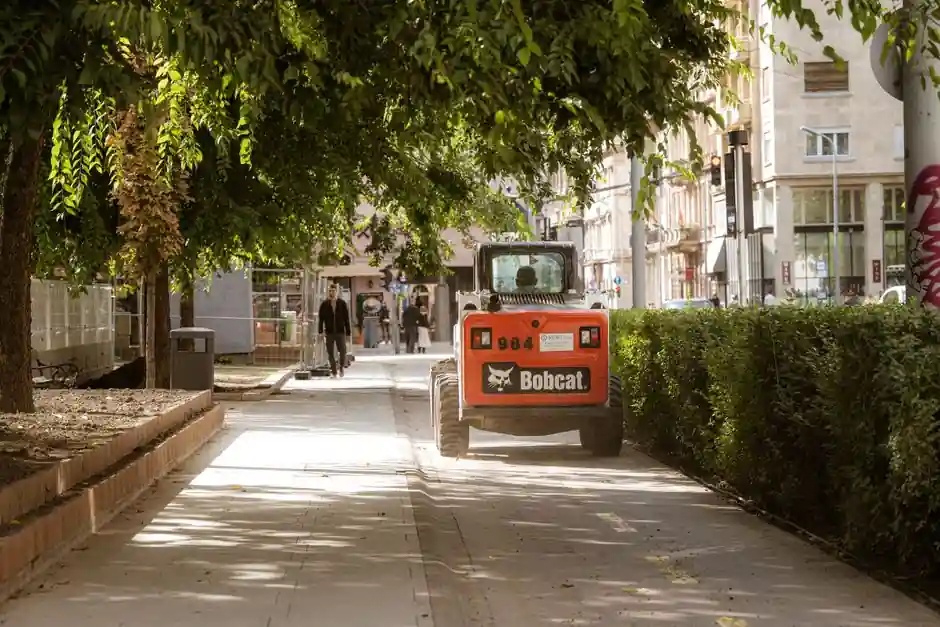
Skid steer loaders sized 1,000-1,750 lb ROC with 50-70 hp engines and 3,000-5,000 lb operating weight are the most common match for landscaping and light urban construction duty [S7], while the overall class spans roughly 2,800 to 11,600 lb [S2] for heavier civil work.
Selection for city work in 2026 is driven by four concrete constraints: available street and alley width, diesel or low-emission rules on residential blocks, the daily attachment mix (bucket, breaker, auger, sweeper), and the ROC needed for the heaviest lift on the bill of materials. A unit that satisfies those four usually beats a larger machine that forces road closures and haul permits [S5][S3].
Frame size and ROC: small-frame for tight streets, large-frame for utility cuts
Small-frame skid steers delivering 1,000 to 1,750 lb ROC at 50-70 hp and 3,000 to 5,000 lb machine weight are widely specified for landscaping, light construction, and municipal right-of-way work where the envelope is the limiter [S7]. The full class covers roughly 2,800 to 11,600 lb, with vertical-lift models favored where the operator must load trucks at full reach and radial-lift models favored where the priority is digging and grading below grade [S2][S4].
For dense urban projects the small-frame unit is almost always the default: a 6-ft-wide mini can enter a standard business door, tow behind a 1-ton truck without an oversized-load permit, and work a basement or interior demo where diesel exhaust is a problem on a low-emission electric or low-emission diesel variant [S5]. Larger-frame skid steers earn their keep on utility trench work, pavement patching, and high-cycle truck loading where the additional ROC and counterweight pay for the wider street footprint they need [S2].
Lift path: vertical vs radial, and why it decides truck-loading cycles
Vertical-lift and radial-lift paths are the two dominant geometries on offer in 2026, with vertical lift growing fastest in unit terms and radial lift still the largest installed segment by share [S4]. Vertical-lift machines keep the bucket path near vertical as the arms rise, which preserves reach at full lift height and is preferred for loading high-sided trucks, placing pallets on a flatbed, or stacking material against a wall [S2][S4]. Radial-lift machines arc the bucket inward as the arms rise, which gives more breakout force at grade and better digging geometry, so they dominate trenching, excavation, and below-grade work [S4].
For urban infrastructure where the day plan mixes pavement cuts, sidewalk grading, and material restocking, the geometry that wins is whichever one matches the heaviest daily cycle. A contractor running 200 truck-loading cycles a day on a repaving job should pay the premium for a vertical-lift unit; a crew running 150 ft of utility trench per day will be faster on a radial-lift unit because breakout force at the dig point is the productivity driver [S4][S2]. The skid steer loader category page in the encyclopedia breaks the trade-off out in more detail.
Hydraulic flow, attachments, and quick-coupler standardization
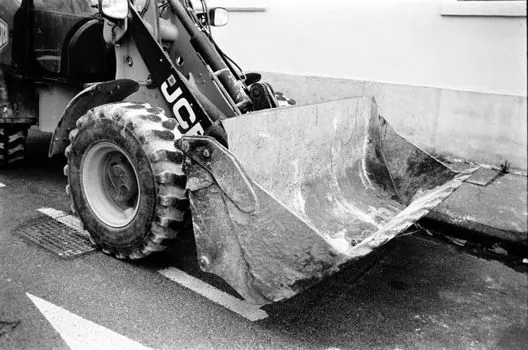
Hydraulic auxiliary flow is the spec that quietly decides whether a skid steer can actually run a cold planer, a high-flow breaker, or a snow blower, and OEM guidance in 2026 still groups attachments into standard-flow (roughly 15-25 gpm) and high-flow (roughly 30-40 gpm) bands with separate circuit plumbing [S1][S5]. Standard-flow covers buckets, forks, augers, trenchers, and most sweepers; high-flow is required for planers, large cold-planer drums, and high-cycle hydraulic breakers, and mismatching the two is a common cause of underperforming attachments on city jobs [S1].
Quick-attach couplers matter as much as flow on a multi-trade urban job because the crew will be swapping attachments 6 to 12 times a day. Spec the machine to the coupler standard the rental fleet in your city actually uses (the legacy vertical-pin and the newer horizontal-pin systems are not cross-compatible without an adapter), and confirm joystick controls and 12 V/24 V electrical taps for powered attachments before delivery [S1][S3]. For crews that also need to do night pours or sidewalk replacement, the related coverage on spec-driven selection of truck-mounted concrete pumps for urban infrastructure is worth pairing with this purchase.
Drivetrain, tires vs tracks, and the CTL comparison
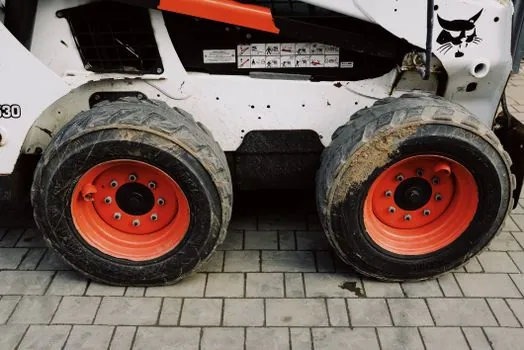
Wheeled skid steers are the right pick on finished surfaces like concrete pads, asphalt patches, and paved paths where ground disturbance and transport weight are the priorities, while compact track loaders (CTLs) win on soft, muddy, or uneven urban sub-base work where flotation and traction matter more than surface damage [S6]. The deciding KPI is ground pressure: a tracked undercarriage typically cuts psi on the ground by a factor of three to four versus tires, which protects lawns, plaza pavers, and soft sub-base on day-one site access [S3][S6].
CTLs are a cost-effective choice for operations with significant infrastructure like concrete pads, paved paths, or large construction areas [S6], but they cost more to buy, more to ship (steel tracks add a ton), and they chew up hot asphalt in summer. For an urban crew that runs 70% on finished surface and 30% on dirt, a wheeled small-frame skid steer is usually the lowest total-cost option; flip that ratio and the CTL earns its premium back [S6][S3].
Power, emissions, and the move to electric in city cores

Electric skid steer loaders are increasingly specified for urban environments with strict noise and emissions rules, and OEM data shows that the quieter operation is the primary driver rather than fuel cost alone [S8]. Tier 4 Final diesel remains the default for sites without a low-emission zone constraint because it removes range anxiety on multi-shift days, but low-emission diesel and battery-electric variants are now viable on basement, interior, and night-shift urban work where diesel particulate and noise are contractual liabilities [S5][S8].
The practical rule in 2026 is to map the machine to the city or project emissions rule first, then to the work cycle: if the jobsite is inside a low-emission zone or a night-noise-restricted residential block, electric or low-emission diesel with a diesel particulate filter is the default; if the site is open-air and the day plan runs 8+ hours under load, Tier 4 Final diesel still wins on energy density and refuel time [S5][S8].
Selection criteria compared: small-frame wheeled vs large-frame wheeled vs CTL
On a four-criterion comparison, a small-frame wheeled skid steer scores best on footprint (under 6 ft width, 3,000-5,000 lb), acceptable on ROC (1,000-1,750 lb), best on transport cost (tows on a 1-ton truck, no permit), and worst on ground pressure on soft sub-base [S7][S3]. A large-frame wheeled skid steer scores best on ROC and breakout force at the dig, mid on footprint, and worst on transport cost because of width and weight [S2][S4].
A CTL scores best on ground pressure and traction on soft or muddy urban sub-base, mid on ROC, and worst on hot-asphalt surface damage and per-mile transport cost, so it fits crews that spend the majority of the day off finished surface [S6]. The compact equipment landscape for related site work, including rough terrain forklift spec'ing for urban infrastructure and concrete pump truck selection for urban infrastructure work, uses the same three-column trade-off.
Limitations and common failure modes on city jobs
The four failure modes that actually sink urban skid steer purchases in 2026 are: undersized auxiliary flow for the chosen attachment, wrong coupler standard for the rental fleet in the city, diesel spec that violates a local low-emission or night-noise ordinance, and a lift path geometry that fights the daily truck-loading cycle [S1][S5][S8]. Each of these is a paper-spec issue caught before delivery, not a field failure, and each one costs more to fix after the machine is on the ground than to spec correctly up front.
For crews that also run winter duty, the related guidance on skid steer snow removal: pick flow rate, undercarriage, and cab first lays out the same flow and cab filtration logic, and it pairs naturally with the wheel loader category for sites where the bucket capacity of a skid steer is the binding constraint.
Trackable signals for the next quarter: OEM announcements of higher-density battery packs for compact electric skid steers, more city procurement RFPs that hard-code low-emission or electric compact equipment, and the spread of standardized high-flow hydraulic quick-couplers across the major rental fleets. These are the three indicators that will shift the selection matrix for urban infrastructure buyers through the rest of 2026 and into 2027.
Spec-level background on the components involved: backhoe loader.