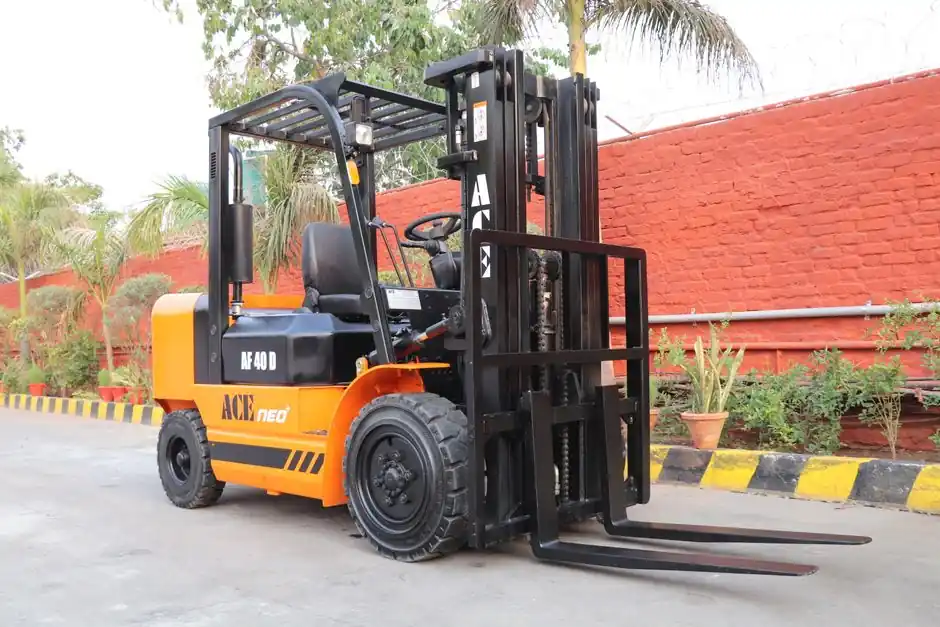
Rough terrain forklifts specified for mining are defined by four non-negotiable engineering features: large pneumatic tires, diesel power, at least 380 mm of ground clearance, and switchable 2WD/4WD drivetrains that hold traction on slopes up to 50% grade, compared to 10–15% for warehouse forklifts [S5]. The global market for these machines was estimated at $220–240 million in 2025 with a projected CAGR of 3.5–4.0% through 2030, and construction plus mining applications account for 60–65% of all deployments [S5].
For an open-pit or quarry-floor operation, the practical envelope is a 4×4 diesel machine rated 3,500–5,000 kg, fitted with off-road tires sized 16/70-20 to 16/70-24, an operating weight of 5.2–8.5 tonnes, and a maximum lift height of 3,000–6,000 mm [S4]. Sizing the heaviest anticipated load with a 20% safety margin is the single most-cited productivity lever, since underspec'd machines in 850 surveyed sites lost 25–40% of working time to stuck equipment, tip-overs, or insufficient reach [S5]. A baseline primer on rough terrain forklift design is useful before stepping into spec details.
Capacity classes and where each one fits a mine site
Rough terrain forklifts segment into four practical capacity classes that map directly onto mining tasks: compact 1.8–2.5 t units for light consumables and parts runs, mid-range 3.5–5.0 t machines for pipe, cribbing, and palletized reagent handling, heavy-duty 5.0–10.0 t units for structural steel and conveyor components, and telehandler-class machines rated to 9,000–11,000 lb for high-reach maintenance and liner-change work [S3][S5]. Mid-range 4 t machines are the most common tonnage on construction and lumber sites, while 3 t units are typically reserved for farm or small yard work and 8 t units for ports and heavy infrastructure [S4].
A 3,500 kg rated load, a 4,000–5,000 kg operating weight, and 4×4 full-time four-wheel drive describe the standard mid-range profile and fit the majority of pit-floor material moves [S4]. For applications where the load exceeds 5 t or the lift exceeds 6 m, telehandlers such as the Caterpillar TL943 (43 ft reach, 9,000 lb capacity, 99 hp Cat C3.4B) or the Manitou M50-4 (11,000 lb capacity, 74 hp diesel, hydrostatic transmission, 4WD) become the more rational choice [S3]. The forklift encyclopedia page gives a broader view of how these off-road variants sit inside the wider industrial truck family.
Drivetrain, tires, and ground clearance: the engineering floor
Full-time 4WD with switchable 2WD road mode is the dominant configuration for 2026 model-year rough terrain forklifts, and it is paired with high-torque direct-injection diesel engines sized 43–55 kW for 2.5 t units and up to 90 kW for 10 t units [S4][S5]. Tire sizing is the most visible differentiator: a typical 2.5 t model runs 12.5/80-18 fronts and 27×10-12 rears, while 4 t and 5 t machines use 16/70-20 or 16/70-24 off-road tires engineered for mud, gravel, and slope work [S4][S5].
Ground clearance is the second non-negotiable: heavy-duty rough terrain forklifts exceed 380 mm, roughly 2.5–3.8× the 100–150 mm clearance of a standard warehouse forklift, which is what lets them cross rocky pit floors and haul-road ruts without undercarriage damage [S5]. Boltless one-piece welded frames are specified to raise chassis strength by roughly 20% over bolted alternatives, a value that becomes a tipping-resistance margin on uneven haul-road cambers [S1]. Oscillating axles, wide wheelbases, and tilt-correction systems are the next-tier features to look for when the ground is consistently broken rather than merely soft [S3].
Comparison: telehandler vs straight-mast rough terrain forklift on five decision criteria
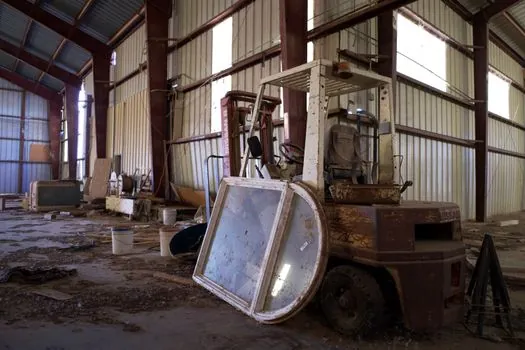
On a mine site the choice between a telehandler (e.g. Cat TL943, Manitou M50-4, JCB 510-56) and a straight-mast rough terrain forklift (3–5 t, 4WD) comes down to five engineering criteria. Reach: telehandlers win, with 43–56 ft lift heights versus 3,000–6,000 mm on straight-mast units. Lift capacity at full height: telehandlers hold 9,000–11,000 lb but derate quickly with extension; straight-mast machines hold 2,000–5,000 kg more consistently to full lift. Maneuverability: straight-mast forklifts turn in a smaller radius and fit standard pit-floor lane widths. Ground clearance and slope handling: both classes match, at 380+ mm and 50% grade. Engine power: telehandlers run 74–130 hp turbocharged diesels, while mid-range straight-mast units run 43–55 kW (roughly 58–74 hp), so telehandlers carry a fuel-burn penalty of 20–30% for the same tonnage moved [S3][S4][S5].
The decision rule that comes out of the comparison is straightforward: pick a straight-mast 4 t rough terrain forklift for pallet, pipe, and consumables moves where reach stays under 6 m; pick a telehandler only where the work plan requires frequent 9 m+ reach or boom-positioning that a mast cannot deliver. Both selections are available in the broader mining dump truck support fleet, where a 4 t forklift typically pairs with a 20–40 t rigid-frame haul unit for pit-floor reloading. For readers building a full mining support spread, the related truck-mounted crane selection for mining write-up covers the lifting complement to a rough terrain forklift.
Where the rough terrain forklift fits and where it does not
Rough terrain forklifts are specified for material handling on mud, gravel, sand, and slope work, including pallets of bricks, concrete blocks, steel, timber, and palletized reagents, and they cover building construction, infrastructure, road and bridge works, mining sites, and outdoor industrial yards [S4]. On a mine site specifically, they handle pipe and cribbing moves, conveyor idler and roller changes, tire and rim transport, reagent palletizing, and pit-floor consumables runs that a haul truck or loader cannot economically cycle [S1][S8].
Where the class does not fit: high-volume bulk earthmoving, primary ore haulage, and any duty that requires sustained 50+ km/h road speeds. CASE rough terrain forklifts, for example, are speed-limited to 24 mph (roughly 39 km/h), which makes them a yard and pit-floor machine, not a long-distance hauler [S9]. For bulk haulage, the relevant machine class is the rigid-frame or articulated mining dump truck, not a rough terrain forklift; for dynamic ground improvement before a haul road goes down, see the dynamic compactor selection for road construction reference. The related write-up on forklift selection for road construction covers the smoother-terrain use case where a less aggressive 2WD chassis can still do the job.
Selection checklist and the signals to track next
The minimum spec list a mining buyer should sign off against in 2026 is: rated capacity at 500 mm load center 20% above the heaviest planned load, full-time 4WD with 2WD road mode, diesel engine meeting current Tier 4 Final / Stage V emissions where site air permits require it, ground clearance of at least 380 mm, off-road tires sized 16/70-20 or larger, an ergonomic ROPS/FOPS operator cab, and load-sensing hydraulics that derate cleanly at full reach [S3][S4][S5]. Brands with a deep 2025–2026 presence in the segment include Caterpillar, Toyota, Manitou, Komatsu, and Bobcat, with the Bobcat V923 (9,000 lb, 23 ft, 130 hp turbo-diesel) and the SkyTrak 10054 (10,000 lb, 54 ft reach, Cummins Tier 4 Final) the most-cited telehandler variants [S3][S10].
Two trackable signals to watch for the next spec refresh: the rollout of Stage V emissions-compliant diesel platforms into the 2.5–5 t class through 2026, and the gradual substitution of hydrostatic transmissions for torque-converter units on mid-range machines, a change that improves low-speed maneuverability on pit-floor mud but raises the hourly service cost. Until those two shifts settle, the conservative 4 t, 4WD, 380 mm-clearance, 16/70-20-tire spec remains the safe default for greenfield mine support fleet tenders.