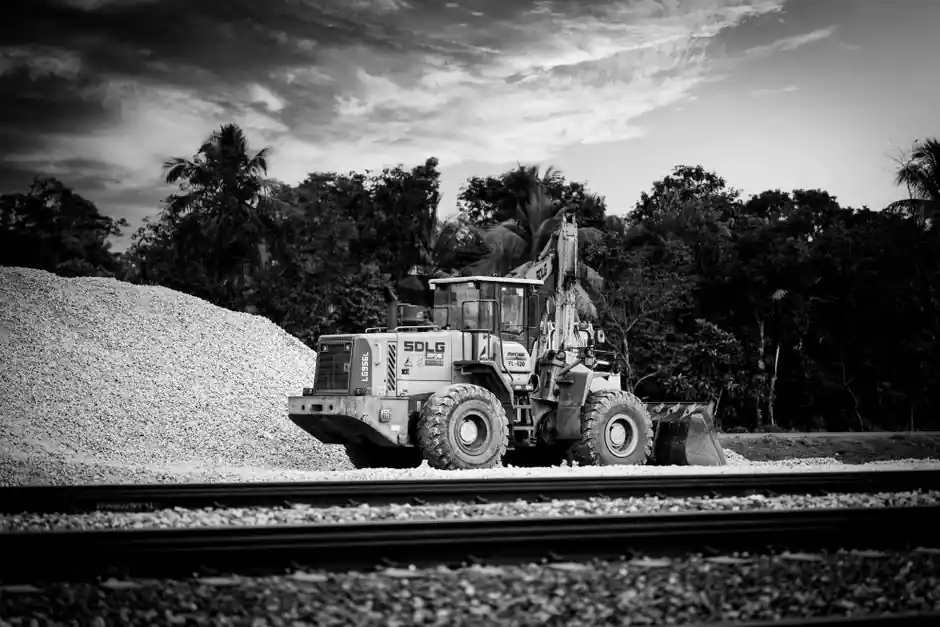
Compact track loaders (CTLs) are the dominant skid-steer-class platform for pipeline right-of-way work, favored over wheeled units in pipeline construction, utility trenching, and forestry applications per dealer guidance from July 2026 [S5].
Pipeline spreads impose a specific load profile on a skid steer loader: repetitive cycles between spoil pile and trench, frequent attachment swaps (trencher, auger, bucket, compactor), and long stretches of soft, rutted, or recently backfilled ground. Matching rated operating capacity (ROC), lift path geometry, hydraulic flow, and undercarriage type to those conditions is the difference between a productive crew and a stuck machine.
Frame Class and ROC: Match the Load, Not the Marketing Sheet
Rated operating capacity defines the maximum load a skid steer can safely handle at the bucket pivot, and small-frame units run 1,000-1,750 lb ROC at 50-70 hp and 3,000-5,000 lb operating weight, medium-frame units run 1,750-2,200 lb ROC at 70-90 hp and 5,000-8,500 lb, while large-frame machines exceed 2,200 lb ROC, reaching 4,000 lb on heavy models, at 90-110+ hp and 8,500-11,000 lb [S3]. ROC declines as lift height increases, so the published peak figure must be checked at the typical working height of the pipeline crew, not at ground level [S3].
For most pipeline laterals and distribution work, medium-frame machines offer the best balance of power, reach, and transport weight; large-frame units earn their keep on mainline spreads with deep trench boxes, large-diameter pipe bedding stone, or on-site loading of 20-ton trucks. Under-speccing a frame to save on rental typically costs more in cycle-time overruns than the daily-rate difference. For crews cycling between spoil handling, bedding placement, and backfill, the wheel loader alternative only makes sense above roughly 3 cubic yard bucket capacity.
Radial vs Vertical Lift: Geometry Decides the Cycle
Vertical-lift designs keep the load closer to the machine's center of gravity and deliver roughly 15-20% greater dump height than radial-lift counterparts, making them the correct choice for loading tall dump trucks, placing bedding stone onto pipe-laying pads, or stacking cribbing on elevated trench boxes [S3].
Radial-lift machines trade peak height for greater forward reach at mid-lift, which suits low-sideboard trucks, ditch-side spoil placement, and work where the operator loads and reverses in a tight loop. On pipeline jobs with mixed lift targets (low dump trucks plus high spoil screens), the vertical-lift geometry reduces the number of repositioning cycles per shift.
Wheeled Skid Steer vs Compact Track Loader on the Right-of-Way
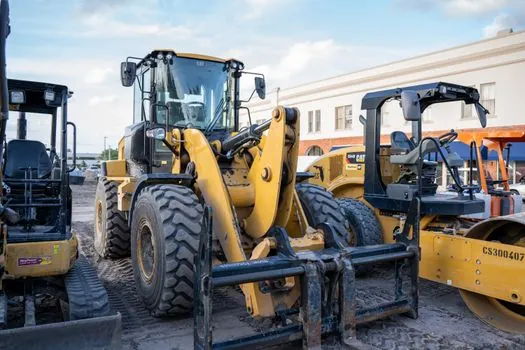
Compact track loaders are typically preferred over wheeled skid steers for pipeline construction because lower ground pressure (often 4-6 psi for tracked units vs roughly 25-30 psi for wheeled) reduces rutting, improves flotation on soft subgrade, and extends the work window after rain [S5]. Tracked undercarriages also deliver better tractive effort for pushing spoil and pulling a trencher through cohesive soils.
Wheeled skid steers remain the lower-cost, higher-road-speed option for hard-surface urban utility work, indoor manhole tie-ins, and sites with strict finished-grade protection. A practical selection rule: choose the CTL when more than 30-40% of the cycle occurs off hardstand; choose the wheeled skid steer when the machine lives on pavement or compacted gravel. Both platforms use the same quick-coupler interface, so a fleet running mixed undercarriages can share augers, brooms, and buckets.
Hydraulic Flow, Engine Power, and Attachment Duty Cycle
For high-intensity excavation and crushing work on a pipeline spread, the spec floor is a high-power engine paired with high-torque hydraulics, since trencher, auger, and hydraulic breaker attachments impose continuous high-flow demand rather than intermittent loader-arm loads [S2]. Standard-flow auxiliary circuits on small-frame units (around 15-20 gpm) are adequate for brooms and light augers, while high-flow circuits (30-40+ gpm) are required for cold planers, large augers, and trenchers above 36-inch depth.
Engine power must be matched to the worst-case combined load: propulsion plus full auxiliary flow plus hydraulic cooling fan. Cat's 275 XE skid steer, for example, runs a 122 hp gross engine (SAE J1995:2014) against 4,205 lb ROC and a 12,705 lb operating weight, illustrating the high-power end of the current 2026-vintage compact loader catalog [S4]. On the opposite end, the 226D3 with 67.1 hp, 1,550 lb ROC, and 5,849 lb operating weight suits lighter utility and residential lateral work [S4].
Selection Criteria Comparison: Matching Skid Steer Spec to Pipeline Phase
The table below lines the three principal machine options against the four decision criteria that drive pipeline-spread selection. All values come from manufacturer catalog and 2025-2026 selection guidance; verify against the specific OEM data plate for the unit being rented or purchased. [S2]
Small-frame wheeled skid steer (1,000-1,750 lb ROC, 50-70 hp): best for urban lateral tie-ins and finished-grade work; lowest daily rental and transport cost; poor flotation on soft right-of-way; limited to light augers and brooms at standard flow [S3]. Medium-frame CTL (1,750-2,200 lb ROC, 70-90 hp): best general-purpose pipeline machine; balanced transport weight; handles 24-36 inch trenchers and mid-size augers; vertical-lift variants available [S3][S5]. Large-frame CTL (2,200-4,000 lb ROC, 90-122 hp): best for mainline spreads, deep trench, and high-volume bedding placement; highest transport and fuel cost; requires high-flow hydraulics for productive trencher and cold-planer cycles [S3][S4]. The decision is not which machine is "best" but which combination of ROC, lift path, and undercarriage matches the dominant cycle on that specific spread.
Operating Conditions, Safety, and Common Failure Modes
The best skid steer for construction duty is one with higher lifting capacity, enhanced stability, and confirmed compatibility with heavy-duty attachments, paired with the operator-presence and overhead-guard safety package required on a busy right-of-way [S6]. On pipeline work, two failure modes dominate: (1) under-rated ROC causing tip-overs when the operator swings a heavy attachment on slope, and (2) tracked undercarriage wear accelerated by sharp rock and welded pipe bedding. Both are spec-and-procedure issues, not machine defects.
A practical pre-mobilization checklist for any pipeline spread: confirm ROC at the planned lift height (not at ground level), confirm auxiliary flow matches the heaviest attachment, confirm undercarriage type against the dominant ground condition, and confirm quick-coupler compatibility with the existing attachment fleet. Skipping any one of these typically surfaces as a mid-shift bottleneck. Crews already running trenchers and shoring equipment will recognize the same selection logic that governs a pipeline pump spec: match the unit to the worst-case duty, not the average.
Trackable signals for the next planning cycle: OEM updates to SAE J1995:2014 gross-power ratings on 2026/2027 model-year skid steers, and any dealer-side fleet-data showing ROC-versus-cycle-time on pipeline spreads. For crews sizing the trenching side of the spread, the selection logic for soil-excavation equipment follows the same ROC-plus-flow framework outlined here; complementary fleet choices like compact track loaders also feed into broader construction machinery and equipment planning.
Related analysis: Tank container selection for pipeline construction: T-code, pressure, and material match.