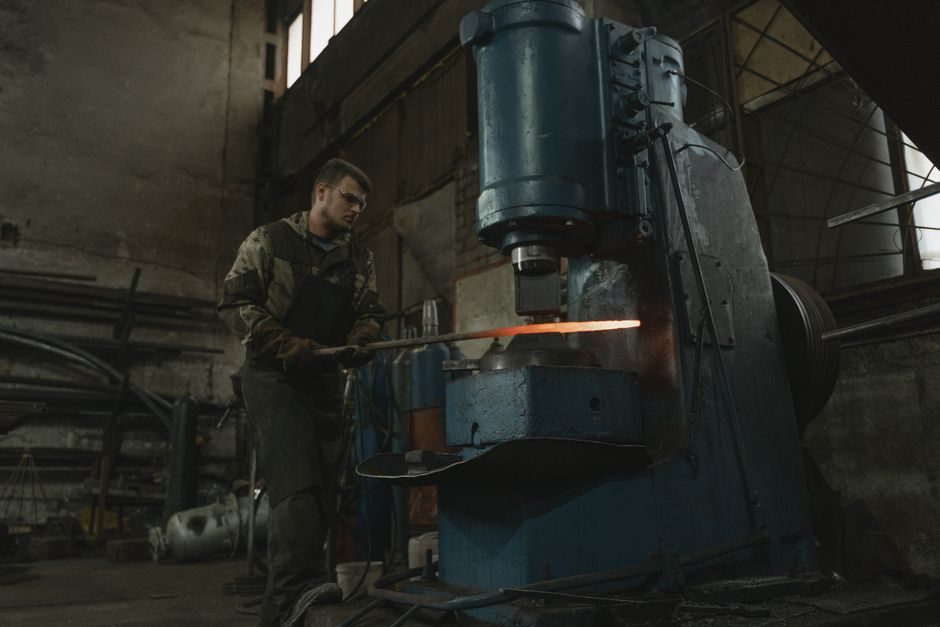
Match the press to the job in three layers — required tonnage, frame geometry, and pump/motor drive — and the rest of the spec falls out of the workpiece, not the catalog. A 200-ton H-frame shop press, a 4-post CNC hydraulic press, and a servo-driven cold-extrusion press are three different machines solving three different forming problems, even when the nameplate force looks similar [S1][S2].
Press-master-stocked tonnage spans 20-ton hydraulic broach presses to 350-ton H-frame presses in current 2026 dealer lineups, with a 250-ton class repeatedly cited as the workhorse for general metal forming, straightening, and broaching [S3]. Servo-hydraulic retrofit on a conventional motor-driven press is now quoted at 30-50% energy reduction on the same duty cycle, which is the single largest operating-cost lever a buyer can pull in 2026 [S2].
Tonnage Sizing: Force, Safety Factor, and Stroke
Tonnage is the first cut, and the common engineering rule is to size the press at roughly 1.2-1.5x the calculated peak forming force so the machine never idles at the end of its force curve. Wuxi KLT's "Four-Column CNC Hydraulic Press" line is built around stretch, cutting, shaping, and molding duties, with the Y32 series CNC four-column molding machine and YD27 multi-station CNC drawing machine covering the multi-hundred-ton range for sheet drawing work [S2].
Stroke and daylight matter as much as peak force. A press that can deliver 250 tons but only has 150 mm of usable stroke will not deep-draw a deep cup; conversely, a long-stroke press in the wrong frame class will deflect before it reaches rated tonnage. For straightening work, Press Master's SP straightening press ships in the 250-ton class with a roll-in table option (RTP-250-51) for handling long shafts, which is the typical North American pattern for a shaft-and-axle job [S3].
Frame Geometry: H-Frame, C-Frame, and 4-Post
Frame geometry sets what can physically pass through the press, so the workpiece dictates the frame before the tonnage does. Press Master's current product matrix splits cleanly into H-frame (HFP 350-ton, HFBP broach press), C-frame (CFP 200-ton), 4-post (4PP 50-ton), gantry (GSP 150-ton), and specialty (SHP) lines, all in stock for 2026 delivery [S3].
An H-frame shop press is the right call when the workpiece is symmetric, you need three-sided access for loading, and you want a bed that resists off-center moment loads. Press Master rates its HFBP at 250 tons with an "extra wide" bed variant for wide flanges and long broaching cuts [S3]. A C-frame hydraulic press is the right call when you need a single-sided open throat for slide-in dies, slugs, or assembled sub-components that cannot be split apart to load.
Skip the C-frame for any job where side thrust exceeds roughly 10-15% of rated tonnage — C-frames deflect under off-center load and the bed is not designed to react horizontal die forces. For deep-draw, composite molding, and brake-pad hot pressing, the four-column down-stroke or four-column double-action servo press (Cosmos's flagship cold-extrusion line) is the geometrically correct choice because the four columns hold parallelism across the full stroke [S1].
Drive Type: Servo-Hydraulic vs Conventional Asynchronous
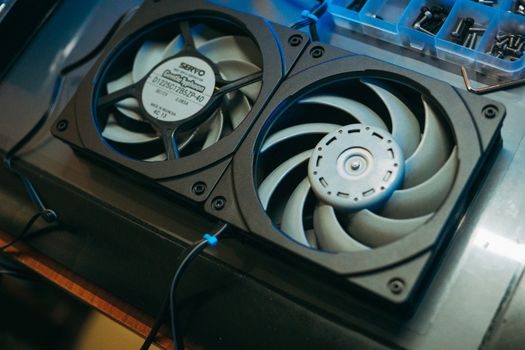
Drive type is the second-largest line item after tonnage, and the 2026 default on new Chinese-built presses is shifting to electrohydraulic servo. Wuxi KLT publishes 30-50% energy savings when a servo hydraulic system replaces a conventional fixed-displacement motor pump on the same forming duty, and backs it with a CNC system that controls stroke, pressure, speed, and arbitrary set-point profiles [S2].
Cosmos positions its full four-column and frame-type line as "servo-driven hydraulic press" — cold extrusion, up-stroke, down-stroke, and double-action — which is the same architectural shift: replace the constant-running induction motor with a servo-driven pump that draws only the flow and pressure the stroke actually needs [S1]. The trade-off is control electronics and servo pump cost; the payback is energy, lower oil temperature (longer seal life), and quieter idle.
For a buyer comparing 4-post press options, the hydraulic cylinder and hydraulic pump pairing is where the efficiency gain is realized — a servo-driven variable pump matched to a low-friction cylinder cuts both no-load losses and throttling losses, which is the mechanical reason the 30-50% figure holds up under measurement. Conventional two-stage pumps still win on lowest-first-cost for simple single-stroke shops that cycle below roughly 10 strokes per minute.
Standards, Certification, and Precision Class
Two standards cover most of the geometry and precision questions a buyer will ask: Chinese GB 9166-2009 for hydraulic press general specifications, and Japanese JIS B 6403-1994 for first-grade hydraulic press precision. Cosmos publishes that its presses exceed GB 9166-2009 and meet JIS B 6403-1994 first-grade on parallelism, verticality, pressure accuracy, and positional accuracy, with three-stage inspection covering parts, assembly, and whole-machine testing [S1].
For CE-marked export into the EU, Wuxi KLT publishes CE quality certification as a baseline, with parts inspection under internal regulations and a one-year warranty on the machine [S2]. For North American shops, Press Master's stated differentiator is that "all of the electrical, hydraulic and mechanical parts are industry-standard and are readily available all over North America," which is a maintenance and parts-availability claim, not a safety-marketing claim [S3].
Pressure-holding and circuit safety depend on the hydraulic valve block, pressure switch, and relief architecture. Generic industrial pressure switches on the 2026 market span roughly 0-200 bar adjustable ranges with 1/4 PT thread process connection, with common set-point families at 1.6 MPa, 3 MPa, 5 MPa, and 10 MPa for low-pressure clamp and pilot circuits [S4]. A press that needs to hold position for more than a few seconds under load also needs a hydraulic actuator with proven static leak-down performance — Press Master's July 2026 article "Cylinder Drift: When the Ram Won't Stay Put" treats this as a safety issue, not just a maintenance nuisance [S3].
Use Cases by Industry and Press Class
Press class maps to industry fairly cleanly. For automotive panels, brake-pad hot pressing, and resin grinding-wheel forming, Cosmos ships dedicated automated production lines on a four-column servo-hydraulic base, with parallelism and temperature control as the binding specs [S1]. For general metal-parts forming — trimming, stretching, straightening, and edge cutting — Wuxi KLT positions its Y27 four-column sheet-drawing press, HPHS frame CNC drawing machine, and YH27 frame CNC molding machine as the workhorses, with 14 years of in-house R&D and 10,000+ classic cases on file [S2].
For North American job shops, Press Master's H-frame 250-350 ton class, C-frame 200-ton class, and 4-post 50-ton class cover the typical mix of straightening, broaching, and small-frame forming. Forklift-tire presses and gantry straightening presses are specialized derivatives of the same platforms, built for very large or unusually shaped workpieces [S3].
Buyers evaluating presses for forging-class duties should cross-reference against the forging press selection map — hot forging presses and cold-extrusion presses overlap in tonnage but differ in frame stiffness, ram speed profile, and thermal management.
Who Should NOT Buy the Mainstream H-Frame
Skip the standard H-frame shop press if any of the following apply: the workpiece is wider than the bed and cannot be repositioned mid-stroke, the forming force has a significant horizontal component (most H-frames will deflect), or the cycle is so short that the fixed-displacement motor wastes more energy than it spends forming. In those cases, a 4-post press, a C-frame, or a servo-hydraulic retrofit is the structurally and economically correct answer, not a bigger H-frame [S3].
Also avoid the cheapest imported press for any job that holds force under dwell — lower-tier machines routinely show cylinder drift within months because the hydraulic cylinder seal package and valve lapping are not built for static holding pressure [S3][S4].
Shortlist Logic for a 2026 Buyer

A clean 2026 shortlist works like this: (1) calculate peak tonnage with a 1.2-1.5x safety factor; (2) pick frame geometry by workpiece shape and access needs; (3) choose servo-hydraulic if cycles exceed ~10 strokes/min or energy cost is material, otherwise conventional two-stage is fine; (4) verify GB 9166-2009 / JIS B 6403-1994 precision class for forming work, and CE marking for EU shipment; (5) confirm valve, pump, and cylinder are stocked brands in your region (Wuxi KLT publishes 1-year warranty, Press Master emphasizes North-American-stocked parts) [S1][S2][S3].
Trackable signals for the next 90 days: new servo-pump efficiency curves from Chinese OEMs (current claim is 30-50% energy savings, but head-to-head measured data on identical duty cycles is still thin in the public record), and any update to JIS B 6403 or GB 9166 precision-class definitions that would shift the 2026 shortlist math.