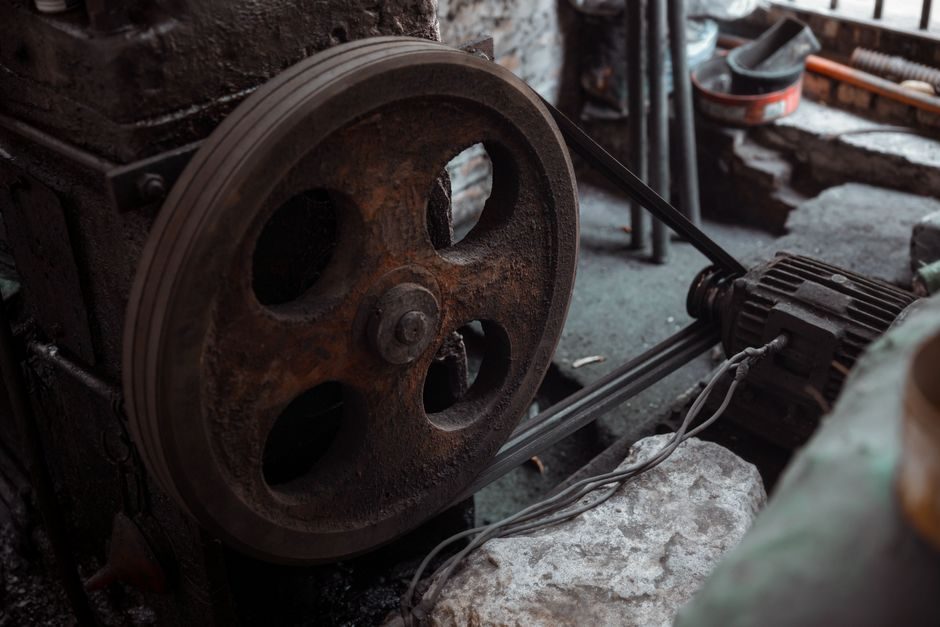
Taper bushes are split steel or cast-iron sleeves with a matching taper on the hub bore, clamped by high-tensile cap screws to lock a taper bush onto a cylindrical shaft. The format eliminates keyway machining and allows field replacement without re-machining the driven component.
Common metric/imperial series span 1008 (12.7 mm bore) up to 5050 (127 mm bore) [S4][S5], with the 1610, 2517, 3020, 3535, and 4040 sizes dominating V-belt drive, conveyor, and blower applications. Wholesale entry pricing on the 2517/3020/3535 cast-iron taper-lock family sits in the US$ 2.00-3.50 per-piece band on Made-in-China as of May 2026 [S9][S4].
Bore Range and Series Numbering
Each bushing size is a four-digit code: the first two digits equal the bore in sixteenths of an inch, the last two equal the flange length in eighths of an inch — a 2517 therefore accepts a 2-1/16" (~52.4 mm) bore at maximum and projects 2-1/8" flange length [S4].
Standard stocked ranges cover 9.5 mm (1008) through 127 mm (5050) bores; metric and imperial bores are interchangeable in the same body because the locking taper is independent of the through-bore diameter. For low-torque fractional-horsepower drives the 1108-1610 range is typical; for industrial conveyor head pulleys the 3020-4040 range carries the load [S4][S5].
Shaft Tolerance, Surface Finish, and Keyless Grip
Taper-lock grip relies on shaft surface condition, not friction welding: commercial steel shaft to h6/h7 tolerance with Ra 0.8-1.6 µm finish is the working baseline for full torque transfer. Under-tolerance shafts slip under shock load; over-tolerance shafts prevent full taper engagement and the cap screws bottom out before the taper seats. [S1]
Cap-screw torque is the second variable — published tightening tables for the 2517/3020/3535 group use 30-65 N·m depending on size, and re-torque is required after the first duty cycle because the split seats. Treating the taper bush as a friction-fit only — not a keyed joint — is the most common commissioning error in the field.
Material Selection: Ductile Iron vs Carbon Steel
Cast (ductile) iron taper-lock bushes dominate the conveyor and pulley market because the split-and-taper geometry absorbs the casting process cheaply and the iron body damps vibration in V-belt drives [S2][S8]. Wholesale ductile-iron 2517 units ship at roughly US$ 2.80-3.30 per piece in 50-piece MOQ lots [S9].
Forged or machined carbon-steel taper sleeves are specified where the duty cycle includes high cyclic loading, reversing torque, or ambient temperature above 200 °C; they cost 2-4× the cast-iron equivalent but hold cap-screw preload under thermal cycling. Stainless 303/316 variants exist for washdown and food-grade lines but are non-stocked at most industrial distributors.
Matching Bushing to Driven Component
The pulley, sprocket, or coupling hub must be pre-bored to the bushing's outer pilot diameter before the taper bush is inserted — this is a factory operation, not a field retrofit. Hub material should be iron or steel with a minimum tensile strength around 250 MPa to grip the taper without hoop cracking. [S3]
Standard V-belt pulleys in SPA/SPB/SPC profiles are sold as matched pulley-plus-bushing SKUs on Made-in-China, with SPA sheaves from US$ 1.20-1.80 per piece in 10-piece MOQ [S2]. For heavy industry, suppliers such as Shijiazhuang Yide Machinery manufacture matched pulley-taperbush-coupling sets in ductile iron and C45 steel, typically with 1000-piece MOQ for OEM [S8].
Comparison: Three Main Taper-Bush Variants
Buyers typically choose between three formats on three criteria:
1. Cast ductile-iron taper-lock (1008-5050 series): lowest cost (US$ 2-4 wholesale), best damping for V-belt drives, limited to ~3000 rpm continuous duty. Fits conveyors, fans, light mixers [S9].
2. Steel (C45/1045) taper-lock bush: 2-4× cost, handles reversing load and 200 °C+ ambient, common in industrial valve actuators and Roots blowers. Specified when the driven machine sees cyclic shock [S3].
3. Split-taper QD (QD = quick-disconnect) bush: US-origin format, common in API-spec pump and compressor drives, premium cost, fastest field changeover. Interchangeable with the metric taper-lock family only through adapter hubs.
Who Should NOT Specify a Standard Taper-Lock
Taper-lock grip is unsuitable for precision servo or encoder-coupled drives because the split introduces measurable angular play (typically 0.1-0.3°) and runout. Use a shrink-disk or zero-backlash locking assembly instead.
It is also wrong for tapered shafts, splined shafts, or any application requiring axial positioning repeatability — the bushing clamps radially and floats axially. For pressure transmitter mounting brackets and instrument shaft drives, specify a clamp collar or set-screw collar from the matched shaft collar family instead, which gives true axial reference.
Installation Torque and Reuse Limits
Cap-screw grade matters: the stock 10.9/ZS-grade screws supplied with cast-iron taper bushes are single-use in high-torque duty because the threads yield on first tightening. For repeatable field service, replace with 12.9-grade screws at every re-assembly. [S2]
A correctly seated bushing shows zero relative motion between shaft and hub under hand-brake test (shaft held, 200 N·m torque applied to hub). Any audible slip or visible scribe-line movement indicates either under-torque, oversize shaft, or contaminated taper faces — all three require disassembly and re-cleaning before re-torque.
Standards and Sourcing Signals
There is no single ISO standard covering the full taper-lock bushing range; major US/European manufacturers (Martin, Dodge, Fenner, Taper-Bore) hold proprietary dimensions, though the 1008-5050 envelope has become de facto industry interchange. Sourcing on Made-in-China currently shows 9 active OEM SKUs and 1 dedicated taper-bush manufacturer under the Shandong Liaocheng cluster as of May 2026 [S3][S9].
Watch the cap-screw grade marking on the bushing flange — unmarked or 8.8-grade screws are a quality red flag. Forged C45 steel and ISO 4014 cap screws from a named mill will be on the supplier's CoC; ductile-iron castings to ASTM A536 65-45-12 are the spec baseline for conveyor and blower duty. Cross-check the flow meter drive-end coupling spec when a taper bush is fitted downstream of a metering pump — slip there reads as process noise, not as a mechanical fault.
Next, compare three castings-side-by-side MOQ quotes (2517, 3020, 3535) from two Shandong OEM channels and one Taiwan channel before issuing the PO, and request a 0.05 mm radial-runout report on the first article to lock the quality baseline for the production run.