Specifying an emergency stop button starts with three non-negotiables set by EN ISO 13850 and IEC 60947-5-5: a red mushroom actuator on a yellow background, mechanical latching that holds the circuit open until deliberate reset, and positive (forced) opening of at least one NC contact [S2][S3].
Beyond that baseline, the practical selection is driven by four numeric gates: mounting cut-out (16.2, 22.3, 22.5 or 30 mm), contact count and current (1NC/10A up to 3NC + 1NO/6A), ingress rating (IP40 indoor up to IP67/IP69K washdown) and housing material (polyamide/polyester plastic vs AISI 316 stainless) [S1][S2][S4][S6].
Mounting Cut-Out and Head Diameter
The most common panel cut-out is 22.5 mm, which accepts the 30 or 40 mm red mushroom head used on most industrial control stations and matches Form A contact blocks per IEC 60947-5-1 [S2][S6]. A 16.2 mm cut-out (with 250,000-cycle contact rating) suits handheld pendants, AGV control boxes and compact panels where panel real estate is tight [S1][S4].
22.3 mm Form A variants from norelem use AgNi contacts and a yellow frame, with a twist-right-or-left release that lets operators reset without looking at the actuator [S6]. For general industrial panels the 16/19/22 mm triplet is the dominant Chinese export pattern, with 22 mm models rated up to 660 V AC and 10 A for high-demand enclosures [S5].
Contact Configuration and Electrical Rating
EN ISO 13850 mandates at least one forced-break NC contact, and a single 1NC/10A block covers most low-voltage motor stop circuits up to 600 V insulation (Ui) [S1][S2]. Where the E-Stop has to drop out a contactor coil AND signal a safety relay, a 2NC or 2NC + 1NO block is the safer choice because the second NC provides redundancy against a single contact welding [S2][S3].
Typical ratings cluster in two bands: 24-690 V AC/DC at 6-10 A for general industrial use, and 250 V AC at 3 A for the smaller 16/19 mm heads used in compact panels [S2][S5]. All compliant blocks are described as positive mechanical linkage / forced break, which is the property that guarantees the NC contact opens even if the contacts weld shut [S2][S3].
Housing Material and Sealing
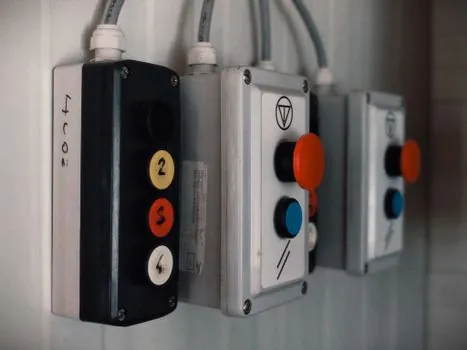
Polyamide or polyester plastic is the default for indoor control panels, giving IK08 impact resistance and IP67 sealing at the lowest cost, with operating temperature from -40 to +80 C [S2][S3]. AISI 316 stainless steel with mirror-polished Ra4 surface is the right pick for food, beverage, pharmaceutical and clean-room lines, where the housing must survive CIP/SIP chemical washdown to IP69K and ambient temperatures up to +100 C [S2][S3].
For hazardous-area chemical or refinery duty, the explosion-proof button category adds ATEX-rated enclosures and 2-4 M20/NPT cable entries, with steel-bodied stations sized 110x110 mm and double gaskets to keep IP69K after years of thermal cycling [S2][S3].
Reset Method and Operator Interface
Push-lock / pull-release is the classic pattern on plastic 22.5 mm buttons, while twist-to-release (clockwise or either direction) is dominant on stainless and Form A units because it can be operated with gloved, wet or dirty hands [S2][S3][S6]. Key-release versions add a physical lockout against unauthorised reset, which is increasingly specified on cells guarded by emergency light towers and area scanners [S3].
Self-monitoring variants open the safety circuit if the cover is removed or damaged, which closes a gap in machines where a defeated E-Stop would otherwise leave a hidden hazard [S2][S3]. For pendant stations on cranes and hoists, an M12 connector and twist-release head is the common configuration, with 1NC contacts and a 250,000-cycle mechanical life [S1].
Who an E-Stop Is For, and Where It Is Overkill

An E-Stop is mandatory on every machine where EN ISO 13850 applies: presses, conveyor lines, packaging machinery, CNC, robots, AGV and any equipment with uncontrolled stored energy. It is the right call for any station wired into a safety relay, contactor, or variable-frequency drive stop input [S2][S3][S7].
A standalone latching pushbutton is overkill on purely electrical loads below 24 V / 1 A, on handheld battery tools, and on instruments that already have a software emergency routine and a hardwired isolation switch. In those cases a simpler emergency stop circuit through the device's own safety I/O is often more reliable than a separate panel button.
Application Match-Up: Plastic vs Stainless vs Pendant
Plastic polyamide housings win on indoor panels, control desks and AGV pendants where cost, weight and a 22.5 mm cut-out dominate the bill of materials; the KCK/IDEM plastic series is rated -40 to +80 C, IP67/IP69K, 24-690 V AC/DC up to 10 A, and 1NC to 3NC contact stacks [S2]. AISI 316 stainless wins on food, pharmaceutical and outdoor chemical lines, with mirror Ra4 finishes, +100 C thermal headroom, FDA/EHEDG hygiene documentation, and the same 24-690 V envelope at 6 A switching [S2][S3].
Pendant stations are a third category: 16.2 mm cut-out, 1NC twist-release, M12 connector, 250,000-cycle mechanical life, and a yellow frame on the operator's hand rather than a fixed panel [S1][S4]. Across all three families, the shared selection logic is: cut-out diameter first, then contact count, then housing material, then reset style, then sealing class.
Installation, Test Interval and Common Failure Modes
EN 60204-1 calls for periodic functional test of every E-Stop, and most plant practice is a push-and-reset cycle every 6 to 12 months depending on duty cycle. Mount the station in a 22.5 mm hole or via screw-on base, route cable through M20 or NPT entries (2-4 ports depending on whether you bring in a separate indicator or auxiliary), and verify the latching and release action after wiring [S2][S3].
Most field failures trace back to three causes: liquid ingress when an IP65 panel is upgraded to washdown without changing the gasket, contact welding on a station that is undersized for the inrush of its contactor coil, and a defeated or taped actuator that turns the button into dead hardware. Specifying a higher IP rating, a second NC, and a self-monitoring cover closes all three [S2][S3].
Shortlist Logic for 2026 RFQs
For a new build, default to a 22.5 mm cut-out, 2NC positive-break block, 10 A / 600 V rating, IP67 minimum, and a twist-to-release red mushroom head in polyamide; this covers roughly 80% of indoor industrial panels and is the catalog default for IDEM/STEUTE-style stations [S2][S6]. For food, pharma or outdoor chemical service, move to AISI 316 with mirror Ra4, IP69K, +100 C thermal headroom, and CIP/SIP validation documentation [S2][S3].
For AGV, pendant and compact-panel use, drop to a 16.2 mm Form A unit with AgNi contacts, twist reset and 250,000-cycle mechanical life; the pressure transmitter selection discipline of cut-out, contact, material, sealing carries over directly, and the same supplier audit should cover both component families [S1][S4]. For a fleet of new machines, lock the BOM to one cut-out size and one contact block vendor to cut panel-drill tooling cost and to keep spares interchangeable across lines.
Track these three signals over the next two quarters: (1) any EN ISO 13850 revision that tightens the 250,000-cycle mechanical-life expectation, (2) growth of ATEX/IECEx dual-certified E-Stops for new European chemical builds, and (3) wider rollout of IO-Link safety E-Stops that report button health to the PLC instead of relying on a hardwired NC loop. For related process-instrument selection logic, see the Radar Level Meter Sizing: 2026 Range, Blind Zone, and Antenna Cut map and the How to Choose a Level Transmitter: A 2026 Spec Map guide.