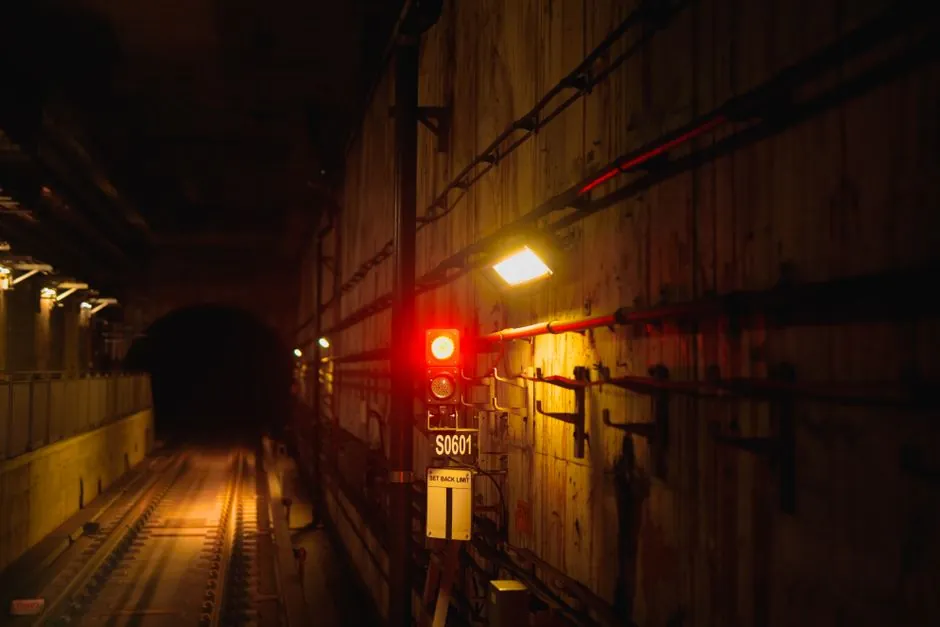
Signal tower lights in the Ø45 mm to Ø80 mm diameter range, with 1 to 5 stackable LED modules and built-in buzzers at 85-90 dB at 1 m, cover the majority of machine-status signaling on automated production lines and workstations [S5][S6][S8].
The same product family spans AC 110 V, AC 220 V, DC 12 V, and DC 24 V coils, with PC or AS lenses over ABS housings, and protection ratings from IP23 (open-frame buzzer models) to IP55 (wall-mount semi-circular models) [S5][S6][S7][S8][S9]. For background on the broader signal-device category, see the signal tower light encyclopedia entry and the parent lamps and light fittings page.
Body Diameter vs. Viewing Distance
Qlight STC45ML (Ø45 mm) suits close-range bench-top panels and small cells, with module heights from 106 mm to 198 mm and a lens made of PC over an ABS housing [S5]. For larger cells, ST80EL (Ø80 mm) pole-mount units stretch up to 287-447 mm overall height to keep the top tier above eye line and partial obstructions [S6].
Wall-mount semi-circular units change the geometry entirely: Qlight SWT (Ø90 mm half-circle) sits at 216 mm tall and 46 mm deep, giving a 180° viewing cone for corridors and aisle ends [S7]. Hanyoung STL series goes the other way, offering Ø25, Ø40, Ø60, and Ø80 mm cylinders for tight-installation cabinets where a Ø60 tower would not physically fit [S4].
Stack Height, Module Count, and Color Codes
Stack height is a direct function of how many discrete machine states the line needs to communicate. Qlight ST45ML accepts 1-5 tier stacks from 106 mm (one module) to 358 mm (five modules) on the same Ø45 mm body, with red, amber, and green as the common baseline [S8]. The Hanyoung STL series publishes the same 1-5 module range with five color options and an aluminum pipe as the central pole for direct-mount or stand-off installation [S4].
For monocolor panel-mount replacements, the ECVV-listed units (Ø50 mm body, 8 x 19 cm base dia. x height) ship as single-color, 1-tier units on 70 cm lead wires, with steady-only or steady-plus-buzzer variants, at 179-259 g net weight [S1][S2][S3]. These single-tier units are used where a single red, yellow, or blue indication is the entire scope, and they cannot be field-expanded to a 3- or 4-tier stack [S2].
Voltage, Wiring, and Cabling
Voltage selection must match the cabinet control voltage before mounting hole sizing, because the same body is sold in AC 110 V, AC 220 V, DC 12 V, and DC 24 V variants. Qlight ST80EL, for example, lists AC 110 V, AC 220 V, AC 12 V, AC 24 V, DC 12 V, and DC 24 V as separate order codes on the same Ø80 mm housing [S6]. ST45ML keeps the same voltage matrix on the smaller Ø45 mm body [S8].
Single-tier ECVV units expose a 70 cm cable and use color-coded lead wires: black and red for power, gray and signal-color (yellow or blue) for switched control of the indication [S2][S3]. Mounting hole diameter on these entry-level units is 0.45 cm (0.18 in), and the package footprint is 20 x 20 x 20 cm at 0.2-0.3 kg including packaging [S1][S3].
Ingress Protection, Buzzer Level, and Materials
IP rating is set by the housing geometry, not by the LED tier. Qlight STC45ML and ST45ML ship at IP44 standard, dropping to IP23 on built-in buzzer variants because the buzzer opening vents the enclosure [S5][S8]. ST80EL, with its larger Ø80 mm pole-mount body, is also IP44 on the standard build [S6]. Wall-mount SWT moves up to IP55 because the semi-circular housing seals against a vertical surface and avoids top-down water paths [S7].
Acoustic output clusters tightly across the product family: built-in buzzers are published at Max. 90 dB at 1 m, and built-in alarm variants drop to Max. 85 dB at 1 m on the same housings [S5][S6][S8]. Lenses are PC on STC and wall-mount SWT/SWTE units for impact resistance, and AS on ST80EL and ST45ML direct-mount units where UV stability on a horizontal pole is the priority [S5][S6][S7][S8][S9]. All housings in this comparison are ABS, with aluminum center poles on the pole-mount Ø45 and Ø80 mm units [S5][S6][S8].
Comparison: Main Form Factors on Selection Criteria
Four form factors cover essentially every machine-status signaling decision. Ø45 mm direct-mount (ST45ML): 1-5 tiers, 106-358 mm height, IP44/IP23, 90 dB buzzer, AC/DC 12-24 V and AC 110-220 V, lens AS [S8]. Ø45 mm pole-mount (STC45ML): 1-5 tiers, 106-198 mm height, IP44/IP23, 90 dB buzzer, same voltage matrix, lens PC [S5]. Ø80 mm pole-mount (ST80EL): taller overall at 287-447 mm for the same 1-5 tier range, IP44, 90 dB buzzer, 85 dB alarm option, AS lens, ABS housing, Al pole [S6]. Wall-mount semi-circular (SWT Ø90 mm half / SWTE Ø70 mm): fixed 1-3 tier geometry, IP55, 85-90 dB buzzer, 46-76 mm projection depth off the wall, PC lens, ABS housing, 122-286 mm height [S7][S9].
The decision logic is straightforward: pick Ø25-Ø45 mm for bench-top and small-cabinet duty where a tier 4-5 stack is needed but ceiling height is tight; pick Ø60-Ø80 mm pole-mount where the operator stands 3 m or more from the line and the top tier must clear guards; pick wall-mount semi-circular for aisle-end and corridor-facing status boards where a 180° arc is required and IP55 washdown rating is mandatory. Avoid Ø80 mm pole-mount on cells where the operator stands within 1 m, because the larger lens footprint blocks adjacent panel space without adding useful information.
Where a Single-Tier Indicator Replaces a Stack Light
A single-tier, single-color tower light is the right call when the machine state is binary and the indication is fixed at install time. The ECVV Ø50 mm body units (179-259 g) cover red, yellow, and blue single-color steady or steady-plus-buzzer duty at AC 110 V or AC 220 V, with 70 cm leads and a 0.45 cm mounting hole, and they are common on automotive lighting stations, parking gates, and small factory fixtures [S1][S2][S3].
These units are NOT the right call for any application that may grow to 2 or more states. They cannot be field-expanded because the housing is a single sealed tier, and the cable exit is sized for one power pair and one switched pair only [S3]. If future states are likely, specify a modular Ø45 mm or Ø80 mm stack from the start, even if only one tier is populated on day one. Similar modular logic applies to motion-control hardware: see the linear guide and crossed roller guide reference pages, where the same field-upgradability argument drives selection of modular carriage lengths.
Cross-Reference to Adjacent Spec Decisions
Signal tower lights share cabinet space and control voltage with a wide range of industrial signaling and motion components, so the same selection discipline applies across categories. For a deeper look at how IP rating, duty cycle, and form factor drive a parallel decision on a different device, see the electric linear actuator selection for agricultural machinery reference. Cabinet-level signal wiring also tends to share trunking with limit switches and motor leads, so a sound-tower decision often sits next to a submersible pump installation spec, and the same washdown IP55 logic that drives SWT wall-mount units also drives food-line equipment choices such as the stretcher selection for food processing spec map. [S5]
Trackable signals: (1) the migration of stack lights from 4-wire discrete to IO-Link controlled QTG-IOL and QTC-IOL series on the Qlight smart-factory line, which changes the wiring decision away from the 70 cm lead-wire models above; (2) wider adoption of Ø80 mm bodies in place of Ø60 mm on automotive body-in-white cells, driven by top-tier visibility above robot fences. The parent construction machinery and equipment page covers the heavy-equipment signaling context where IP55+ ratings and Ø80+ diameters become non-negotiable.