Plastic tubing selection starts with four numbers — operating temperature, working pressure, chemical exposure, and required bend radius — because every polymer family has a hard envelope on at least one of them. Push past the catalogue colour codes: a 4 mm OD polyurethane (PU) line at 8 bar is not interchangeable with a 12 mm PTFE line at 200 °C, and treating the two as "plastic tube, plastic tube" is where most field failures originate.
This map is written for process, instrumentation, and pneumatics engineers who already know they need plastic — and now need the polymer, the reinforcement, and the fitting standard nailed down. We use the pneumatic tubing reference page as a baseline for instrument-air duty, and cross-link to engineering plastic and plastic pipe for the heavier process-pressure cases. Expect concrete temperature, pressure, and tolerance values below — anything hedged in adjectives is filler, not a spec.
Five Polymer Families and the Duty Each One Owns
Polyurethane (PU) covers the low-pressure, high-flex duty — typically -40 °C to +80 °C continuous, with working pressure around 8–10 bar at 6–8 mm OD and a bend radius as tight as 4× OD; it is the default for pneumatic tubing on valve manifolds and robot tool drops [S1]. Polyethylene (PE) — both LDPE and HDPE — extends chemical resistance to acids, alkalis, and water-treatment chemicals at the cost of pressure rating (typically ≤10 bar at room temperature for the 6–12 mm OD range) and upper temperature near 60 °C; HDPE also shows up as a low-cost plastic pipe liner in non-pressurised drain lines.
Polyamide (PA, nylon 6 / nylon 12) raises the temperature to roughly 80–120 °C continuous and the pressure to 15–25 bar at 8–10 mm OD, at the expense of moisture pickup — nylon 6 in saturated air can lose ~1% of its tensile strength and creep noticeably above 80 °C. PTFE owns the high-end envelope: continuous service from -200 °C to +260 °C, near-universal chemical compatibility, and a 4:1 pressure safety ratio at temperatures where every other polymer has already softened — which is why PTFE shows up on the engineering plastic reference for chemical-plant analyser lines. PVC sits at the bottom: cheap, food-grade options exist, but cold-flexibility drops below 0 °C and plasticiser migration under heat rules it out of any service above ~60 °C.
Five Selection Criteria You Cannot Skip
Temperature first, pressure second, chemistry third, flexibility fourth, certification fifth — in that order, because the first three typically disqualify a polymer family outright, while the last two decide between equivalents. On temperature, a 10 °C margin above the worst-case ambient plus any adiabatic compression heating from throttled gas is the minimum; on pressure, derate the catalogue "burst pressure" by at least 4:1 to get a working pressure at temperature, not at 23 °C lab conditions. Chemistry rules are absolute: ketones and esters swell PU and PVC; strong oxidisers (concentrated HNO₃, ozone above 0.1 ppm) attack nitrile rubber seals and stress-crack PE; only PTFE, PFA, and certain grades of PVDF survive halogenated solvents and hot acids [S1].
Flexibility, quantified as minimum bend radius at 23 °C, drives routing cost more than the tube itself: a 6 mm OD nylon line that needs 30 mm bend radius dictates a much larger routing footprint than a 6 mm PU line happy at 12 mm. The fifth criterion — certification — is what separates a commodity tube from a fit-for-purpose one: look for ISO 7628 (road-vehicle pneumatic brake tubing), SAE J844, EN 855 (hydraulic thermoplastic hose), FDA 21 CFR for food contact, USP Class VI for pharmaceutical, or UL 94 V-0 for flame. A tube without a printed standard on the jacket is, in practice, a tube without traceability.
Comparison Table: Main Polymer Options Against 4 Decision Criteria
Engineering decision logic, not a marketing matrix — the four criteria below are the ones that actually eliminate candidates on a P&ID.
- PU (polyurethane): continuous -40 °C to +80 °C, working pressure ≈ 8–10 bar at 6–8 mm OD, very tight bend radius (≈ 4× OD), poor with ketones/esters/hot water above 60 °C — best fit: shop-floor pneumatics, robotics, low-pressure instrumentation air [S1].<br>- PE (LDPE/HDPE): continuous -40 °C to +60 °C, working pressure ≈ 6–10 bar at room temperature, moderate bend radius (≈ 8–10× OD), excellent water/acid/alkali resistance — best fit: water treatment, laboratory drain, low-pressure chemical dosing.<br>- PA (nylon 6 / nylon 12): continuous -40 °C to +80–120 °C, working pressure 15–25 bar at 8–10 mm OD, bend radius ≈ 6–8× OD, sensitive to moisture and strong acids — best fit: lubricating oil lines, hydraulic pilot circuits, fuel-handling within rated envelopes.<br>- PTFE: continuous -200 °C to +260 °C, working pressure to ~20 bar at 6–10 mm OD, bend radius ≈ 10× OD, near-universal chemical resistance — best fit: analyser sample lines, chemical-plant instrumentation, steam-adjacent service.<br>- PVC (plasticised): continuous -10 °C to +60 °C, working pressure ≈ 4–8 bar at room temperature, tight bend radius, poor with solvents and plasticiser-migration-limited above 50 °C — best fit: potable water, low-cost food/beverage, instrumentation air in dry indoor service.
Who Should NOT Pick the "Default" Polyurethane Option
Polyurethane is the default pneumatic tubing for a reason — it bends, it absorbs vibration, it takes a 90° routing through a cable tray without kinking. It is the wrong choice the moment any of four conditions are present, and the most common field failure I see is exactly this: an engineer specifies PU for a duty it was never rated for. The four disqualifying conditions are: (1) sustained temperature above 80 °C (e.g. near a turbine enclosure, a boiler header, or any steam-adjacent area) — PU softens and the pressure rating halves; (2) any contact with ketones, esters, concentrated acids, or hot water above 60 °C — the polymer swells and the burst strength drops by half within hours; (3) outdoor UV exposure beyond ~2 years without a black-jacketed or additive-stabilised grade — clear PU yellows and embrittles; (4) any food, pharmaceutical, or potable-water service where a USP Class VI, FDA 21 CFR, or WRAS-listed grade is mandated — generic industrial PU does not carry these approvals [S1].
If any of those four flags is up, the engineering answer is nylon for the temperature/pressure jump, PTFE for the chemistry/temperature jump, or HDPE for the chemistry/cost jump. Skipping the triage step is how plants end up with plasticiser-leached PVC in an analyser shelter, or clear PU in a chemical washdown area — both are visible inside twelve months as either brittleness or sticky surfaces.
Reinforcement, Fittings, and Why the Connection Is Half the Spec
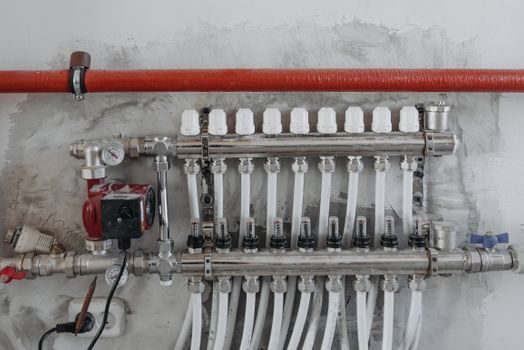
A tube's catalogue pressure is meaningless if the fitting does not match. Three concentric layers show up in the higher-pressure grades: an inner polymer liner (the wetted surface), an intermediate reinforcement (braided polyester, aramid, or stainless steel wire), and an outer jacket (UV/abrasion/colour). Plain unreinforced PU is fine to ~10 bar; reinforced thermoplastic hose (typically to EN 855 or SAE 100R7/R8 for the hydraulic derivatives) reaches 70–210 bar working pressure depending on braid layer count. Fittings must follow the same standard: a push-in fitting rated 10 bar on a 210-bar hose is a fitting, not a termination.
For instrument-air and low-pressure process lines, push-in fittings (e.g. ISO 14743-compliant cartridged fittings) install in seconds and re-use is acceptable up to the manufacturer's cycle count — typically 50–100 matings for the O-ring carrier. For PTFE and PFA, the credible fitting is a compression-style ferrule (Swagelok-type geometry) or a flared 37° JIC end, because the cold-flow of PTFE under a push-in O-ring will eventually lose seal. Thread the fitting standard back to the tube standard and the application: a brake-system tube to ISO 7628 must terminate in ISO 7628-compliant fittings; an analyser line to pneumatic tubing duty uses compression ferrules; a steel-plastic composite pipe in building services terminates in a different mechanical-connection family entirely and is not interchangeable with any of the above.
Real Use Cases and the Specs They Pin Down
Use case 1 — CNC machine pneumatic logic lines, 6×4 mm PU at 6–8 bar, room temperature, dry indoor air, ~30,000 matings/year on the push-in fittings: the spec is a calibrated-PU shore hardness around 98A, oil-resistant grade, with a printed working pressure and temperature on the jacket per ISO 7628 or EN 855 references. Use case 2 — chemical-plant analyser sample line, 6×4 mm or 1/4"×1/8" PTFE at 0–15 bar and 150–220 °C, with intermittent exposure to HCl, H₂S, or solvent vapours: the spec is virgin PTFE, no plasticiser, sintered and translucent, terminated in stainless compression ferrules; nothing else survives that envelope.
Use case 3 — potable-water point-of-use in a food plant, 12×9 mm LDPE or PE-X at ≤6 bar and ≤40 °C: the spec demands WRAS, FDA 21 CFR, or DVGW W270 on the print line, plus a maximum extractable-lead value the manufacturer has to publish. Use case 4 — outdoor compressed-air drop on a loading-bay robot, 8×5 mm black-jacketed PU or PA at 8–10 bar, ambient -20 °C to +50 °C with UV exposure: spec black-jacketed, hydrolysis-stabilised PU, with a 4:1 safety factor on burst pressure at the worst-case ambient plus 10 °C for adiabatic heating. A useful comparative anchor for adjacent spec-driven decisions is the How to Choose a Cast Aluminum Alloy: A Spec-Driven Selection Map article — same "match numbers first" logic, different material.
Limitations, Failure Modes, and How to Audit a Spec'd Line

Plastic tube failures are almost never random. The four modes that account for the majority of post-installation incidents are: (1) permeation — gas molecules (especially H₂, He, O₂) diffuse through the polymer wall; PTFE and PFA minimise but do not eliminate this, and for high-purity gas lines stainless tubing is the correct substitute; (2) creep and cold-flow — under sustained pressure, the inner diameter grows ~1–3% over months, which is why fittings on PTFE must be re-torqued at commissioning and again after 24 h; (3) chemical attack — even "chemically resistant" polymers have specific exclusions; PTFE resists almost everything, but molten alkali metals, fluorine, and certain fluorocarbon solvents at high temperature will etch it; (4) kinking from under-spec'd bend radius — once a plastic tube is kinked, the wall is permanently thinned at that point, and the working pressure at the kink drops by ~50% [S1].
Audit pass: confirm printed standard on the jacket, confirm working pressure at temperature (not at 23 °C), confirm chemical compatibility against the specific fluid — not "similar" fluid — in the manufacturer's published compatibility table, confirm fitting standard matches tube standard, and confirm bend radius is ≥ the catalogue minimum at the worst-case operating temperature, not at 23 °C lab. Track capacity signals in adjacent industrial-plastic categories for a fuller view of supply — the Foam Fabrication Suppliers 2026: Process Map, Capacity Signals, and Sourcing Reality piece shows the same kind of regional capacity data that resin and tubing buyers cross-reference. Final shortlist logic: lock the polymer family from temperature + chemistry, lock the pressure class from working pressure + safety factor, then choose the reinforcement and fitting standard — and reject any tube whose catalogue page does not print all three on the same line.