
Choosing industrial rubber tubing is a four-axis decision: elastomer family, dimensional spec, service envelope, and supply format — locked in that order before any vendor or brand is discussed.
The fastest disqualifier is elastomer-to-service mismatch: natural latex tubing (dipped, by Kent Elastomer Products in Ohio — the only US-domestic dipped natural latex tubing manufacturer) is sized strictly by ID, wall and OD in fractional inch and sold by box, reel, foot or roll [S3]. A 50 ft reel carries up to 3 pieces for tubing under 1/2" OD; reels of larger OD ship in 25 ft lengths [S3].
Elastomer family: match the polymer to the fluid and temperature window first
Natural latex (polyisoprene) tubing is the default for surgical, lab and low-pressure fluid-handling duty, sold in three measurable dimensions — inside diameter, wall thickness, and outside diameter — with durometer left to the dip process rather than a customer-set value [S3]. Dipped latex surgical tubing in the US market is supplied in 100 ft boxes (50 ft boxes for OD over 1/2"), 50 ft reels (25 ft for OD over 1/2"), by-the-foot cut lengths, 10 ft and 25 ft rolls, and a bulk-tubing option in 10/25/50/100 ft aggregate lengths made up of random-length pieces [S3].
Silicone (typically silicone rubber) is the higher-temperature and food/medical choice, supplied as custom-molded parts, tubing and hoses, food-grade components, and high-temperature components via compression molding or liquid silicone rubber injection molding for industrial, food and mechanical systems [S1]. When the duty is extrusion profile rather than tubing per se, EPDM, EPDM rubber, nitrile and PVC/rubber compounds are the common extrudable families, with formats including sponge, solid, co-extruded seal strip and metal-inserted section for building, automotive sealing, and door/window weatherstrip [S4].
Dimensional spec: ID × wall × OD, tolerance, and durometer as a hard gate
Inside diameter, wall thickness and outside diameter are the three values that physically define a tube, and the buyer who specs only OD usually pays for a custom run [S3]. Latex-tubing.com explicitly organises its catalogue by any of the three dimensions so a buyer can navigate to the right SKU starting from whichever dimension their fitting or gland is fixed on [S3].
Tolerance on extruded rubber tubing is process-driven: solid/sponge extrusion, co-extrusion, and metal-inserted co-extrusion are the four practical format choices for industrial rubber profiles [S4]. When the application is pneumatic, the tube must also satisfy the pressure and bend-radius envelope for pneumatic tubing duty, where the wall/OD ratio and the elastomer's elastic recovery dominate cycle life.
Service envelope: temperature, pressure, chemical compatibility, regulatory grade
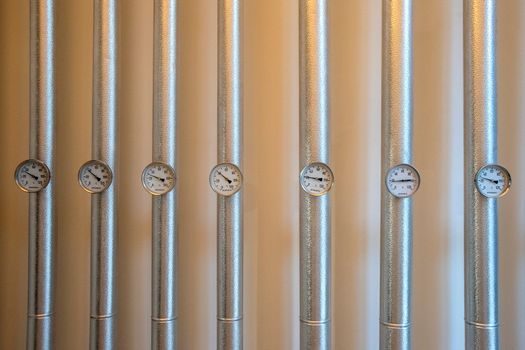
Continuous service temperature separates the families more sharply than any single test: silicone grades are typically chosen where latex or nitrile would soften or age; EPDM is chosen for outdoor, ozone and hot-water/steam exposure; nitrile is chosen for hydrocarbon oil and fuel resistance [S4]. Food-grade and high-temperature silicone components are a standard custom-molding output, alongside industrial tubing and hoses, for OEM customers supplying food, beverage and medical systems [S1].
For dipped latex surgical tubing, the service envelope is implicitly medical/laboratory low pressure — Kent Elastomer's product line is sized for that band, not for high-pressure hydraulic or high-temperature process duty [S3]. The buyer's first hard gate is therefore: does any candidate elastomer cover the required temperature AND the required chemical exposure AND the required pressure? If no elastomer in the candidate set clears all three, the spec must be re-scoped, not the brand changed.
Who natural latex and silicone are NOT for: the disqualification map
Natural latex dipped tubing is not a fit for sustained petroleum-oil or hydrocarbon-solvent service, for service temperatures well above the latex ageing window, or for applications where latex-protein allergy is a regulatory or customer constraint [S3]. Silicone is not a fit for high-pressure hydraulic pulsing where its tear and abrasion resistance is the limiting factor, nor for low-cost commodity weatherstrip where EPDM or PVC/rubber compound extrusion dominates the cost curve [S1][S4].
EPDM is not a fit for petroleum-oil service, and nitrile is not a fit for outdoor ozone/UV exposure at elevated temperature — pair the polymer to the dominant degradation mechanism, not to the colour or the shelf SKU [S4]. When the line carries a mix of fluids (e.g. water + occasional oil exposure), the conservative spec is EPDM with a nitrile liner or a co-extruded profile rather than a single-polymer tube [S4].
Criteria-based comparison: latex vs silicone vs EPDM vs Nitrile for tubing duty
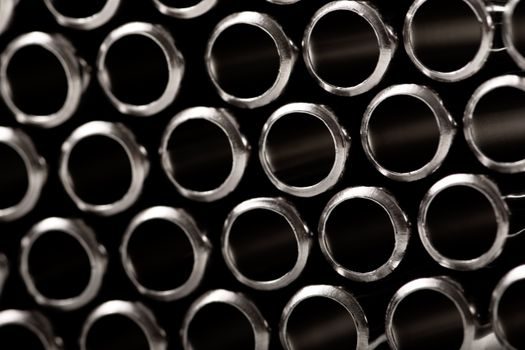
Four practical candidates line up against four buyer-side criteria. Dipped natural latex tubing: best on elastic recovery and low-pressure flexibility, supplied in fractional-inch ID/wall/OD with box/reel/foot/roll formats; limited on high temperature and hydrocarbon resistance [S3]. Custom-molded silicone tubing and hoses: best on temperature ceiling, food/medical grade availability, and OEM custom geometry; higher unit cost and longer lead time on small runs [S1]. EPDM and PVC/rubber compound extrusion profiles: best on weather, ozone, hot-water and cost-driven weatherstrip duty; weak on hydrocarbon-oil resistance [S4]. Nitrile (NBR) extrusion: best on oil, fuel and abrasion resistance; weak on ozone and low-temperature flexibility — the elastomer spec is covered in the nitrile rubber reference [S4].
A useful rule of thumb: if the fluid is water-based and the temperature is moderate, EPDM or silicone wins on life-cycle cost; if the fluid is oil-based, nitrile is the only defensible single-polymer choice; if the duty is medical/lab low-pressure fluid handling with skin or mucosal contact, dipped natural latex remains the default in the US market — a sourcing view shared with the industrial magnet suppliers and manufacturers: 2026 sourcing map in its emphasis on the country-of-origin gate as a hard filter.
Supply format, MOQ and lead time as the final gate
Supply format changes the unit economics more than brand does. Dipped latex surgical tubing is available by the 100 ft box, 50 ft reel, by-the-foot cut length, 10 ft roll, 25 ft roll, and bulk 10/25/50/100 ft aggregate — the bulk option is positioned as the economical choice for buyers whose application uses smaller pieces and who can accept random-length pieces [S3]. Custom silicone tubing from a project-based molder is sold against drawings, samples or application requirements, with the project running from early-stage review to mass production rather than off a shelf SKU [S1].
For extrusion profiles (sponge, solid, co-extruded seal strip, metal-inserted), the practical supply conversation is OEM and custom, with favourable price framed against customisation rather than against a catalogue line [S4]. A buyer who needs 200 ft of identical 1/4" ID × 1/16" wall latex tubing for a lab build should specify box or reel to avoid random-piece yield loss; a buyer who needs 12 ft for a prototype should specify by-the-foot or 10 ft roll [S3].
Sourcing signals to track on the 2026-07-31 horizon
Three signals are worth watching over the next buying cycle: (1) whether Kent Elastomer's three Ohio facilities remain the only US-domestic dipped natural latex tubing footprint, which would keep the "Made in USA" gate as a real procurement discriminator [S3]; (2) whether custom silicone molders continue to standardise liquid silicone rubber injection molding as the default for thin-wall tubing and food/medical components, displacing compression molding for high-volume runs [S1]; (3) whether EPDM and PVC/rubber compound extruders keep absorbing the weatherstrip and automotive-sealing volume at the expense of generic rubber extrusion, which would consolidate the supplier map around co-extrusion and metal-inserted formats [S4].
A verifiable next step: pull your last five rubber-tubing line items, write down the elastomer family, the ID × wall × OD with tolerance, the fluid/temperature window, and the supply format, and score each on the four-axis matrix above. Any line that fails on elastomer-to-service match is the first re-spec candidate; any line that scores but was bought on brand alone is the first consolidation candidate. For buyers sourcing from broad industrial catalogues, the same matrix logic that drives the foam fabrication suppliers 2026: process map, capacity signals, and sourcing reality guide applies — process and capacity map to format before they map to vendor.