
For laboratory work, the controlling question is which hazard dominates the task: biological agent, liquid chemical splash, particulate dust, or light aerosol spray. EN 14325 and EN 14126 govern the fabric and seam performance, and the CE "Types 1 to 6" mark on a coverall tells the buyer exactly what the garment has been tested against, not what marketing claims it can handle [S5][S6].
Laboratories differ from refineries in two ways that change the spec: garment reuse is rare, so single-use coveralls in 50-65 g/m² microporous film-laminate dominate the market, and biological hazards (BSL groups 2 to 4) force a fabric that passes EN 14126 in addition to the basic chemical Type. A standard polyprop nonwoven will block dust but fail bloodborne-pathogen penetration within minutes, so spec writers must check both standard numbers before signing the PO [S2][S6].
Hazard Map and EN Type Selection for Lab Tasks
EN 14605 defines Types 3 and 4 liquid protection: Type 3 resists pressurised liquid jet (the rig pressurises a dyed surrogate at roughly 1 bar through a 1.0 mm nozzle), Type 4 resists light spray from four directions. EN ISO 13982-1 covers Type 5 particulate, where the test aerosol is sodium chloride or a similar fine dust drawn through the fabric at a fixed flow. EN 13034 defines Type 6, which only certifies limited spray and mist; it is the weakest liquid mark and is often mis-marketed as full chemical protection [S5][S6].
Biological labs add EN 14126 on top of the basic Type. That standard tests fabric against four test organisms or surrogates in four exposure modes: liquid bacterial penetration (ISO 16604), liquid viral penetration, wet bacterial penetration, and biological aerosol penetration. Garments carrying the EN 14126 "B" marking have passed all four, while a garment marked only as Type 5b or 6b is partial coverage that some EU site safety officers reject outright [S5][S6].
Type-by-Type Comparison: 4 Decision Criteria
The decision matrix a lab procurement officer should run has at least four columns: liquid threat level, particulate/dust load, biohazard presence, and re-use class. A Type 1 gas-tight suit (EN 943) is mandatory for BSL-4 and certain cytostatic-handling cells; it is rarely needed in an academic chemistry lab where a Type 3 or 4 coverall is the correct and cheaper answer [S5][S6].
For routine QC and prep labs handling powdered reagents, a Type 5 coverall with EN 14126 (labelled 5b or 6b depending on which sub-marks pass) is the cost-efficient baseline. A wet bench working with 30% hydrogen peroxide, glacial acetic acid, or strong oxidisers should step up to Type 3 with taped seams and a chemical-resistant laminate, not a microporous film fabric, since peroxides attack many microporous membranes faster than the test protocol captures [S2][S6].
Fabric, Seam, and Closure Specifications

Microporous film-laminate (MFL) on a 50-65 g/m² spunbond polypropylene carrier is the workhorse for Type 5/6 disposable coveralls, with hydrostatic head values typically 100-200 cm H₂O on the seam and 80-150 cm H₂O on the body cloth. SMS (spunbond-meltblown-spunbond) is a cheaper alternative for low-hazard prep rooms but its particle filtration is roughly an order of magnitude lower than MFL at the same basis weight, and it does not qualify for many Type 5 listings [S2][S5].
Seam construction is the failure point most often missed on the PO. Serged (stitched) seams pass Type 5 only, bound seams pass Type 4, and taped/heat-sealed seams are required for Type 3 and Type 1. Zippers must be covered by a double storm flap with a self-adhesive closure; a single adhesive flap is acceptable for Type 4 but not for pressurised-jet Type 3 work. The hood-to-chin panel should not gap more than 5 mm when the wearer extends the neck, or the BSL-3 audit will fail on first inspection [S2][S6].
Sizing, Donning, and Fit Validation
EN 14325 lists six size codes (S to XXXL) tied to chest, height, and body-length ranges; any coverall that ships only M, L, XL without a numeric chest range should be rejected. A correct fit check is to squat fully while wearing the suit: if the crotch seam rides up more than 30 mm, the size is wrong and the Type rating is void for any dynamic task [S6].
For a typical Asian-market disposable coverall priced around US$ 3 to US$ 5 per piece at MOQ 1,000, the cost driver is the seam type and the laminate weight, not the brand. The cheapest serged-seam SMS coverall at US$ 2.50-3.50 suits a cleanroom prep area, but a taped-seam MFL coverall with the EN 14126 B mark lands at US$ 6-12 per piece at the same quantity; that 2-3x price premium is what separates a genuine BSL-3 suit from a marketing-grade copy [S3].
Testing and Documentation Buyers Should Demand
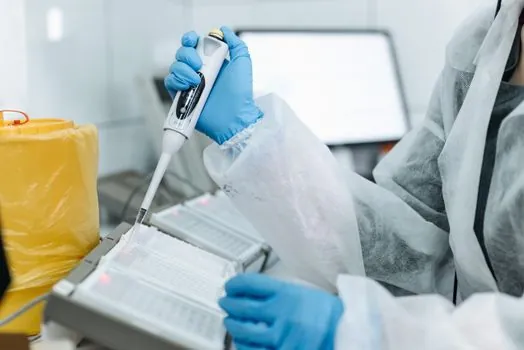
Every shipment should carry: a Declaration of Conformity (DoC) referencing the relevant EN Type, the notified-body four-digit number, a fabric lot number, a manufactured-on date, and either a CE label on each garment or on the master carton. A lab that cannot produce a current DoC within 24 hours of an audit is, in practice, wearing unrated clothing regardless of what the catalogue claims [S6].
The PCERF model, with thermal-manikin, flame, and moisture-management rigs in one lab, is a benchmark reference for any spec gate that touches both chemical and thermal hazard classes [S2].
Common Specification Errors and How to Avoid Them
Three errors appear in roughly half of incoming lab clothing specs: (1) ordering Type 6 only when the lab handles pressurised liquid, (2) accepting a fabric with EN 14126 marking on the datasheet but no B sub-mark on the garment label, and (3) treating the suit as a one-size-fits-all when the wearers' height range spans 155-190 cm, which it almost always does in a working lab [S5][S6].
The single most common spec error in 2026 lab tenders is dropping the EN 14126 requirement when the task is "only" inorganic chemistry, even though the same lab uses the same hoods for biological stain work the following week. For a fuller list of selection criteria that also apply to upstream process labs, see the protective clothing selection reference for oil and gas facilities and the adjacent welding protective clothing class map, both of which use the same EN Type framework as this lab guide. For broader PPE and lab context outside clothing, the protective clothing encyclopedia entry lists the fabric, seam, and certification terms in one place.
Lab buyers should pin notified-body re-test dates in their supplier scorecards and re-validate the Type 5b/6b sub-mark on every new lot before the next BSL-3 audit, since that is the most likely place a generic lab clothing programme will be flagged in 2026 inspections.
Spec-level background on the components involved: pressure transmitter, and flow meter.