Selecting protective clothing for mining operations is a hazard-driven exercise, not a brand exercise: every garment spec must trace back to a documented site risk assessment covering flame, thermal, mechanical, chemical, and static-electricity exposure [S1].
The decision is governed by a stack of EN/ISO standards (notably EN ISO 11612 for limited flame spread, EN 1149-5 for dissipative electrostatic properties, EN 13034 for light chemical spray, and EN ISO 20471 for high-visibility), with mining-specific clauses layering on top for retroreflective trim placement and dust/coal-mine methane zones [S2].
Hazard Class Mapping for Underground and Surface Mines
The first gate in any mining PPE selection is a documented hazard inventory, broken into four commonly-used classes: thermal/FR, chemical/spray, mechanical/cut-abrasion, and visibility/anti-static [S1]. The Protective Clothing and Equipment Research Facility (PCERF) at the University of Alberta runs dynamic heat-and-moisture transfer models on textile systems under high heat flux to quantify the trade-off between protection and wearer comfort, a trade-off that becomes acute in deep underground workings where ambient temperatures regularly exceed 30°C with humidity above 80% RH [S1]. For coal-mine methane atmospheres, garments must additionally avoid static-charge accumulation, which is where EN 1149-5 dissipative surface resistivity (typically less than 2.5 x 10^9 ohm surface resistance) becomes a hard gate on fabric selection [S2]. Surface iron, copper, and oil-sand operations add a light-chemical-spray requirement (EN 13034 Type 6), so a single uniform rarely satisfies all four classes at once, and most sites end up with two or three garment systems layered by task.
EN/ISO Standard Stack and What Each Gate Actually Filters
The standard stack for mining PPE is layered, and each layer filters a different failure mode. EN ISO 11612 sets limited-flame-spread (A1/A2) and convective/contact/radiant heat thresholds (B, C, D codes), with a single-layer arc-rated variant gating electrical work near 1 kV switchgear and trailing-cable splicing. EN 1149-5 covers anti-static (dissipative) coatings on outerwear, mandatory for zones with flammable atmospheres or dust clouds. EN 13034 Type 6 covers light chemical spray, relevant for reagent handling in mineral processing. EN ISO 20471 governs high-visibility, with Class 2 (intermediate) the typical minimum for surface vehicle movements and Class 3 (highest) for low-light pit-floor operations. The CEN/TR 15419:2017 guidance document, originally written for chemical protective clothing, provides the procurement-side selection, use, care, and maintenance framework that most European mining operators have adopted verbatim for tender language [S2]. For flame resistance, ASTM F1506 (arc-rated) and NFPA 2112 (flash-fire) appear in North American operations, but EN ISO 11612 remains the dominant cited standard in EU, Australian, and most African mining jurisdictions.
Fabric Weight, Layering, and the Protection-versus-Comfort Trade-off
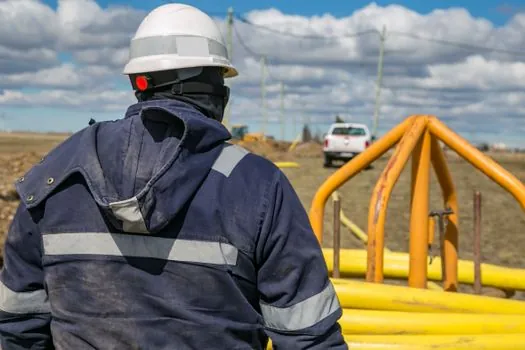
PCERF research has shown that protection and comfort are conflicting phenomena, and the practical expression of that conflict is fabric weight and layer count [S1]. Single-layer FR cotton or modacrylic blends at 200-260 gsm are adequate for general underground wear, but they fail the contact-heat and radiant-heat gates of EN ISO 11612 at higher performance levels. Adding a flame-resistant lining or a thermal liner pushes the system weight to 300-400 gsm, which is the typical operational range for high-heat tasks like furnace tap-hole work or continuous miner maintenance. Above 400 gsm, wearer heat strain becomes a limiting factor: PCERF modelling links every additional 100 gsm of clothing weight to measurable increases in core temperature rise under sustained work rates, which is why modular layered systems (base, mid, outer) are now specified over single-piece coveralls in most modern underground tenders. The same conflict drives the move from PVC-coated rainwear to breathable PU-laminate outer shells: the laminate passes EN 343 weather classes while still allowing moisture-vapour transmission, reducing condensation buildup inside the FR inner layer.
Comparison of Common Garment Systems Against Decision Criteria
For procurement teams, the four common garment systems used in mining line up against decision criteria as follows. (1) Single-layer FR coverall at 200-260 gsm modacrylic: lowest cost, meets EN ISO 11612 A1/B1/C1 and EN 1149-5, but fails higher heat levels and offers no chemical resistance. (2) Two-layer FR system (FR base + FR outer at 300-350 gsm combined): meets EN ISO 11612 up to B2/C2/D2, suitable for hot process areas, but adds 100-150 gsm of heat load. (3) FR outer with chemical-spray laminate (PU or PTFE membrane): adds EN 13034 Type 6 protection for mineral processing and reagent zones, but breathability drops and cost rises 40-60%. (4) High-visibility FR outer with retroreflective trim to EN ISO 20471 Class 2 or 3: required for surface vehicle movements, with Class 3 mandatory where haul-truck reversing alarms are the primary proximity warning. Most operations end up specifying at least two of these systems side-by-side, allocated by task and by documented hazard-zone map. [S1]
Use Cases, Failure Modes, and What PCERF Testing Catches
Real failure modes in mining PPE are rarely the dramatic burn-through seen in lab videos; they are cumulative, driven by repeated laundering, abrasion against rock, and chemical exposure degrading FR finishes. PCERF runs laundering-durability and abrasion-cycle tests on candidate fabrics, measuring tensile and tear strength loss and char-length creep after 25, 50, and 100 industrial wash cycles [S1]. The facility also developed specialised test equipment and new testing protocols with industry and government collaborators, covering the conflicting phenomena of protection and comfort in high heat flux environments [S1]. For oily/greasy environments, EN 13034 Type 6 treated fabrics lose repellency after roughly 30-50 wash cycles unless re-proofed, which is why tender language should specify the number of wash cycles a garment must survive at a given repellency rating. A common procurement error is specifying Type 6 only, which does not cover continuous liquid contact; sites with reagent dip tanks need Type 4 (liquid saturation) garments with sealed seams instead.
Procurement, Care, and Maintenance Loop
The CEN/TR 15419:2017 framework structures procurement around four explicit steps: selection (matched to hazard assessment), use (donning, doffing, contamination control), care (laundering, inspection, repair), and maintenance (replacement triggers) [S2]. Each step has documentable evidence: selection cites the risk assessment, use cites the donning procedure and training records, care cites wash-cycle counts and inspection logs, maintenance cites replacement dates when garments fail visual or performance criteria. For mining operations, the most often-skipped step is the inspection gate after each wash cycle, where seam integrity, retroreflective trim brightness, and zip/closure function are verified. EN ISO 20471 specifies minimum retroreflective performance, and field measurements on garments older than 12 months in heavy-soil mining environments routinely show 30-50% brightness loss even when the fabric is intact, which is the trigger to pull the garment from service.
For sites moving from general FR to multi-hazard systems, a useful next step is to commission a side-by-side garment trial with measured wearer-heat-strain data, ideally through a facility running the kind of heat-and-moisture transfer modelling PCERF does [S1]. A second trackable signal is the publication of updated EN ISO 11612 revision drafts, which historically tighten contact-heat thresholds and add radiant-heat test method refinements every 4-6 years, and which directly affect what passes tender for the next procurement cycle. See also this related spec map on protective clothing selection for oil and gas facilities, which uses the same CEN/TR 15419 framework but with hydrocarbon-specific hazard classes. For adjacent heavy-industry PPE work, the truck-mounted crane selection for road construction spec gate map covers hi-vis and weather-gate logic that overlaps with surface mining PPE. Underground logistics vehicle selection shares visibility gates with shuttle system selection for port logistics, useful when integrating PPE into the same site-traffic management plan.
Spec-level background on the components involved: protective clothing, mining dump truck, and pressure transmitter.