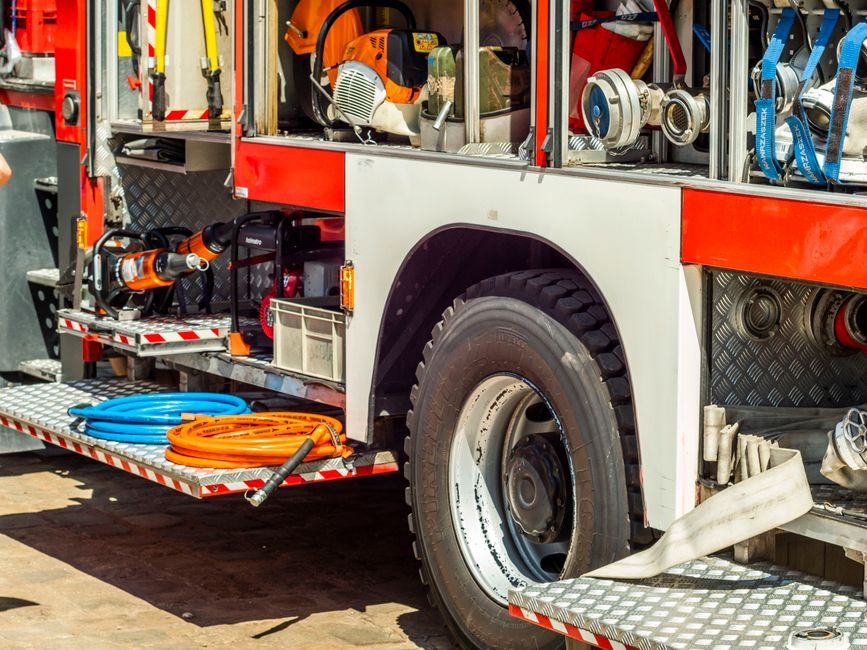
A hydraulic accumulator stores pressurized fluid under gas pre-charge and can discharge it in milliseconds, covering demand peaks before a pump reaches steady-state output [S1].
A hydraulic pump converts mechanical or electrical input into continuous flow at a rated GPM and PSI, and its availability is set by mechanical speed, prime-mover reliability, and duty cycle [S2][S7].
Function Split: Stored Energy vs Continuous Source
An accumulator is a pressure vessel with a gas pre-charge (nitrogen is standard) on one side of a bladder, piston, or diaphragm, and hydraulic fluid on the other side [S1]. When system pressure drops below stored pressure, the gas expands and ejects fluid into the circuit; charging occurs when pump pressure exceeds pre-charge plus system setpoint.
A pump's job is bulk fluid generation. The BAOLILAI 4281838 is described as built for "high-load and high-frequency operation," which is the exact demand profile where an unaided pump wastes energy and accumulates heat [S2]. ATO's 1-gallon (4 L) bladder accumulator, listed at USD 417.20 per SKU ATO-HBA-4L, is the small-volume counterpart designed to sit next to such a pump and bridge its response gap [S4].
Selection Criteria for Availability-Critical Circuits
Three decision dimensions dominate specification: peak-to-average flow ratio, response-time budget, and energy-recovery potential [S1]. When the ratio exceeds roughly 3:1 and peak duration is under a few seconds, a bladder or diaphragm accumulator is almost always justified; when average flow demand is steady, the pump alone is the lower-cost path [S1][S3].
Material and form-factor follow from the duty. Bladder units (carbon steel shells, NBR or nitrile bladders) handle high-cycle pulse-damping; piston accumulators take higher volumes and higher max pressures; diaphragm units suit compact, low-volume pulse dampers [S1][S4]. Made-in-China sourcing shows diaphragm and bladder configurations shipping from Tianjin in MOQ-10 batches, indicating steady industrial catalog demand rather than one-off project sales [S3].
Option Comparison on Four Decision Criteria

Engineers rarely choose one or the other in isolation; the practical decision is sizing the accumulator that pairs with the pump. The table below lines up the main accumulator types against the criteria that govern availability on a typical machine tool or press circuit [S1][S3][S4].
Bladder accumulators: medium-to-high flow discharge, fast response (typically tens of milliseconds), replaceable bladder element, common for energy storage and emergency backup. Piston accumulators: highest available volumes and pressures, slightly slower response than bladder, larger envelope, used in heavy industrial presses. Diaphragm accumulators: smallest envelope, lower max volumes, good for pulsation damping on instrumentation lines and small clamping circuits [S1][S3][S4]. Pump-only circuits score worst on the "instantaneous peak" criterion because pump ramp-up and motor acceleration impose fixed mechanical delays [S2][S7].
Use Cases That Justify Each Path
Accumulator-dominant circuits: emergency power-supply hold-up for clamp pressure on injection-molding machines, brake-pressure reserve on mobile cranes, nitrogen-pre-charged pulsation dampers on pump-discharge lines, and leak-oil compensation in long-idle hydraulic stands [S1]. ATO's HBA-series 4 L unit is dimensioned for the small-volume end of these duties, with bladder construction giving the fast response that clamp and brake circuits require [S4].
Pump-dominant circuits: continuous-duty machine tools, large hydraulic presses where average flow exceeds peak flow, mobile equipment with dedicated engine-driven pumps (Hiab spare-part listings show 2700-PSI hydraulic pumps as a maintenance-replacement item, implying steady-state specification is the engineering intent) [S7]. The BAOLILAI 4281838 datasheet positions the pump for sustained "high-load and high-frequency operation" rather than millisecond response [S2]. For such circuits, adding an accumulator is the availability upgrade; replacing the pump alone rarely is.
Limitations, Failure Modes, and Sourcing Constraints
Accumulators are pressure vessels and fail in specific, well-known modes: bladder rupture from gas permeation or over-pressurization, pre-charge loss over time, and seal leakage at the gas-side valve [S1]. They require periodic pre-charge verification and a pressure-relief path sized for full pump flow, which adds hardware the pump-only circuit does not need. Pumps fail differently: cavitation from inlet starvation, wear of gear or vane tips, shaft-seal leakage, and motor overload trips — failure modes that are mechanical, not pneumatic [S2][S7].
Catalog availability is high on both sides. Siebert Hydraulik, a Parker Olaer-certified distributor, stocks accumulators for system integration, indicating stable European distribution [S1]. ATO's online catalog lists the 4 L bladder unit at USD 417.20 with active SKU data, indicating continuous U.S. e-commerce availability [S4]. Made-in-China listings show diaphragm and bladder accumulators shippable in 10-piece MOQs from Tianjin, with OEM packaging and standard L/C, T/T, D/P, Western Union, PayPal, and Money Gram payment terms — a useful baseline for procurement risk on the accumulator side [S3]. On the pump side, the 2700-PSI Hiab spare part is a catalog SKU (WAL70401750), not a custom build, so replacement lead-time is typically days rather than weeks [S7].
Sizing Tools and Verification
Specifying an accumulator against a pump is a calculation problem, not a guess. Bailey Hydraulics publishes free online calculators covering cylinder force and speed, gear-pump replacement sizing, and pump displacement-to-horsepower conversions — the same equations that govern whether an accumulator is large enough to bridge a pump's acceleration window [S8]. Engineers writing a specification should run the pump ramp-up time, peak flow, and acceptable pressure droop through these calculators before committing to a bladder volume; a 4 L ATO-HBA-4L is not interchangeable with a 50 L piston unit, and the calculator output makes that explicit [S4][S8].
For pump-only circuits where the demand is steady, a calculator-driven gear-pump sizing exercise is sufficient and the accumulator can be omitted entirely [S8].
Trackable signals to watch on this topic: bladder-accumulators with integrated pressure transducers entering OEM catalog (improves condition monitoring, no published release date); pump OEMs publishing energy-recovery specs that include accumulator-coordinated modes; and any move by Parker Olaer distribution partners to publish pre-charge service intervals as a warranty condition. Current BAOLILAI 4281838 and Hiab 2700-PSI pump data sheets, plus the ATO 4 L bladder listing, remain the live references for cross-checking the next catalog update [S1][S2][S4][S7].
Related: pressure transmitter, flow meter, industrial valve.